The denial of science has entered the highest levels of government, and no matter what the data says, the U.S. promises to cease all efforts to curtail, or even study, climate change. Astrophysicist Katie Mack calls this retrenchment a form of “data nihilism,” writing in an exasperated tweet, “What is science? How can a thing be known? Is anything even real???” Indeed, what can we expect next from what Isaac Asimov called the United States’ anti-intellectual “cult of ignorance”? A flat earth lobby?
Welp… at least a couple celebrity figures have come out as a flat-earthers, perhaps the vanguard of an anti-round earth movement. First Cleveland Cavaliers guard Kyrie Irving made the claim on a podcast, insisting, Chris Matyszczyk writes, that “we were being lied to about such basic things by the global elites.” Then, no less a basketball worthy than Shaquille O’Neal weighed in with his own belief in flat-earthism.
Is this a joke? I hope so. Neil DeGrasse Tyson—who hosted the recent Cosmos remake to try and dispel such scientific ignorance—replied all the same, noting that Irving should “stay away from jobs that require… understanding of the natural world.” The weird affair has played out like a sideshow next to the mainstage political circus, an unsettling reminder of Carl Sagan’s prediction in his last book, The Demon Haunted World, that Americans would soon find their “critical faculties in decline, unable to distinguish between what feels good and what’s true.”
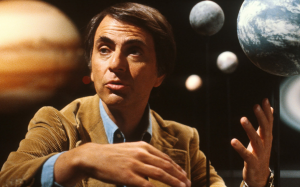
Sagan devoted much of his life to countering anti-science trends with warmth and enthusiasm, parking himself “repeatedly, arguably compulsively, in front of TV cameras,” writes Joel Achenbach at Smithsonian. We most remember him for his original 1980 Cosmos miniseries, his most public role as a “gatekeeper of scientific credibility,” as Achenbach calls him. I think Sagan may have chafed at the description. He wanted to open the gates and let the public in to scientific inquiry. He charitably listened to unscientific theories, and patiently took the time to explain their flaws.
In the very first episode of Cosmos, Sagan addressed the flat-earthers, indirectly, by explaining how Eratosthenes, a Libyan-Greek scholar and chief librarian at the Library of Alexandria, discovered over 2000 years ago that the earth is a sphere. Given the geographer, mathematician, poet, historian, and astronomer’s incredible list of accomplishments—a system of latitude and longitude, a map of the world, a system for finding prime numbers—this may not even rank as his highest achievement.
In the Cosmos clip above, Sagan explains Eratosthenes’ scientific method: he made observations of how shadows change length given the position of the sun in the sky. Estimating the distance between the cities of Syene and Alexandria, he was then able to mathematically calculate the circumference of the earth, as Cynthia Stokes Brown explains at Khan Academy. Although “several sources of error crept into Eratosthenes’ calculations and our interpretation of them,” he nonetheless succeeded almost perfectly. His estimation: 250,000 stadia, or 25,000 miles. The actual circumference: 24,860 miles (40.008 kilometers).
No, of course the Earth isn’t flat. But Sagan’s lesson on how one scientist from antiquity came to know that isn’t an exercise in debunking. It’s a journey into the movement of the solar system, into ancient scientific history, and most importantly, perhaps, into the scientific method, which does not rely on hearsay from “global elites” or shadowy figures, but on the tools of observation, inference, reasoning, and math. Professional scientists are not without their biases and conflicts of interest, but the most fundamental intellectual tools they use are available to everyone on Earth.
Ask me anything
Explore related questions