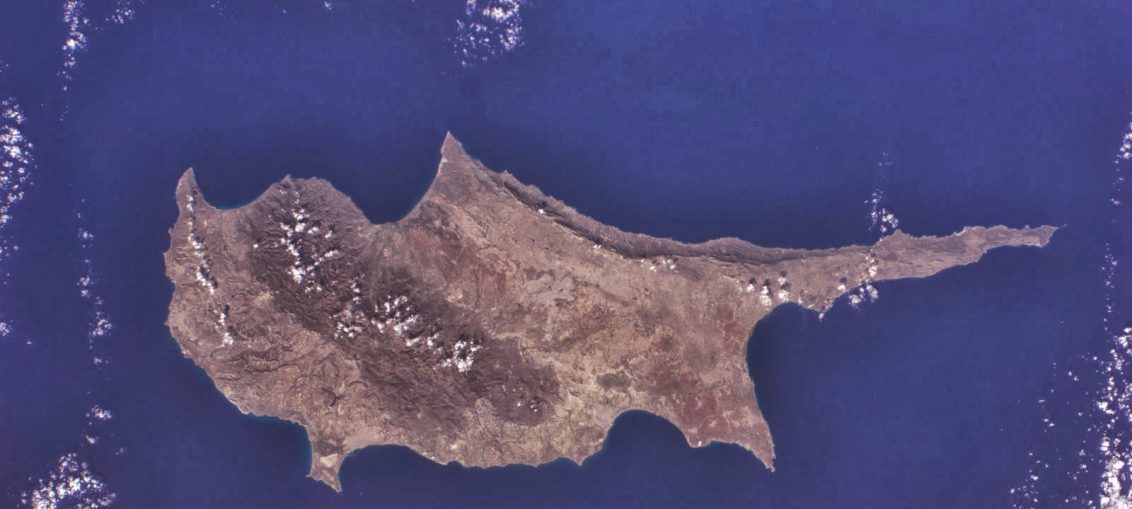
A very interesting “Risk Analysis” on the Cyprus dispute, the on going negotiations and the prospects for a just and viable solution.
By Panagiotis Karampelas*
It has been 12 years since the last attempt for a solution to the Cyprus dispute. This time the President of the Republic of Cyprus Nicos Anastasiades and the Turkish Cypriot community leader Mr. Mustafa Akinci are trying once again to bridge the distance that separates the two sides. But with their whole neighborhood up in flames as a background, this task looks as difficult as ever.
The history behind this dispute is well documented and repeating it wouldn’t help this analysis. In brief, the Cyprus dispute in its current form was shaped after the Turkish invasion in 1974. Since then the northern 36% of the island is occupied by Turkey, where in 1983 the Turkish Cypriot community unilaterally formed the “Turkish Republic of Northern Cyprus”. Since then there was a number of initiatives taken by mainly the UN, notably in the early ‘90s the “Set of Ideas” initiated by the then UN Secretary-General Javier Pérez de Cuéllar and concluded by his successor Boutros Boutros-Ghali with no success.
In 2004 the Republic of Cyprus became a member of the EU and in the same year the “Annan Plan”, as it remained known, was rejected by 75,83% of the Greek Cypriots. Since then, an interesting development took place: natural gas was discovered inside the Exclusive Economic Zone (EEZ) of the Republic of Cyprus. The prospect of economic growth mobilized all key international players and in 2014 a new series of negotiations begun.
However, the unsuccessful coup d’état in Turkey as well as the ongoing war in Syria and Iraq against the IS, has increased the need of a closer look on the risks involved in the Cyprus dispute, as one new problem in that area may be one too many…
What has happened so far?
In February 2014 President Nicos Anastasiades and the then Turkish Cypriot community leader Mr. Derviş Eroğlu agreed on a Joint Declaration that was to be the foundation of the new negotiations. These started on the May 15, 2014 with Mr. Mustafa Akinci on the Turkish Cypriot side, after he replaced Eroglu as a leader of his community. Although the hopes were high and there was significant progress in most chapters, with both sides talking about a referendum even as early as 2015, the process slowed down as disagreements started to surface. What became apparent quite early was that Akinci wouldn’t be able to plan the Turkish Cypriot negotiating strategy without the consent of Ankara.
As 2015 saw limited progress, the referendum was pushed forward for 2016. Due to many leaks over what was being discussed so far and the heated statements by the political opposition on both parts of the island, the two sides decided not to openly disclose any new information, but instead to keep updated only the political parties with the condition that there will be an embargo to the press.
The positions of each side
As the months went by, what became obvious in 2016 is that if the negotiations are to fail it will be due to the disagreements on the chapters of Security and Guarantees.
So far, the Greek Cypriot’s main positions are:
– No Turkish forces on the island after the solution. It is absurd for a free independent western country and a member of the EU to have foreign troops on its territory.
– They do not agree with the current status quo of the guarantees (Greek, Turkish, UK) or any version of it, with the above argument applying here as well.
– They reject a two-step solution. To them there is the danger of that intermediate period being prolonged well into the future, turning that first step into a new status quo, different from the one that will be agreed upon. Instead they prefer a clear-cut solution, effective immediately after a positive outcome of the referendum.The Turkish Cypriot side’s main positions are:
– They want the guarantee of Turkey, even if Greece and the UK refuse to renew their role as guarantors. They have made quite clear the fact that they consider Turkey as the only country that can help or support them. This, however, means that Turkey will be guaranteeing only the Turkish Cypriot side unlike the provisions of Cyprus’ first Constitution of 1960, where the guarantees were applying on all of country. Even so, Turkey used that provision as an excuse for the 1974 invasion. If the current position of the Turkish side is accepted, such an intervention could, at least theoretically, be even easier.
– They want a Turkish military presence of around 25% of the current force, for a so far undisclosed period.
– They openly do not want an intermediate period, however, with the above positions regarding the Turkish military presence they indirectly leave this option quite open.
– They want a rotating presidency system which, along with other administrative provisions, indirectly change the agreed position of a bi-communal, bi-zonal federation to that closer to a “confederation”, something rejected by the Greek side.Until now and based on the limited flow of information so far, there seems to be an agreement on most chapters. For example, 30%-50% of government and public sector positions will be occupied by Turkish Cypriots and the 90.000 settlers from Turkey will remain, some with the Cypriot nationality and some with a “Green Card” status. The agreement on these issues caused some serious reactions from the Greek Cypriot opposition, based on the fact that the Turkish minority which represents approximately 18% of the total population of the island, will have a disproportionately larger representation in the government, and the fact that the legalization of the settlers will practically legalize the actual results of the invasion.
* Panagiotis Karampelas is a Strategic & Political analyst.
Read the rest of the analysis HERE
Ask me anything
Explore related questions