





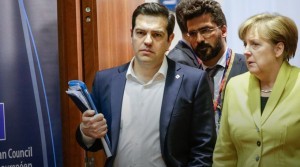
The European Union and Turkey sealed a deal on Friday to tackle the migration crisis, European Council President Donald Tusk announced after the end of the two-day EU meeting.
Turkey and the European Union reconfirmed their commitment to the implementation of their joint action plan activated on 29 November 2015.
Much progress has been achieved already, including Turkey’s opening of its labour market to Syrians under temporary protection, the introduction of new visa requirements for Syrians and other nationalities, stepped up security efforts by the Turkish coast guard and police and enhanced information sharing.
Moreover, the European Union has begun disbursing the 3 billion euro of the Facility for Refugees in Turkey for concrete projects and work has advanced on visa liberalisation and in the accession talks, including the opening of Chapter 17 last December.
The basic points of the EU-Turkey agreement are:
1) All new irregular migrants crossing from Turkey into Greek islands as from 20 March 2016 will be returned to Turkey. This will take place in full accordance with EU and international law, thus excluding any kind of collective expulsion.
2) For every Syrian being returned to Turkey from Greek islands, another Syrian will be resettled from Turkey to the EU taking into account the UN Vulnerability Criteria. A mechanism will be established, with the assistance of the Commission, EU agencies and other Member States, as well as the UNHCR, to ensure that this principle will be implemented as from the same day the returns start.
3) Turkey will take any necessary measures to prevent new sea or land routes for illegal migration opening from Turkey to the EU, and will cooperate with neighbouring states as well as the EU to this effect.
4) Once irregular crossings between Turkey and the EU are ending or at least have been substantially and sustainably reduced, a Voluntary Humanitarian Admission Scheme will be activated.
5) The fulfilment of the visa liberalisation roadmap will be accelerated vis-à-vis all participating Member States with a view to lifting the visa requirements for Turkish citizens at the latest by the end of June 2016, provided that all benchmarks have been met.
6) The EU, in close cooperation with Turkey, will further speed up the disbursement of the initially allocated 3 billion euros under the Facility for Refugees in Turkey and ensure funding of further projects for persons under temporary protection identified with swift input from Turkey before the end of March.
7) The EU and Turkey welcomed the ongoing work on the upgrading of the Customs Union.
8) The EU and Turkey reconfirmed their commitment to re-energise the accession process as set out in their joint statement of 29 November 2015. They welcomed the opening of Chapter 17 on 14 December 2015 and decided, as a next step, to open Chapter 33 during the Netherlands presidency.
9) The EU and its Member States will work with Turkey in any joint endeavour to improve humanitarian conditions inside Syria,
Read the full EU-Turkey statement here.
Ask me anything
Explore related questions




