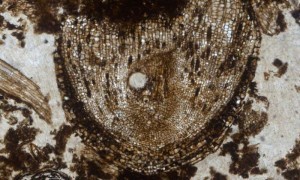
Scientists at Oxford University have discovered the oldest known plant root stem cells in a 320 million-year-old tree fossil.
The cells, which gave rise to the roots of an ancient plant, were found in a fossilised root tip held in the Oxford University Herbaria.
The discovery was made by Oxford Plant Sciences PhD student Alexander (Sandy) Hetherington during the course of his research.
The research, published in the journal Current Biology, marks the first time an actively growing fossilised root has been discovered – in effect, an ancient plant frozen in time.
The 320 million-year-old stem cells discovered by the scientists are different to all those living today, with a unique pattern of cell division that remained unknown until now.
That shows that some of the mechanisms controlling root formation in plants have now become extinct or they may have been replaced by others.
These roots come from the rooting structures of the plants growing in the first tropical wetland forests in Earth, where trees were over 50m tall and were in part responsible for one of the most dramatic climate change events in history. The evolution of deep rooting systems increased the rate of chemical weathering of silicate minerals in rocks – a chemical reaction that pulled CO2 out of the atmosphere, leading to the cooling of the Earth and thus one of the planet’s great ice ages.
Source: phys.org
Ask me anything
Explore related questions