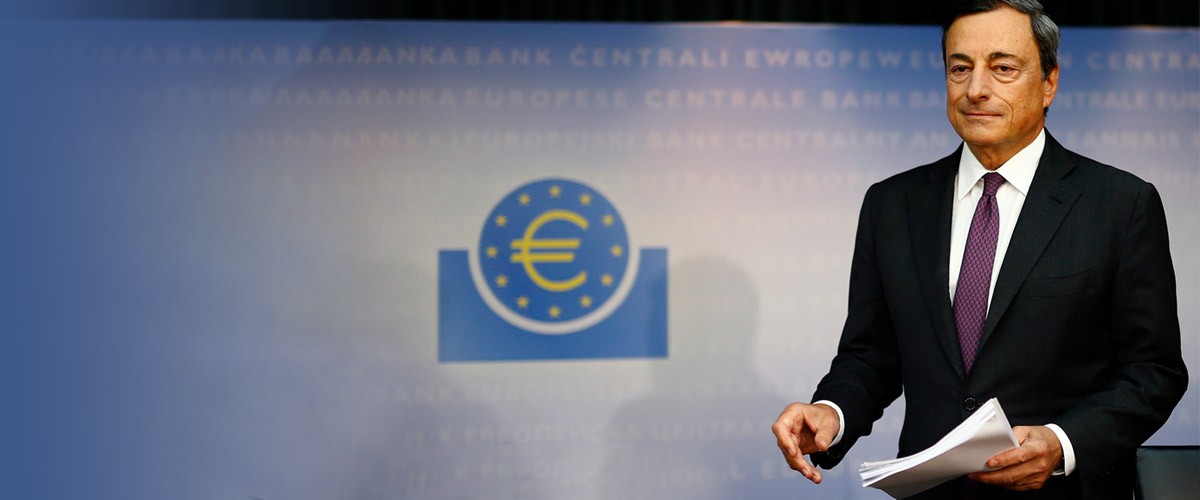
The head of the European Central Bank announced yesterday a great reduction in interest rates and ECB’s intention to buy asset backed securities from October and government bonds of 500 billion euros.
The statements of ECB’s head has raised now the question of who wins and who looses from these decisions.
According to analysts, if this intervention had been addressed only to business loans, it would have been a restricted action and would not have been enough to stimulate the broader European economy. However, ECB’s decision to extend the program to residential mortgage-backed securities will benefit the European economy and mainly the countries of the South Europe.
The announcement of further reducing the deposit rate of ECB, concerning the interest rates on deposits of the banks to the ECB, to -0.20% led the two-year bonds of Germany, Austria, Belgium, Finland, France, the Netherlands, Denmark and Switzerland to negative yield meaning that investors effectively pay to hold their money in short-term debt. The 2-year bond yield in Germany fell by 5 basis points to -0.072%.
The market was caught by surprise, since only six out of 57 economists who participated in the poll conducted by Bloomberg had forecast this reduction in interest rates.
The latest measures announced have divided the economists who appear sceptical about how effective they would be.
However, they all agree that by reducing the interest rates and announcing an asset backed securities and covered bonds program, the ECB has almost exhausted its weapons against the persistently low inflation and disappointing recovery of the Eurozone. They also consider that the next step of Mario Draghi would be a broad program of quantitative easing (QE).
Neil Williams, chief economist at Hermes Group said: “Today’s ECB moves are a step in the right direction, but too little, too late to snuff out deflation-risk and kick-start growth.”
He added: “The ECB’s private asset purchases may help, but the amounts are small, and any benefit will fall more to the bigger, core members, Germany, France and Italy, than the periphery. Far more useful would’ve been the ‘bazooka’ of unlimited sovereign QE, which was not fired today. But, Senor Draghi’s clearly leaving his powder dry. His hesitancy to use all bullets reflects how empty the policy tool box is.”
With demand subdued and the likelihood at some stage of rising bond yields, the ECB will have to capitulate on QE,’ Williams added.
“Whether all of this will help remains to be seen,” said ING DiBa economist Carsten Brzeski.
The ECB has “emptied its toolbox almost entirely”, said Carsten Brzeski. “The ECB has now reached a point at which fully-fledged QE is the only option left.”
Ask me anything
Explore related questions