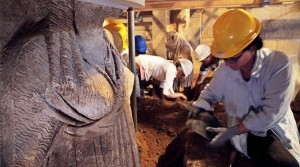
Mr. Theodoros Mavrogiannis, associate professor of history and archeology at the University of Cyprus, said that he is convinced that the tomb of Amphipolis belongs to general and close friend of Alexander the Great, Hephaestion. Speaking to private MEGA TV channel, he confirmed the dating given by Ms Katerina Peristeri and stressed that ” Caryatids have a political message and refer to the Athenian governmental syste,, since Hephaestion was an Athenian.”
Based on ancient written sources and especially on historic Diodorus Siculus (80-20 BC), Mr. Mavrogiannis says that all indications lead to the conclusion that the tomb of Amphipolis was built for Hephaestion.
“I believe that the monument was built between 322 and 318 BC, but we have to wait until ceramics found there confirm the date “, he said.
“I submitted my opinion according to which the tomb belongs to Hephaestion, general of the army of Alexander the Great, but of course I cannot be absolutely sure, since there is no relative inscription. He died in November 324 BC in Ecbatana of Media and Diodorus Siculus, Arianus and Plutarch wrote about his funeral. According to these sources, the body of Hephaestion was burned in a building called “Pyra” (Fire), but no ancient writer mentions that his tomb is in Babylon”, he added.
Mr. Mavrogiannis also mentioned that “I do not agree with the opinion that Caryatids do not convey a political message, it says “Athenians have finally returned to Amphipolis”. I think Caryatids refer to the Athenian oligarchy established by Antipatros in 322 BC. When overthrew democracy and laws, he allowed the contrary-minded, who took his side, to settle at Thrace.”
“Regarding the way Hephaestion is related to the Athenians, we can refer to a study published in 1991, according to which the father of Hephaestion, Amyntor, was an Athenian citizen. So, the Caryatids may also refer to the Athenian origin of Hephaestion”, he stressed.
Ask me anything
Explore related questions