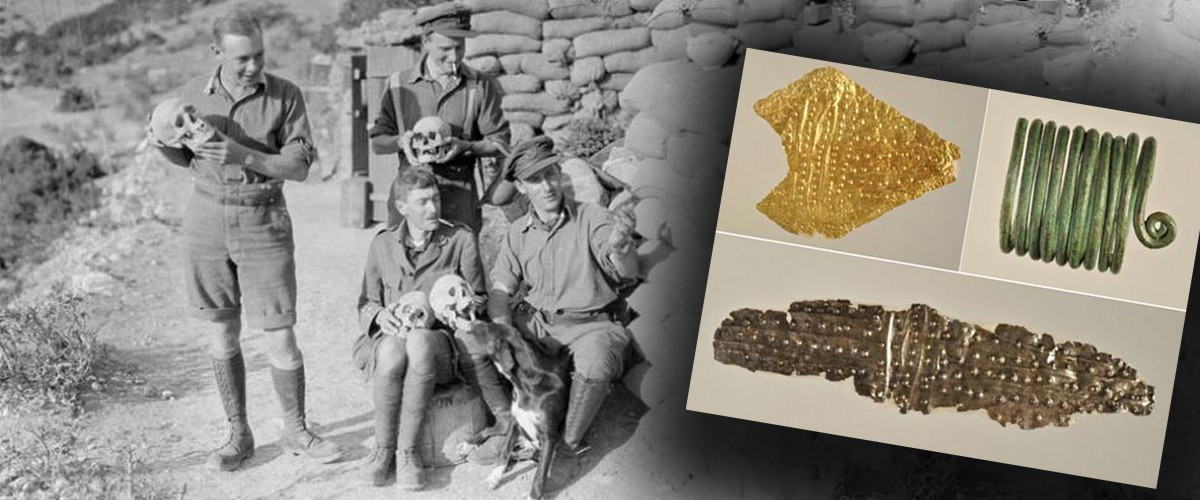
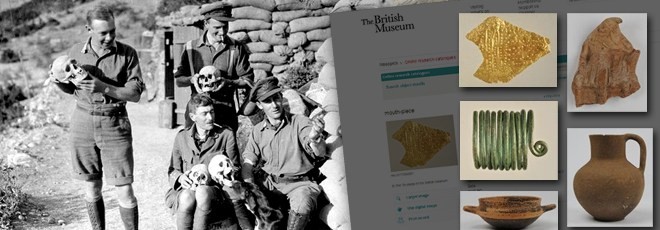
The British Museum responded to accusations about displaying potentially looted artefacts from the Amphipolis Tomb. The bone of content had to do with a number of items from Amphipolis that are featured at the British Museum, potentially plundered from the site from British soldiers stationed in the area during World War I. Several of these items were believed to have been illegally removed by Dr. Eric Gardner, a medical officer posted in the area, and later donated to the British Museum according to Zougla.gr.
The British Museum has composed a letter in response to the accusation of displaying looted artefacts from the 6th century B.C. that predate the tomb by two centuries.
The letter in its entirety:
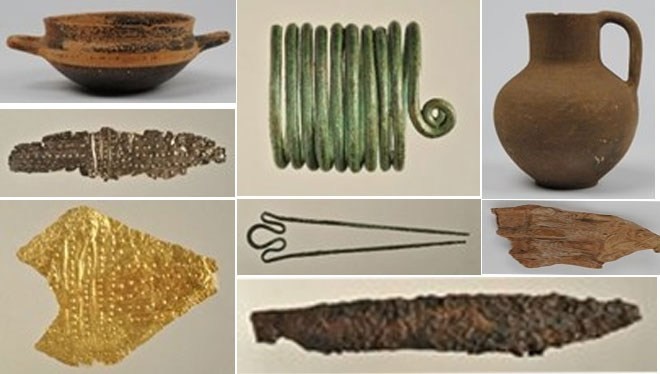
“The British Museum collection does not include artefacts from the Kasta tumulus at Amphipolis in northern Greece, currently being excavated by archaeologists from the Greek Ministry of Culture. There is a small group of objects, including two ceramic vessels, metal ornaments and two weapons, were donated during the course of the First World War by a soldier in the Royal Army Medical Corps, Dr. Eric Gardner. The objects donated by Eric Gardner to the British Museum are consistent with a modest burial of around the sixth century BC. As such they cannot be associated with the later fourth century tomb currently being excavated at the Kasta tumulus: there is no evidence that British soldiers discovered or excavated this important tomb.
The recent discoveries at a large burial tumulus at the site of Amphipolis in northern Greece have generated considerable media interest. Ongoing excavations at the Kasta Hill have revealed an impressive tomb entrance which is dated to the late fourth century BC, around the time of Alexander the Great. The burial chamber has not yet been excavated but is likely to contain a very wealthy assemblage if it is found intact.
Amphipolis is a multi-period site which dates back to the prehistoric period. It became an Athenian colony in the fifth century BC and was the site of an important battle of the Peloponnesian War. Like any Greek city, there were many burials in the area around the settlement. Burials from the Iron Age onwards have been excavated in the surrounding area.
Amphipolis stands on the river Struma (Strymon), which became the front line between the Bulgarian and Allied forces during the First World War. As a result of military activity a number of pieces of a monumental stone lion were discovered near the river by British soldiers. The Lion of Amphipolis, which was restored in the 1930s has been associated with the Kasta tumulus by the excavators. Although it is likely that this monumental lion was the grave marker for such a monumental tomb, it was discovered several kilometers to the south on the opposite bank of the river. It is possible that it was moved from the Kasta tumulus to this location at some point in antiquity.
A large number of antiquities were discovered by British and French soldiers engaged in the Salonika Campaign (1915-1918) as a result of military activity. In February 1916 an agreement was made between the Greek Archaeological Service, represented by Georgios Oikonomos, and representatives of the Allied army about the discovery of antiquities. This ensured that Greek archaeological law was upheld in areas which were under the control of British and French forces. At the end of the War, many of the finds made by the British Salonika Force were exported to London with the permission of the Greek government. The British Museum collection contains 3,000 objects from the British Salonika Force.
During the ocurse of the War the British Museum accepted a donation by a soldier in the Royal Army Medical Corps, Dr. Eric Gardner. This group of objects, associated with Amphipolis, was described as “the contents of a grave excavated on the Strymon” and dates to approximately the sixth century BC. It consists of two ceramic vessels, a bronze ring and pin and a gold mouth-piece; a bronze spear and knife were subsequently associated with this donation although they were not registered at the time. Gardner is known to have been present when a different tomb near Amphipolis was exposed by Bulgarian shellfire: fish-hooks from this tomb were used by British troops to catch fish in the nearby lake. It is likely that trench-digging and shellfire uncovered a number of tombs at Amphipolis, although the British Museum collection includes only one such tomb group and four miscellaneous objects acquired before the First World War.
The objects from Amphipolis donated by Eric Gardner to the British Museum are consistent with a modst burial of around the sixth century BC. As such they cannot be associated with the later tomb currently being excavated at Kasta tumulus: there is no evidence that British soldiers discovered or excavated this important tomb.”
Ask me anything
Explore related questions