The earliest May Day celebrations appeared in pre-Christian times, with the Floralia, festival of Flora, the Roman goddess of flowers, held April 27 during the Roman Republic era, and with the Walpurgis Night celebrations of the Germanic countries. It is also associated with the Gaelic Beltane, most commonly held on April 30. The day was a traditional summer holiday in many pre-Christian European pagan cultures. While February 1 was the first day of Spring, May 1 was the first day of summer; hence, the summer solstice on June 25 (now June 21) was Midsummer.
As Europe became Christianized, the pagan holidays lost their religious character and May Day changed into a popular secular celebration. A significant celebration of May Day occurs in Germany where it is one of several days on which St. Walburga, credited with bringing Christianity to Germany, is celebrated. The secular versions of May Day, observed in Europe and America, may be best known for their traditions of dancing around the maypole and crowning the Queen of May. Fading in popularity since the late 20th century is the giving of “May baskets,” small baskets of sweets or flowers, usually left anonymously on neighbors’ doorsteps.
Since the 18th Century, many Roman Catholics have observed May — and May Day — with various May devotions to the Blessed Virgin Mary In works of art, school skits, and so forth, Mary’s head will often be adorned with flowers in a May crowning. May 1st is also one of two feast days of the Catholic patron saint of workers St Joseph the Worker, a carpenter, husband to Mother Mary, and surrogate father of Jesus. Replacing another feast to St. Joseph, this date was chosen by the Pope Pius XII in 1955 to create as a counterpoint to the Communist International Workers Day celebrations on May Day.
Beginning in the late 20th century, many neopagans began reconstructing traditions and celebrating May Day as a pagan religious festival.
Being a traditional European spring celebration, May Day is a national public holiday in many countries, but in only some of those countries is it celebrated specifically as “Labour Day” or “International Workers’ Day”. Some countries celebrate a Labour Day on other dates significant to them, such as the United States which celebrates Labor Day on the first Monday of September.
Beginning in the late 19th Century, as the trade union and labor movements grew, a variety of days were chosen by trade unionists as a day to celebrate labor. In the United States and Canada, a September holiday, called Labor or Labour Day, was first proposed in the 1880s. In 1882, Matthew Maguire, a machinist, first proposed a Labor Day holiday while serving as secretary of the Central Labor Union (CLU)) of New York. Others argue that it was first proposed by Peter J. McGuire of the American Federation of Labor in May 1882, after witnessing the annual labour festival held in Toronto, Canada. In 1887, Oregon was the first state of the United States to make it an official public holiday. By the time it became an official federal holiday in 1894, thirty U.S. states officially celebrated Labor Day. Thus by 1887 in North America, Labor Day was an established, official holiday but in September, not on 1 May.
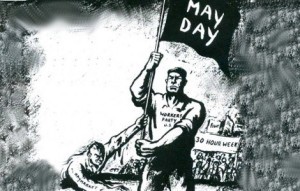
1 May was chosen to be International Workers’ Day in order to commemorate the 4 May, 1886 Haymarket affair in Chicago. The police were trying to disperse a public assembly during a general strike for the eight-hour workday, when an unidentified person threw a bomb at the police. The police responded by firing on the workers, killing four demonstrators.
In 1889, a meeting in Paris was held by the first congress of the Second International, following a proposal by Raymond Lavigne which called for international demonstrations on the 1890 anniversary of the Chicago protests. May Day was formally recognized as an annual event at the International’s second congress in 1891. Subsequently, the May Day Riots of 1894 occurred. In 1904, the International Socialist Conference meeting in Amsterdam called on “all Social Democratic Party organizations and trade unions of all countries to demonstrate energetically on the First of May for the legal establishment of the 8-hour day, for the class demands of the proletariat, and for universal peace.” The congress made it “mandatory upon the proletarian organizations of all countries to stop work on 1 May, wherever it is possible without injury to the workers.” Across the globe, labor activists sought to make May Day an official holiday to honor labor and many countries have done so.
May Day has long been a focal point for demonstrations by various socialist, communist and anarchist groups. May Day has been an important official holiday in countries such as the People’s Republic of China, North Korea, Cuba and the former Soviet Union. May Day celebrations typically feature elaborate popular and military parades in these countries
In Greece 1 May is an optional public holiday. The Ministry of Labour retains the right to classify it as an official public holiday on an annual basis, and it customarily does so. The day is called “Εργατική Πρωτομαγιά” (lit: Workers’ 1 May) and celebrations are marked by demonstrations to which left-wing political parties, anti-authority groups and workers’ unions participate.
Source: Wikipedia
Ask me anything
Explore related questions