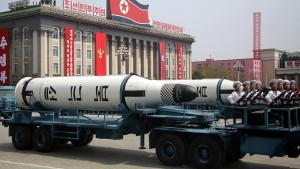
The United States toughened its military pressure and invective against nuclear-armed North Korea on Wednesday, conducting a missile maneuver with South Korea, hinting of a possible return to war with the North and proposing wider United Nations sanctions against “any country that does business with this outlaw regime.”
The American actions came a day after North Korea conducted a successful test of an intercontinental ballistic missile that appeared capable of hitting Alaska and Hawaii and was described by the United States as a “dangerous escalation” in what has become a crisis for the Trump administration. Claiming the test had been timed to America’s July 4 holiday, North Korea’s leader, Kim Jong-un, described the missile as a “gift package” to the United States.
The proposal for broader sanctions appeared aimed especially at China, North Korea’s most important trading partner. It was part of a vocal public effort by the Trump administration to push President Xi Jinping of China by linking improved American-Chinese trade relations to solving the North Korea problem — and threatening worse trade relations if China does not help more.
“There are countries that are allowing, even encouraging, trade with North Korea,” the American ambassador to the United Nations, Nikki R. Haley, told the Security Council at an emergency session on the North Korean missile test. If such countries want good trade relations with the United States, Ms. Haley said, “that’s not going to happen.”
“We will not look exclusively at North Korea,” Ms. Haley said in outlining the toughened American position. “We will look at any country that does business with this outlaw regime.”
Ms. Haley did not specifically threaten China, but she emphasized that 90 percent of North Korea’s trade is with the Chinese and that “much of the burden of enforcing U.N. sanctions rests with China.”
She said the United States was drafting a Security Council resolution that could cut North Korea’s access to foreign currency and restrict oil exports to North Korea, which are mostly supplied by China.
“We will not repeat the inadequate approaches of the past that have brought us to this dark day,” Ms. Haley said.
She also raised the possibility of using America’s “considerable military forces” if necessary, but said, “We prefer not to have to go in that direction.”
The chances of Security Council approval for such a resolution appeared dim at best. China and Russia, both veto-wielding members of the Council, generally oppose the use of sanctions.
China’s United Nations ambassador, Liu Jieyi, did not address the sanctions question but called North Korea’s missile launch an unacceptable and “flagrant violation” of other Security Council resolutions. He called on all antagonists in the crisis to “exercise restraint, avoid provocative actions and belligerent rhetoric.”
American experts on China and North Korea said they saw little hope that the Trump administration’s pressure tactics would succeed with Mr. Xi, who does not want to be seen as bullied by the United States.
“I guess this is a way of putting pressure on China,” said Bonnie Glaser, senior adviser for Asia at the Center for Strategic and International Studies in Washington. But, she said, “I’m very reluctant to say this strategy is going to work.”
Earlier in the day, the top American general in South Korea said “self-restraint” was all that was keeping the United States and South Korea from going to war with the North.
The unusually blunt warning, from Gen. Vincent K. Brooks, the commander of American troops based in Seoul, came as South Korea’s defense minister indicated that the North’s missile, Hwasong-14, had the potential to reach Hawaii.
“Self-restraint, which is a choice, is all that separates armistice and war,” General Brooks said, referring to the 1953 cease-fire that halted but never officially ended the Korean War. “As this alliance missile live-fire shows, we are able to change our choice when so ordered by our alliance national leaders.
“It would be a grave mistake for anyone to believe anything to the contrary.”
Although doubts remained that North Korea had cleared all the technical hurdles to make a fully functional ICBM, the launch prompted Washington and Seoul to conduct a joint missile exercise off the east coast of South Korea on Wednesday. The drill involved firing an undisclosed number of ballistic missiles into the sea.
President Moon Jae-in of South Korea asked President Trump on Tuesday night to endorse the exercise, arguing that the allies had to respond to the North’s provocation with “more than statements,” Mr. Moon’s office said.
The South Korean military said the missiles, which had a range of about 185 miles, had been fired to test the ability to launch “a precision strike at the enemy leadership” in case of war. It did not say how far the missiles had traveled.
Japan’s chief cabinet secretary, Yoshihide Suga, said on Wednesday that Japan and the United States had agreed to take “specific actions to improve our defense systems and our ability to deter North Korea.”
Mr. Suga did not say what those actions were, but a spokesman for Japan’s Defense Ministry said the government was considering buying ballistic missile defense systems from the United States.
It is looking at the Terminal High Altitude Area Defense system, or Thaad, which the United States recently deployed in South Korea, the spokesman said. Another option, known as Aegis Ashore, is similar to what Japan already deploys aboard naval destroyers.
The propaganda battle between the Koreas escalated on Wednesday, even as Asian stock markets appeared to shrug off the latest tensions. The North’s leader, Mr. Kim, said the missile test had been intended to “slap the American bastards in their face.”
South Korea released a computer-animated video showing missile strikes at the heart of Pyongyang, the North Korean capital. The video featured an American B1-B bomber and German-made Taurus air-to-land cruise missiles.
Speaking to the South Korean National Assembly on Wednesday, the defense minister, Han Min-koo, said the Hwasong-14, if launched on a standard trajectory, could have a range of 4,350 to 4,970 miles, enough to hit Alaska and possibly Hawaii.
Analysts had said on Tuesday that the missile appeared to be capable of striking Alaska. Hawaii is farther, about 4,780 miles from Kusong, the North Korean town from which the missile was fired.
A ballistic missile is considered an ICBM when its range is greater than 5,500 kilometers, or about 3,420 miles, according to military analysts.
But Mr. Han said that, although the Hwasong-14 was developed as an intercontinental missile, it was too early to determine whether North Korea had mastered long-range missile technology, especially the re-entry ability that allows an ICBM’s warhead section to survive the intense heat and destruction of its outer shell as it plunges from space through the earth’s atmosphere.
Mr. Han said an ICBM warhead section must endure a heat of 7,000 degrees Celsius, or 12,630 degrees Fahrenheit, while hurtling toward earth at a speed of at least Mach 21, or 4.5 miles per second. The North Korean missile’s maximum velocity was “far below” that, Mr. Han said, casting doubt that it had been put through a proper atmospheric re-entry test.
In Washington, Capt. Jeff Davis, a Pentagon spokesman, said that commercial airplanes, ships and satellites had been put at risk because North Korea did not announce its missile test ahead of time, which would have allowed airspace and sea traffic to be cleared.
“We strongly condemn this act by North Korea,” Captain Davis told reporters at the Pentagon. “It is escalatory. It is destabilizing. It is also dangerous.”
The North Korea crisis coincided, oddly, with the final negotiations at the United Nations on a draft treaty for a global ban on nuclear weapons. More than 120 countries have participated in the negotiations, which have been boycotted by all nuclear-armed nations. The final draft is expected to be approved on Friday.
Disarmament advocates attending the negotiations said the crisis was a direct consequence of what they called the failure of the nuclear-deterrent doctrine, which holds that the only way to avoid nuclear war is to ensure an attacker’s destruction.
“North Korea is the genie that’s come out of the bottle,” Bill Kidd, a Scottish lawmaker who is co-president of Parliamentarians for Nuclear Non-Proliferation and Disarmament, said at a news conference about the treaty.
Ask me anything
Explore related questions