Some PCs that received a free upgrade to Windows 10 less than two years ago are now officially blocked from receiving future updates.
If you are one of the unlucky owners of one of the first 2-in-1 PCs, announced in 2012 and sold throughout 2013 and 2014, your PC was eligible for the free Windows 10 upgrade in mid-2015, and it also received the Summer 2016 Anniversary Update (version 1607) without any compatibility issues.
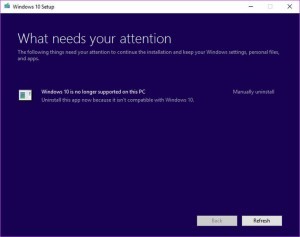
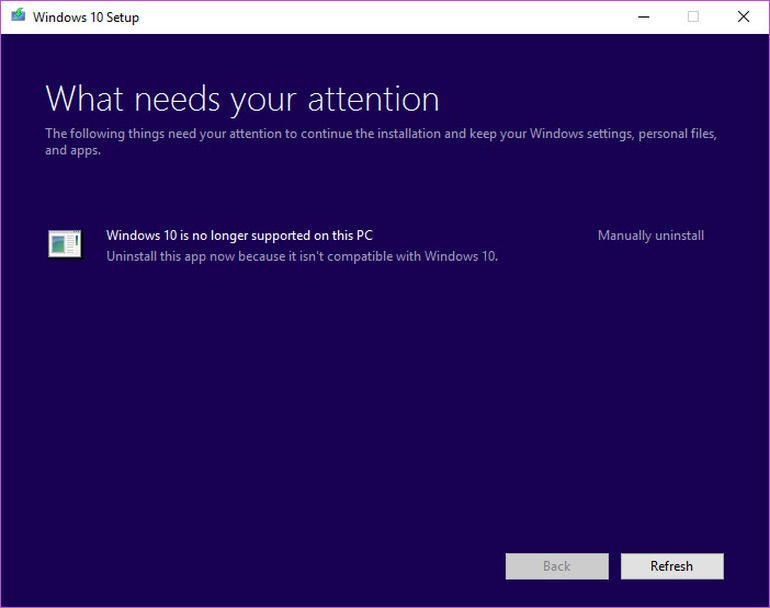
But when Windows Update tries to install the March 2017 Creators Update, version 1703, the installation fails with a dire (and confusing) message that reads:
Windows 10 is no longer supported on this PC
Uninstall this app now because it isn’t compatible with Windows 10.
Don’t be fooled by that message. There’s no app to uninstall. This problem occurs because of a fundamental incompatibility between the PC hardware and the latest release of Windows 10.
I’ve received multiple reports of this problem, which affects devices built around Intel’s Atom Clover Trail series CPUs. Those chips first appeared in entry-level Windows 8 PCs, especially 2-in-1 devices, between four and five years ago.
I was able to confirm that this hard block exists by attempting to install the Creators Update on an HP Envy X2, which uses a Clover Trail CPU, the Atom Z2760. HP shipped me the device in early 2015 and I’ve used it in lab tests as a benchmark for low-spec CPUs.
The compatibility check that’s part of the Windows Setup program gave this system a clean bill of health, but after downloading more than 3GB of setup files for the Creators Update, the upgrade failed, with the error message shown above.
There’s no easy way to work around the block, either. Unless and until the underlying compatibility issue is fixed, this device is stuck on Windows 10, version 1607.
And that’s a big problem for owners of those devices. In the “Windows as a Service” model, Microsoft’s servicing policy says, “Each Windows 10 feature update will be serviced with quality updates [security and reliability fixes] for 18 months from the date of the feature update release.”
If Microsoft sticks to its announced support deadlines, any device running Windows 10 version 1607 will stop receiving updates in early 2018. In some cases, this cutoff date will be only three years after those devices were placed in service.
A search of Microsoft’s website doesn’t turn up any support documents that explain this serious compatibility issue. I did find confirmation from Acer, which published this support note: “Intel Clover Trail processors are not currently supported in Windows 10 Creators Update.”
The following Intel Clover Trail processors are currently not supported on Windows 10 Creators Update:
* Atom Z2760
* Atom Z2520
* Atom Z2560
* Atom Z2580
Microsoft is working with us to help provide compatible drivers to address this incompatibility. If you install the Windows 10 creators update, icons and text may not appear at all, or may show up as solid color blocks or bars. If you have already installed Creators Update and are experiencing problems, you can use Windows 10 recovery options to restore your system to the previous build.
That note is echoed in a reply in this thread on the TechNet Windows 10 IT Pro support forums. That thread was marked as an official answer by forum moderators, including one identified as “Microsoft contingent staff.”
When you try to upgrade a Clover Trail-based PC to the Creators Update, Setup returns the error code 0xC1900209, which means “the system does not pass the compatibility scan to install the update … Incompatible software is blocking the upgrade process.”
The entire affair brings back memories of a confusing announcement in the months before the launch of Windows 10.
In January 2015, Windows boss Terry Myerson announced the new “Windows as a service” plan using this language. I’ve highlighted the head-scratching caveat that was included:
This is more than a one-time upgrade: once a Windows device is upgraded to Windows 10, we will continue to keep it current for the supported lifetime of the device – at no additional charge. [emphasis added]
That odd phrase confused a lot of people and launched more than a few conspiracy theories. In July 2015, two weeks before the official Windows 10 launch date, Microsoft committed to a 10-year support lifecycle for Windows 10 and clarified the “supported lifetime of the device” policy with this footnote. Here, too, I’ve highlighted the relevant portion:
** Updates are cumulative, with each update built upon all of the updates that preceded it. A device needs to install the latest update to remain supported. Updates may include new features, fixes (security and/or non-security), or a combination of both. Not all features in an update will work on all devices. A device may not be able to receive updates if the device hardware is incompatible, lacking current drivers, or otherwise outside of the Original Equipment Manufacturer’s (“OEM”) support period. Update availability may vary, for example by country, region, network connectivity, mobile operator (e.g., for cellular-capable devices), or hardware capabilities (including, e.g., free disk space). [emphasis added]
This is the first example of hardware that was initially supported by Windows 10 but has since run afoul of those rules.
Microsoft and its OEM partners made a big deal of this entry-level Atom processor for the first wave of Windows 8 devices. An Intel press release (PDF) from the launch event in September 2012 highlighted eight tablets and hybrids from Acer, ASUS, Dell, Fujitsu, HP, Lenovo, Samsung, and ZTE.
The devices themselves were delayed until early 2013 because of driver problems.
The HP Envy X2 was a relative star among this class of PCs, boasting a real-world battery life measured in days, with a detachable tablet that compared favorably in size and weight (but not app support) to the then-current iPad model.
The Envy X2 went on sale at a starting price of $700, but the price was cut by $100 shortly thereafter. HP and its distributors continued to offer the device until its replacement arrived some two years later, and bargain hunters could still find it for sale in 2015.
No one knows exactly how many Clover Trail-based devices were sold, but collectively the total from all manufacturers was probably in the millions. Today, owners of those devices who took advantage of Microsoft’s free upgrade offer for Windows 10 are facing a rude shock.
It’s possible that Microsoft and Intel will deliver a fix to this issue. That’s what Acer’s support note implies, but with no details of the underlying issue and no official word from Microsoft, that’s certainly not guaranteed. (I’ve asked Microsoft for comment and will update this post when I hear back from them.)
And are there other PC architectures that are likely to face this issue in the next year or two? We don’t know. As Microsoft moves to a Windows 10 upgrade cadence of twice a year, with feature updates delivered in March and September and a support lifecycle of 18 months, that support policy can in theory cause even a two-year-old device to end up on the Island of Lost CPUs.
The irony in this case is that Microsoft aggressively pushed the free Windows 10 upgrade offer to the owners of these devices, turning up the pressure dramatically as the July 2016 cutoff date approached. Now, less than a year later, those devices are being cut off without notice.
The bottom line: If your PC was originally designed for Windows 8 or Windows 8.1 and the manufacturer doesn’t officially support it for Windows 10, you’re at risk.
For the short term, at least, this policy shouldn’t affect PCs that were designed for Windows 10 or for which the manufacturer has explicitly delivered support for Windows 10 in the form of drivers and firmware updates. But that could change in a few years, perhaps without notice.
Ask me anything
Explore related questions