
×
GreekEnglish

×
  • Politics
  • Diaspora
  • World
  • Lifestyle
  • Travel
  • Culture
  • Sports
  • Cooking
Sunday
07
Dec 2025
weather symbol
Athens 15°C
  • Home
  • Politics
  • Economy
  • World
  • Diaspora
  • Lifestyle
  • Travel
  • Culture
  • Sports
  • Mediterranean Cooking
  • Weather
Contact follow Protothema:
Powered by Cloudevo
> Culture

The insane grammar rule non-English speakers won’t have heard of

Apparently, a lot of English grammar rules only come as a surprise to those who know them most intimately

Newsroom November 9 07:02

English grammar, beloved by sticklers, is also feared by non-native speakers. Many of its idiosyncrasies can turn into traps even for the most confident users.

But some of the most binding rules in English are things that native speakers know but don’t know they know, even though they use them every day. When someone points one out, it’s like a magical little shock.

This week, for example, the BBC’s Matthew Anderson pointed out a “rule” about the order in which adjectives have to be put in front of a noun. Judging by the number of retweets—over 47,000 at last count—this came as a complete surprise to many people who thought they knew all about English:

Things native English speakers know, but don’t know we know: pic.twitter.com/Ex0Ui9oBSL

— Matthew Anderson (@MattAndersonNYT) September 3, 2016

That quote comes from a book called The Elements of Eloquence: How to Turn the Perfect English Phrase. Adjectives, writes the author, professional stickler Mark Forsyth, “absolutely have to be in this order:

opinion-size-age-shape-colour-origin-material-purpose Noun

So you can have a lovely little old rectangular green French silver whittling knife. But if you mess with that order in the slightest you’ll sound like a maniac.”

Mixing up the above phrase does, as Forsyth writes, feel inexplicably wrong (a rectangular silver French old little lovely whittling green knife…), though nobody can say why. It’s almost like secret knowledge we all share.

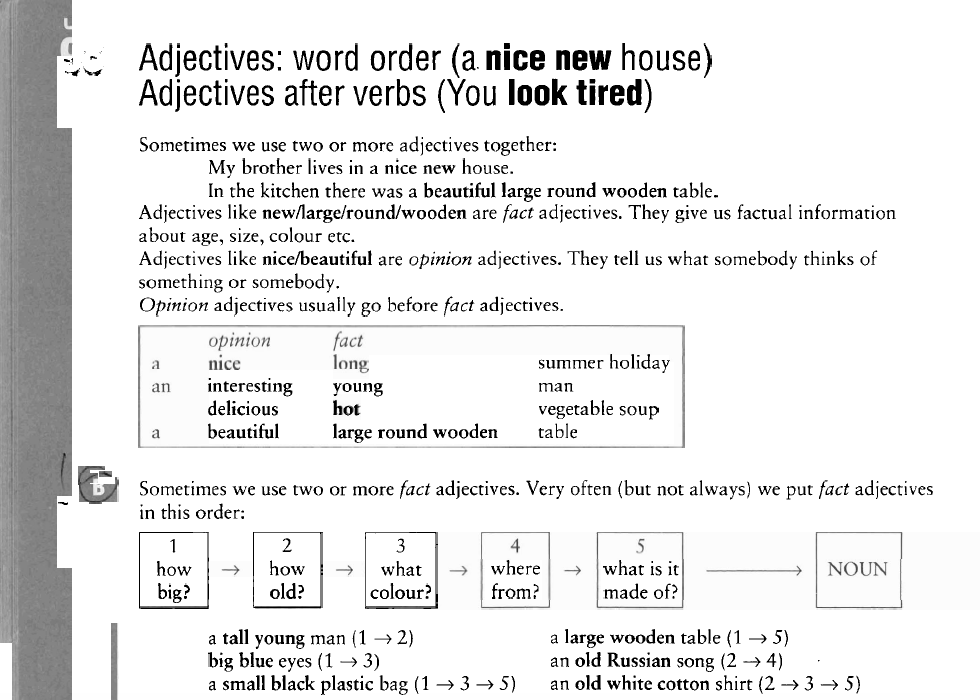
Learn the language in a non-English-speaking country, however, and such “secrets” are taught in meticulous detail. Here’s a page from a book, published by Cambridge University Press, used regularly to teach English to non-native speakers. An English teacher in Hungary sent it to us.
ss

The book lays out the adjective order in the same way as Forsyth’s surprising illumination. Hungarian students, and no doubt those in many other countries, slave over the rule, committing it to memory and thinking through the order when called upon to describe something using more than one adjective.

>Related articles

Israel will participate in Eurovision; Spain, the Netherlands & Ireland withdraw

Mendoni from Washington: Culture is a connecting and unifying force between the US and Greece

Hagia Sophia: At the mercy of…crony contractors, the adventures of the monument of Orthodoxy in Erdogan’s hands

The fact is, a lot of English grammar rules only come as a surprise to those who know them most intimately.

Learning rules doesn’t always work, however. Forsyth also takes issue with the rules we think we know, but which don’t actually hold true. In a lecture about grammar, he dismantles the commonly held English spelling mantra “I before E except after C.” It’s used to help people remember how to spell words like “piece,” but, Forsyth says, there are only 44 words that follow the rule, and 923 that don’t. His prime examples? “Their,” “being,” and “eight.”

Source: qz.com

Ask me anything

Explore related questions

#country#culture#detail#English#foreign#language#native#rules
> More Culture

Follow en.protothema.gr on Google News and be the first to know all the news

See all the latest News from Greece and the World, the moment they happen, at en.protothema.gr

> Latest Stories

“We are really very close to a peace agreement for Ukraine,” says Trump’s special envoy

December 7, 2025

Dismantling of trolleybus cables begins in Piraeus — Watch the video

December 7, 2025

Armed police raid at Heathrow: Train services suspended, arrests and tear gas reported

December 7, 2025

Mitsotakis: “Farmers will receive every euro they are entitled to — Solutions come through dialogue, not roadblocks”

December 7, 2025

Improved weather today — where local showers are expected

December 7, 2025

The livestock farmer who tearfully bid farewell to his 450 sheep collapses; Hospitalized in Giannitsa with stroke symptoms

December 7, 2025

Greece moves toward early repayment of €5.29 billion in bailout debt

December 7, 2025

“My stalker kidnapped me from my bed — I bargained for my life”

December 7, 2025
All News

> Greece

Dismantling of trolleybus cables begins in Piraeus — Watch the video

“The skies of Piraeus and Athens will finally breathe,” says Konstantinos Kyranakis. The first trolleybus lines to be discontinued are “17” and “20,” which will be replaced by electric buses

December 7, 2025

Improved weather today — where local showers are expected

December 7, 2025

The livestock farmer who tearfully bid farewell to his 450 sheep collapses; Hospitalized in Giannitsa with stroke symptoms

December 7, 2025

GREECE – Road safety – Cameras – Bus lanes – Roads – Highway code

December 7, 2025

Video: Farmer tearfully says goodbye to his 450 sheep — all of his local breed

December 6, 2025
Homepage
PERSONAL DATA PROTECTION POLICY COOKIES POLICY TERM OF USE
Powered by Cloudevo
Copyright © 2025 Πρώτο Θέμα