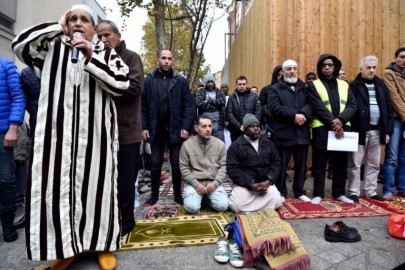
On November 10, Muslims laid their prayer mats on a road in the northern Parisian suburb of Clichy-la-Garenne. They were met with a banner held aloft by local politicians, led by right-wing Mayor Remi Muzeau, which read: “Stop illegal prayers in the streets.”
For eight months, hundreds of Muslims have gathered in front of the town hall every Friday to worship. Now, French lawmakers have pledged to put an end to the public worship sessions, not only in the suburb, but elsewhere in the country.
“They will not have prayers on the street, we will prevent street praying,” Interior Minister Gerard Collomb told Questions Politics on Sunday.
He did not refer to any specific law, although former Interior Minister Claude Guéant outlawed street prayers in Paris in 2011.
The worshippers are aggrieved that a popular mosque in the suburb has been converted into a library since March, despite thousands congregating at the house of worship.
They accuse authorities of not providing suitable space for prayer. Local officials argue there is a mosque north of the town that can accommodate the worshippers, but they say it is not large enough and is tough to reach using public transport.
Leaders of the congregation say they do not want to pray on the streets but feel they have to in order to convey their message. “You think it is a luxury to pray on the street?” Hamid Kazed, head of the Clichy Muslim Union, asked after the confrontation with the local politicians.
As well as Paris, officials have previously spoken of similar street prayers taking place in the southern cities of Marseille and Nice, which both have strong Muslim populations.
Such a ban is already in place elsewhere in Europe. In the Bavarian city of Munich, public Muslim prayers to protest the lack of a mosque in the center of the city were canceled earlier this year for security reasons. Authorities feared that far-right groups would mobilize to attack the congregation.
But, in France, efforts to stop the street prayers are for a very different reason: the battle between religious worship and French secularism.
The country has more than 4.5 million Muslims, representing around 7.5 percent of its total population, and the minority’s integration remains a crucial national issue.
This year’s presidential election pitted religion, specifically Islam, at the heart of the country’s political debate, with Marine Le Pen’s right-wing National Front party railing against “Islamist globalization.” She made the final run-off but independent centrist Emmanuel Macron ran out victorious. The right-wing leader had previously railed against street prayers, decrying them as an “invasion” of Islam in French society.
The battle between France’s secular laws and Islam is ongoing despite Le Pen’s defeat. Around 100 local politicians met the worshippers in Clichy, singing the French national anthem, draped in the sashes of the French tricolor, as if to suggest that such displays of religion were not welcome in the country and not French in nature.
This tension and wider anti-Muslim sentiment has increased after seven radical Islamist attacks since January 2015. They include the November 2015 Paris attacks claimed by the Islamic State militant group (ISIS) that left 130 people dead in the French capital.
The shooting and suicide bomb attacks targeted the heart of French freedom and democracy, in which jihadis laid siege to a concert hall, bar, restaurant and football stadium.
Ultimately, Collomb said he would take into consideration the concerns of the Muslims who took to the streets in Clichy, ensuring that they would have an adequate area to pray. In 2011, Guéant quelled street worshippers, who were praying outside because they did not have enough space indoors, by letting them use a disused fire brigade barracks with capacity for 2,000 people.
“Muslims must have a place of worship to pray,” Collomb said. “We will make sure we resolve this conflict in the next few weeks.”
Source: yahoo.com
Ask me anything
Explore related questions