By Billy Cotsis*
Before I start this article, let me invite you, the reader, to help me. I will pose a question for you, the same one I have been asking my friends – “When and where was the last Hellenic empire?”
The responses have been as follows: Alexander the Great, the guys from 300, Mithridates, Byzantine Empire, the Ptolemies of Egypt, or the Lesvians (ok, my home island so I had to mention them somewhere).
Those who mentioned the Byzantine Empire which ended in 1453 came really close. It was actually a few years later, when the Empire of Trebizond fell to the Ottoman Turks. When I mention this type of trivia to my friends they either ignore me or simply think that my tendency to promote all things Hellenic has actually slipped into the realm of make-believe. It’s true, there really was an Empire of Trebizond…
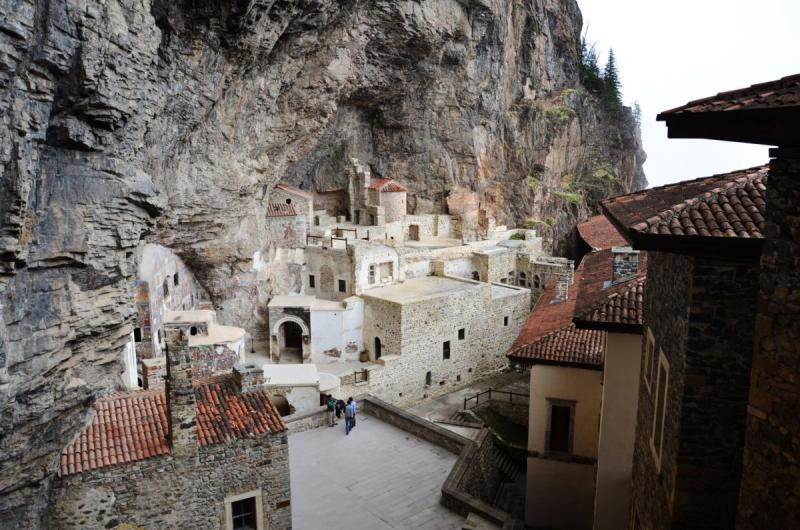
(Panagia Sumela Monastery)
Trebizond (modern Trabzon in Turkey) was a city founded in the eighth century BCE by Greek colonists from Miletus on the Black Sea coast in northern Asia Minor, which became known as the Pontus region. Xenephon, in his classic fourth century BCE book Anabasis describes the joy of his troops as they finally encountered a Hellenic city after a long and treacherous march from Persia, encountering many enemies. Trebizond prospered under the rule of Mithridates and the kings of Pontus during the first century AD, and was an important port for trade during the Byzantine years which commenced around 330AD.
In 1204, after many years of civil war and feuding, Constantinople was taken by the Crusaders through deception – aided and abetted by Emperor Isaac II Angelos for personal gain. A number of Greek speaking successor states emerged. This included the Hellenes of Nicaea in Asia Minor, who would win back Constantinople in 1261 (restoring the Byzantine Empire), the Greeks of Epiros who would be absorbed by the Nicaeans and the Empire of Trebizond.
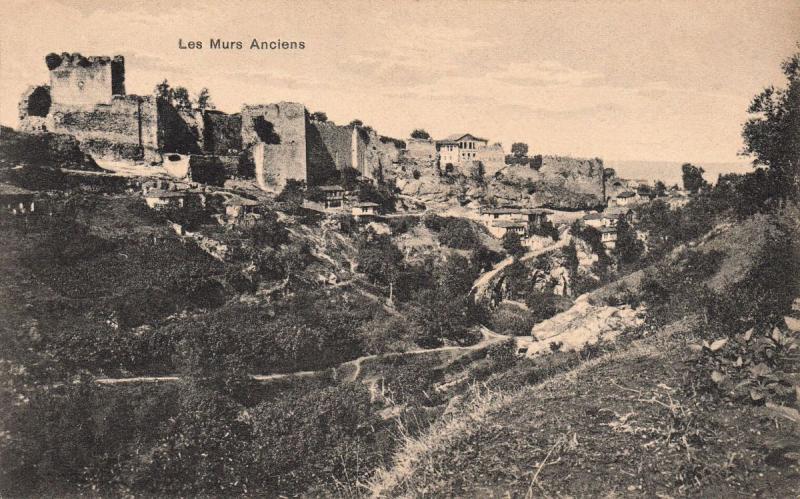
(The Ancient Walls of Trebizond)
If we backtrack to 1185, the Byzantine Emperor Andronicus I was overthrown and his family escaped to Georgia and the protection of Queen Thamar. In 1204 she provided Alexios I Comnenos (Andronicus’ grandson and her nephew) with troops to capture the cities of Pontus, in and around Trebizond. Alexios proclaimed himself Megas Komnenos (Grand Comnenos) and the ‘true’ Emperor of Byzantium. He was able to conquer a significant area on the Black Sea, from the borders of Georgia in the east to Sinope in the west. He also captured the Crimean Peninsula in what is now in the Ukraine. A number of their descendants live in the Ukraine in and around Marioupolis and speak Greek.
Alexios never effectively controlled more than 100km south of the capital. However, this was to his advantage for beyond the high range mountains that Xenephon and his men once encountered, lay some of the most powerful enemies in the region. They included the Seljuk Turks, a number of Turkish fiefdoms, followed by the Mongol foray, and ultimately the Ottomans. Thus, Trebizond was fortunate to be protected by its natural position, as well as the friendship of the Georgians and a series of alliances with Turkish princes, the restored Byzantine Empire and a strong economy.
During the reign of John II (1280-1297), the Empire reconciled itself with Byzantium and ended its pretensions and claims to Constantinople and the entire Greek speaking world. By 1282 the Emperor of Trebizond was known by the title of Faithful Emperor and Autocrat of the whole of the East, the Iberians and the overseas province. This title was in agreement with the Byzantine Emperor.
The Mongols played an important role in Hellenic affairs. While it is fair to say that no Mongol Khan or Greek speaking emperor enjoyed an ouzo or a souvlaki together, it was the Mongol raiders who probably extended the life of the Byzantine Empire and inadvertently improved the economic strength of Trebizond. The Mongols destroyed Ottoman forces in 1402 at Ancyra, allowing Constantinople breathing space to survive for another 51 years.
The Mongol threat prevented Turkish forces from mounting serious campaigns against Trebizond. In 1258 Hulagu Khan destroyed Baghdad. This event ensured Trebizond’s status as an important city on the Silk Road, increasing the wealth and prosperity of the city. In 1295 Marco Polo visited the city on his way back into Europe.
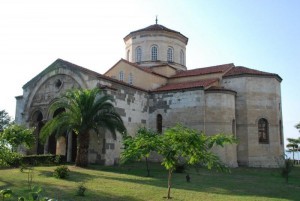
(The Hagia Sophia of Trebizond, now a mosque)
A number of notable Hellenes were born in Trebizond during the years of the empire. This includes Gregory Choniades the astronomer, John VIII the Greek Orthodox Ecumenical Patriarch, Basileos Bessarion a bishop and academic who had a great influence on the Renaissance, George of Trebizond who was born in Crete with a background from Trebizond and was a philosopher who influenced the Renaissance and Michael Panerotos the imperial historian. Furthermore, a number of famous politicians and actors were born in the vicinity of Trebizond in modern times, highlighting how important this area has been to Hellenic culture and history.
It’s worth commenting on what is known about the role of women in Trebizond. I’m not going to paint a picture of women being independent; it is worth noting that several rulers were indeed female. However, many of the royal girls were married to Turkish or Muslim leaders in order to maintain friendly relations. Male rulers generally married Christian women including from the royal houses in Georgia and Constantinople.
Now it’s time to use the word inevitable. Just like Xenephon and his troops inevitably came across Greeks after their long march, it was inevitable that the Hellenes of Trebizond would quarrel in the same ways that had affected the Byzantine Empire over the centuries. In fact, being Greek or rather Byzantines, meant that it would be inevitable for Trebizond to experience a series of civil strife and political assassinations from the period of about 1330 for decades. Inevitably, this precipitated a slow decline for Trebizond, with outlying provinces being taken by the Ottomans. Stability was restored late in the 14th century.
The Greeks of Trebizond became known for building numerous churches and public buildings that are evident when one visits the picturesque modern day Trabzon. A visit to the city with a current population of about 180,000 will reveal the high walls of the old Upper Town which are meant to resemble the walls of medieval Constantinople, the churches of Saint Ann, Saint Constantine, Panayia Chrysokephalos, Saint Andrew, Saint Eugene, Agia Sophia , Aghios Christophoros just to name a few. Most of the churches have either been converted to mosques or had stints over the years as such. A number of fortresses and monasteries are also evident in areas that were once included in the Empire of Trebizond. I should point out that churches and other public buildings can be traced back to the ninth century, hence existing when the area was under the direct control of Constantinople.
Some historians inexplicably tell us that the Ottomans captured the entire Asia Minor by 1350. However, it is worth keeping in mind that Philadelphia in the south and 100km inland from the city of Smyrna held out for many years. Philadelphia somehow managed to heroically survive until 1390 despite being surrounded by formidable enemies for so many years and of course the other city that remained independent was Trebizond.
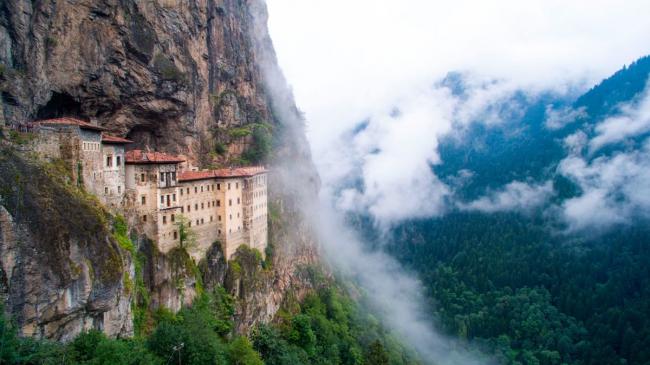
(Panagia Sumela Monastery)
When Constantinople finally fell to the Ottomans in 1453 after a heroic fight to the death, the Byzantine Empire effectively came to an end. However, the Hellenes of Trebizond who were predominantly Pontic (Pontian) and held onto their Byzantine heritage essentially inherit the title of the last Hellenic Empire.
As Xenephon can testify, all good things come to end. He was alive when the Spartan hegemony of Greece came to end against Thebes in 371 BCE and of course he was overwhelmed when his troops (Ten Thousand) finally ended their land journey after reaching Trebizond. The last empire of the Hellenes came to a sudden end when the Ottoman Sultan decided to end the reign of King David (ruled from 1459-1461). After a month long siege, Trebizond succumbed on the sacred day of August 15, 1461. Interestingly, the Byzantine province of the Morea (Peloponnese) held out against the Ottomans, lasting until 1460.
The impact of this civilization can still be felt. As mentioned above there are numerous churches and other buildings that are scattered across the modern city. There are approximately 100,000 Muslims in the area once occupied by the Empire of Trebizond who speak a dialect of Greek. Most of these people live outside Trebizond in about fifty villages and towns.
During the final and disgusting years of the Ottoman Empire in the early 20th century, Pontians as well as other Christians were killed or starved to death (death marches). There was a discussion by the Allied Powers in Europe to create a Pontus state based on the provincial boundaries of the old Empire of Trebizond. Like many Allied promises over the years, supported by Eleftherios Venizelos, this never eventuated and by 1923 the sad population exchange between Greece and Turkey resulted in almost 1.5 million Hellenes (including Pontus) being sent to Greece. Also, tens of thousands of people from Pontus were forced to migrate to Russia and neighbouring countries. This extinguished the Hellenic presence in Trebizond, over 460 years after the end of the Empire of Trebizond.
I’m not sure what Xenephon would make of Trebizond today. One thing that is certain, he would be surprised that the Hellenes are no longer there to greet him and his weary troops.
* Billy Cotsis is the author of “From Pyrrhus to Cyprus: Forgotten and Remembered Hellenic Kingdoms, territories, entities and a fiefdom”
Source: neoskosmos.com
Ask me anything
Explore related questions