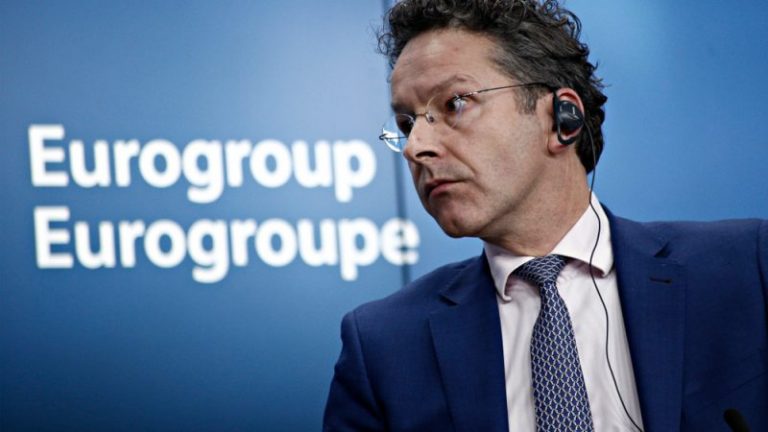
The Greek government will be able to gradually have more and more access to markets as the end of the bailout, the current economic outlook and a sound budget allow Greece to regain its financial independence, former Eurogroup President Jeroen Dijsselbloem said in an interview with EURACTIV’s media partner Athens-Macedonian News Agency (ANA).
Dijsselbloem spoke to ANA’s Christina Vasilaki.
In several instances, you were portrayed in the Greek media – and not only there – as the main supporter and promoter of the German austerity policies. What is your response to this?
Don’t be mistaken. The austerity for Greece became inevitable when the truth came out about the budget deficit, spreads went sky-high, and no one wanted to lend any more money to Greece. It was the consequence of political and financial mismanagement in the decades before the crisis. The only way the other Europeans were going to offer loans to Greece was on condition of sorting out the mess. That was the real situation. Any other Eurogroup chair would have had to deal with the same challenges.
In your book, you point out that the Greek pension system was one of the topics that dominated most of the negotiations with Greek governments. Do you think the implemented reforms, which resulted in several cuts, were all necessary? And, in your opinion, should Greece continue to implement these kinds of policies?
The key question is whether the pension system is sustainable over the long run. In other words, are the contributions paid in, balanced with the benefits paid out? If not, how are you going to pay for this gap? What does that mean for fairness between generations? How much tax can you ask the current generation of working people to pay? Will there still be pensions for future generations? In an aging society, you need to face these issues. A combination of everybody paying their fair share in contributions and everybody working longer allows for benefits of a socially acceptable level. Turning back these measures would simply reset the problem.
Last August, Greece concluded successfully its financial support program. Do you believe that the country will now be able to fully return to the markets, and why has this not happened yet?
The program exit, the current economic outlook, the sound budget, all of this allows Greece to regain its financial independence. And when needed, attract loans from the international financial markets. It hasn’t happened yet, because there is no need. With the very soft terms on the European loans and the cash buffer for emergencies, there is no direct financing need. Gradually, over time, the Greek government will access markets more and more. Markets will want to know whether Greece can maintain a solid economic and financial course.
In your book, you don’t focus very much on relations between Berlin and the International Monetary Fund (IMF). However, it is quite clear from your account that they were far from consistent during all those years. At the end of the day, do you think that the German demand for the IMF’s involvement in eurozone affairs was in the eurozone’s interest?
At the start, the Europeans had no funds, no institutions and no experience in dealing with emergency programmes. And so the IMF was brought in, which does these interventions everywhere in the world. The IMF has been tough; not to make life difficult for Greece, but to introduce realism: How bad are the problems, and what could effective solutions look like? Later on, there was a lot of debate about debt sustainability, and the IMF pushed the Europeans to reduce the debt burden on Greece. That happened again and again, lowering interest rates, lengthening maturities, offering grace periods, but without offering a simple haircut of the debt. Possibly more will have to be done in the future.
It’s a well-known fact that you have a degree in agricultural economics. You also built a career from a very young age in the Labour Party and you served as Eurogroup president in one of the most difficult periods for the eurozone. What will your next job be?
I can’t answer this yet. I have chosen to take my time, after having worked extremely hard in the past, before deciding on a next step.
Source: euractiv
Ask me anything
Explore related questions