×
GreekEnglish

×
  • Politics
  • Diaspora
  • World
  • Lifestyle
  • Travel
  • Culture
  • Sports
  • Cooking
Sunday
18
Jan 2026
weather symbol
Athens 6°C
  • Home
  • Politics
  • Economy
  • World
  • Diaspora
  • Lifestyle
  • Travel
  • Culture
  • Sports
  • Mediterranean Cooking
  • Weather
Contact follow Protothema:
Powered by Cloudevo
> technology

Inbreeding study reveals why humans don’t have sex with their relatives

Prehistoric humans developed surprisingly sophisticated social and mating networks and deliberately sought partners beyond their families

Newsroom November 9 04:07

Even 34,000 years ago, our ancestors knew having sex with their relatives was a bad idea. Analysis of ancient human remains found in Russia has revealed that even among an extremely small society, incest did not take place.

The study, led by Cambridge University and the University of Copenhagen, says prehistoric humans developed surprisingly sophisticated social and mating networks and deliberately sought partners beyond their families.

The study has led to speculation that this could partly explain why anatomically-modern humans proved more successful than other species such as Neanderthals that did not avoid inbreeding.

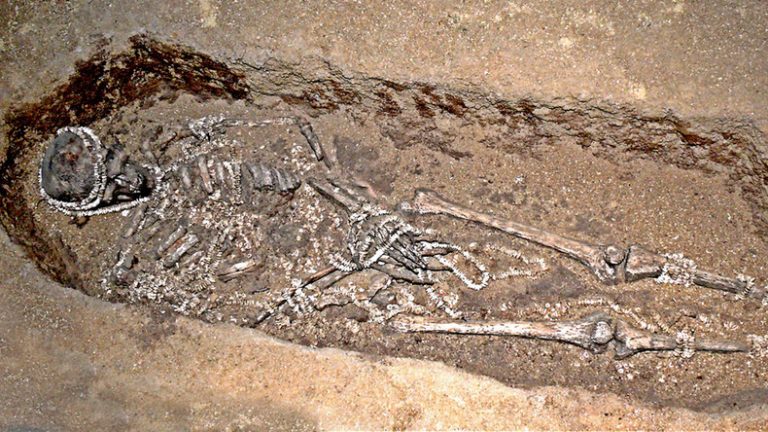
Researchers examined genetic remains of four anatomically-modern humans from Sunghir, an Upper Paleolithic site in Russia. Unusually for finds from this period, the people were found buried together.

To the researchers’ surprise, the individuals were not closely related in genetic terms. At the very most, they were second cousins. This is true even in the case of two children who were buried head-to-head in the same grave.

Objects and jewelry found buried with the remains suggest they may have developed rules, ceremonies and rituals to accompany the exchange of mates between groups which perhaps foreshadowed modern marriage ceremonies.

Professor Eske Willerslev, fellow at St John’s College, Cambridge, said in a statement: “What this means is that even people in the Upper Paleolithic, who were living in tiny groups, understood the importance of avoiding inbreeding.

“The data that we have suggest that it was being purposely avoided. This means that they must have developed a system for this purpose. If small hunter–gatherer bands were mixing at random, we would see much greater evidence of inbreeding than we have here.”

>Related articles

Elon Musk: Don’t save for retirement – It won’t matter

Success stories run aground: Family civil wars that destroyed businesses

Olympian Anna Korakaki uploaded a new photo with a bloated belly

By comparison, genomic sequencing of a Neanderthal individual from the Altai Mountains who lived about 50,000 years ago indicated inbreeding was not avoided.

It led researchers to speculate that an early, systematic approach to preventing inbreeding may have helped anatomically-modern humans to thrive, compared with other hominins.

Source: rt

Ask me anything

Explore related questions

#anthropology#Cambridge University#dna#family#genetics#Inbreeding#incest#Neanderthal#science#technology#University of Copenhagen
> More technology

Follow en.protothema.gr on Google News and be the first to know all the news

See all the latest News from Greece and the World, the moment they happen, at en.protothema.gr

> Latest Stories

Erfan Soltani confirmed alive by Iranian Human Rights Group after days of uncertainty

January 18, 2026

Rescue operation underway for eight hikers on Mount Taygetus; four injured

January 18, 2026

Piers Morgan recovering in hospital after serious fall in London

January 18, 2026

Prime Minister Mitsotakis’ agenda: From talks with farmers’ representatives to Davos for investment outreach

January 18, 2026

Iraq veterans report long-term health concerns after a lack of medical screening for toxic exposure

January 18, 2026

Skirtsos: ‘After years of efforts, the first results on maritime safety are starting to become visible’

January 18, 2026

Politico: Europe for the first time considers tough response to Trump on Greenland tariffs, what is the Anti-Brexit Act

January 18, 2026

The backstory behind Trump’s decision not to attack Iran: The camps in the White House, the SMS from Tehran, and the calls from Arab allies

January 18, 2026
All News

> World

Erfan Soltani confirmed alive by Iranian Human Rights Group after days of uncertainty

The statement follows days of uncertainty and conflicting reports about the fate of the detained protester

January 18, 2026

Piers Morgan recovering in hospital after serious fall in London

January 18, 2026

Iraq veterans report long-term health concerns after a lack of medical screening for toxic exposure

January 18, 2026

Politico: Europe for the first time considers tough response to Trump on Greenland tariffs, what is the Anti-Brexit Act

January 18, 2026

The backstory behind Trump’s decision not to attack Iran: The camps in the White House, the SMS from Tehran, and the calls from Arab allies

January 18, 2026
Homepage
PERSONAL DATA PROTECTION POLICY COOKIES POLICY TERM OF USE
Powered by Cloudevo
Copyright © 2026 Πρώτο Θέμα