





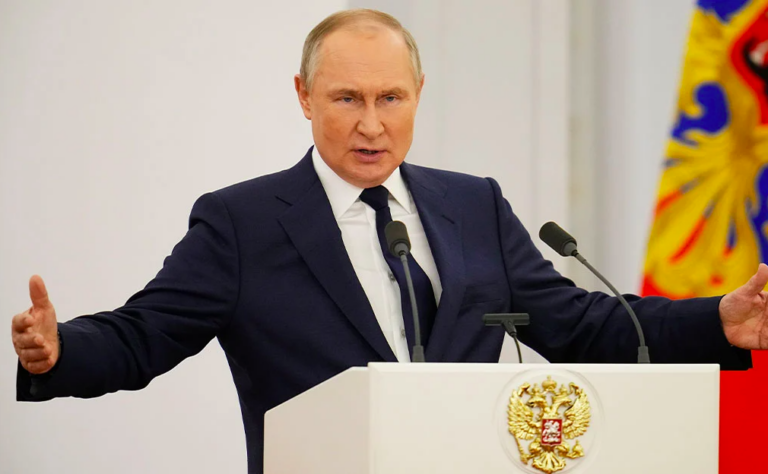
Ukraine’s recent unexpected military operation in Russia’s Kursk region may have caused concern in Moscow, but Russian President Vladimir Putin likely has reasons to celebrate this weekend.
The upcoming regional elections in three eastern German states—Brandenburg, Saxony, and Thuringia—might bring a political victory for Russia, as pro-Russian parties are expected to make significant gains, according to an analysis by Politico.
The far-right party “Alternative for Germany” (AfD) seems to be the biggest winner in these elections. According to recent polls, the AfD has a strong chance of finishing first in all three states, while the newly formed left-wing party “Sarah Wagenknecht Alliance” (BSW) is also rising. This political momentum provides Russia with an opportunity to regain influence in much of former East Germany, an area under Russian control for decades during the Cold War.
If these predictions are confirmed at the ballot box, it is expected to cause significant concern in Germany. The success of the extreme parties will reveal the failure of the country’s political leadership to bridge the gap between East and West, while also destabilizing the tripartite government cooperation in Berlin, which is already facing challenges.
The rise of the AfD and other populist parties in Eastern Germany reflects a broader trend of dissatisfaction rooted in the country’s unification after the fall of the Berlin Wall. In the early 1990s, Western German political forces imposed their policies on the East, sending experienced politicians from the West to govern states like Saxony. This “colonization” of Eastern Germany created a sense of marginalization and undervaluation among the region’s residents.
Despite the German government’s efforts to improve the East’s economic situation, the divide remains. Economic development in former East Germany has significantly improved since the communist era, yet the region continues to lose population, with 15% of its inhabitants having migrated to the West. This demographic drain, especially of women, exacerbates problems and strengthens feelings of alienation.
The failure of centrist and democratic parties to establish their presence in Eastern Germany is evident in the polls. The parties currently governing at the national level—Social Democrats (SPD), Greens, and Free Democrats (FDP)—seem to be at a disadvantage. In Saxony and Thuringia, predictions suggest they will not garner more than 12% of the vote combined, while in Brandenburg, their share is expected to reach 27%. Even when including Germany’s largest center-right party, the Christian Democrats (CDU), the total share of centrist parties does not exceed 50%.
This phenomenon represents a remarkable decline for the parties that shaped East German politics after reunification. The rapid rise of the AfD and other populist parties indicates that the West’s approach has failed to mend relations with the East. Instead, resentment and disillusionment seem to have strengthened extreme political tendencies.
Vladimir Putin, who began his career as a KGB spy in Dresden, East Germany, closely watches these developments. His interest in Germany remains strong, and a victory for pro-Russian parties would be a personal vindication for him. Putin, described by a biographer as “the German in the Kremlin,” maintains a special relationship with Germany, as his experience in Dresden has profoundly influenced him.
Russia’s influence in German politics is not limited to the AfD. Pro-Russian parties, ranging from far-right to far-left, are expected to gather at least 50% of the vote in eastern German regions, according to recent polls. In Thuringia, that figure could reach 65%, with the AfD leading with approximately 30%.
Though not all parties are as fervently pro-Russian as the AfD, they share common narratives promoted by the far right: that NATO bears part of the responsibility for the war in Ukraine and that a peaceful solution could be possible if the West were more serious in its diplomatic efforts.
Discontent in Eastern Germany is often fueled by politicians who treat the region as “the other side.” Friedrich Merz, leader of the CDU, remarked in an interview that “one must explain things a little more in the East than in the West.” While the CDU remains competitive, the AfD leads in some polls, even in Saxony.
The rise of extreme parties in Eastern Germany highlights the depth of Russian influence in the region. Decades of anti-Western propaganda during the Cold War continue to shape public opinion, making Moscow an acceptable alternative for many citizens in the area.
The outcome of the elections will have repercussions not only in Germany but also across Europe, raising concerns about the continent’s stability.
Ask me anything
Explore related questions




