

It was late last year, specifically at the December 23rd Cabinet meeting, when Minister Kyriakos Pierrakakis was presenting the Ministry of Education’s next initiatives. At the top of these moves is a new institution aimed at upgrading secondary education.
The reason is the Public Onassis Schools, which come to accompany the existing structures of the public education system, aiming to offer upgraded knowledge and innovative educational practices to children living in working-class districts in the Attica basin, Thessaloniki and other cities.
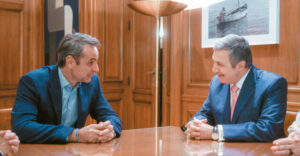
Today at 10am, Mr. Pierrakakis along with the president of the Onassis Foundation Anthony Papadimitriou are due to cross the threshold of the Great Maximus building. There they will be met by Prime Minister Kyriakos Mitsotakis for the signing of the contract between the Greek government and the Onassis Foundation for the Onassis Public Schools, which are expected to open in September this year.
The idea
The concept around this new project is quite simple as well as innovative: it is a “transplant” of a highly successful model of public-private partnership from the health sector to the education sector.
From the public-private partnership between the public and private sectors, from the private sector to the private sector.
In the same way, then, that in the late 1980s and early 1990s the Onasio Cardiac Surgery Center was created and integrated into the National Health System, 22 educational structures throughout the country will now be radically upgraded with Onassis Foundation resources to become new types of school units that will be part of public education.
It is worth noting that the plan does not envisage the creation of 22 new schools, but the conversion of existing units into public Onassis Schools, with the aim of implementing the project as quickly as possible.
According to the plan, at least the first 12 Public Onassis Schools (6 High Schools and 6 High Schools, while there is a possibility to increase to 7+7) are scheduled to open their gates next September, while in another 10 schools the first bell is scheduled to ring in September 2026, housing the daily school routine of a total of about 6,000 students.
The operation
The Onassis Public Schools will have several elements in common with Standard and Experimental Schools. “The Public Onassis Schools (DIMOS) initiative responds to the ever-increasing demand for Model and Experimental Schools in Greece. Greek families are looking for high quality educational institutions that promote excellence and innovation, resulting in applications far outstripping available places. This trend is demonstrated by the fact that in 2024 alone, more than 20,300 applications were submitted for approximately 4,800 available places in Experimental and Model Schools,” the Onassis Foundation said in a statement on its initiative.
Moreover, the DIMOS are expected to serve as another pole of school innovation, thus enhancing the educational diversity and pluralism of our educational system – and, as already mentioned, in regions of the country characterized by intense social and economic challenges. In fact, the Onassis Foundation’s announcement refers to ‘vulnerable areas’.
According to information, the areas where the Onassis Schools are planned to operate are working-class districts in the Attica basin, in Thessaloniki and in other cities where Standard Schools do not operate.
“DIMOS strengthens public education by offering a modern public school model that promotes equal access, excellence and innovation,” the Onassis Foundation’s announcement said. Furthermore, it is specified that “as part of the donation, the Onassis Foundation, in addition to the renovation of the schools, will cover the cost of holding Clubs and Ensembles after the daily timetable, with a focus on contemporary fields of knowledge such as STEM, humanities, art and digital technologies.”
Students will be admitted by examination in the first grade of each grade level, i.e. the first year of high school and the first year of middle school. For the transitional first years, students already attending Classes B and C of the Gymnasiums and High Schools which will be transformed into Onassis will remain and continue to attend them normally.
Similarly, the teachers will be selected from the human resources of the Public Education System by the same process as teachers are selected in the Model Schools. In fact, sources in the Ministry of Education say that additional pay for extra work will be provided for these teachers.
Another common element with the Model and Experimental Schools is found in the fact that the Public Onassis Schools will be directly linked to the public university institutions, with the aim of recording and evaluating the educational innovations that will be implemented in them, such as teacher development and additional activities beyond the school’s timetable.
Responsibilities
The agreement stipulates that the Onassis Foundation will undertake the renovation of the schools, providing up to €1 million per school. In addition, it will cover operating costs up to €0.5 million a year per school, and will also provide scholarships and contribute to the professional development of teachers.
On the other hand, the responsibility of the Greek State will include covering the salaries of teachers and administrative staff. In addition, the State will have a majority in the Steering Committee to be set up for the management of the new schools.
The Message
“The plan is to introduce innovations in education in a way that will allow us to learn from things that happen in the field and then diffuse them more generally throughout the educational process,” Pierrakakis said about the Public Onassis Schools in a recent interview, adding: “But if I had to keep one thing from this reform, I would keep the fact that these schools will be established in areas with social and economic challenges. And that shows something in terms of how we perceive the public system.”
The Onassis Schools join a raft of changes to public secondary education, including the introduction of Literature and the possibility of IB. It should be noted that the Minister of Education was in Geneva, the headquarters of the International Baccalaureate, where he held talks with the director general of the organisation, Oli-Pekka Hynonen, regarding the prospect of introducing IB in Greek public education, which will be piloted in 5 Lyceums from September.
The first phase of the project will be launched in September, which will be started in five pilot projects in the first half of 2011.
IB is recognised by universities and academic institutions around the world and is implemented in about 6,000 schools in 150 countries, with about half of them being public.
The Onassis Heart Surgery Center
The calendar read October 6, 1992, a landmark date for the National Health System. It was the day when the Onaseio Cardiac Surgery Center was starting its operation and was being transferred as a donation from the Onassis Foundation to the Greek State. Five years earlier, in October 1987, work had begun on its construction in Kallithea, at the end of Syngrou Avenue.
The formal act of transfer to the Public Sector took place with Law 2012/1992, by which the Greek Parliament ratified the relevant contracts between the State and the Onassis Foundation. For more than 30 years, the Onassis Foundation has been a benchmark in the fields of heart transplantation, cardiac surgery and adult and paediatric cardiology. Its creation was dictated by the fact that until it opened its doors, heart diseases largely entailed constant and extremely expensive travel abroad for tens of thousands of our fellow citizens.
But beyond the invaluable benefit to heart patients, the creation of the Onassis Hospital also produced a not inconsiderable added value. The reason is the establishment of a new practice in terms of public-private partnership. In essence, the Onassis Foundation undertook the creation of a structure which was then owned, controlled and managed by the public sector and, in particular, by the Ministry of Health, which appoints the management, approves the accounts and exercises management control.
Thus, the Onassis Cardiac Surgery Center (now renamed Onassis Hospital) operates as a non-profit, non-profit legal entity under private law, remaining constantly at the disposal of citizens in need of its highly specialized services.
Ask me anything
Explore related questions