





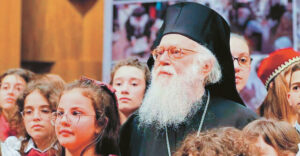
A Life’s Work: The Legacy of Archbishop Anastasios of Albania
“Christ is risen!”—exclaimed in Greek and Albanian, voices breaking with emotion, as a vast crowd gathered to bid farewell to Archbishop Anastasios of Albania. Along the procession route from Athens to Tirana, this sacred phrase echoed in tribute to the man who had dedicated his life to faith, hope, and unity.
For many, this exclamation may seem untimely at a funeral, yet for those mourning Anastasios, it was more than words—it was a motto, a sacred code binding them to their beloved hierarch from the moment he set foot in their land.
Born from Despair
The story behind this indelible phrase was one he had personally shared with a small group of Greek journalists, including the author, in 2017. It was on the occasion of the Orthodox Church of Albania organizing a concert in Tirana featuring the music of Mikis Theodorakis—a symbol of cultural dialogue and reconciliation.
It was 1991 when Anastasios first arrived in Albania. He had already left his mark as a missionary in Africa and had gained worldwide recognition for his work in the Orthodox community. At the request of the Ecumenical Patriarchate, he was sent to Albania to assess the remnants of Orthodoxy following decades of brutal religious suppression.
The scene that greeted him was devastating. “I landed at the airport, a humble building at the time, where I was met by a handful of elderly people. They took me to the Cathedral of the Annunciation—only it was no longer a church; it had been turned into a gymnasium. Inside, I found sick and impoverished people.”
Unable to speak the language, he pondered how best to communicate his mission. “I asked an elderly man who knew Greek how to say ‘Christ is risen’ in Albanian. He told me. So I lit my candle, handed candles to the others, and said, ‘Christ is risen.’ Those were my first words in Albanian. A message of hope. And suddenly, they all began to weep, responding, ‘Truly, He is risen.’ It was one of the most overwhelming moments of my life.”
From that moment on, “Christ is risen” became their motto, a beacon in both joyous and difficult times, carrying them forward in their struggle to resurrect Orthodoxy in a land where religion had been utterly erased.
Building Faith from the Ashes
Determined yet cautious, Anastasios embarked on an extraordinary mission: to restore the Orthodox Church in a country where religious sentiment had been criminalized for an entire generation. “Albania had no churches left. They had been turned into warehouses and stables. It wasn’t just about rebuilding structures; it was about restoring the ability of young people to believe freely.”
Understanding that the future lay with the youth, he directed his efforts toward them, despite daunting challenges. The country’s infrastructure was in ruins. “To travel 20 kilometers in Northern Epirus took us three hours!”
Language was another hurdle. “At 62, I thought I’d pick it up quickly by listening. I was wrong. Unlike when I learned English, I had neither time nor space to make mistakes. And every month, I had to leave and renew my visa.”
Facing Resistance
Suspicion was perhaps the greatest obstacle. “People asked, ‘Why is he here?’ After decades of atheist indoctrination, it was difficult for them to accept that someone had come simply because of faith. Even after years, suspicion lingered. Once, a politician introduced himself as an atheist. I told him, ‘You’re not an atheist; you’re irreligious. But I can assure you—God is very close to you.’ He smiled. We have been friends ever since.”
Mistrust wasn’t confined to Albania. Criticism also came from Greece, particularly accusations that Anastasios didn’t want Greek bishops appointed in Albania. “How could an entire Greek synod be accepted in a nation still rebuilding its identity?”
At times, the attacks became unbearable. “I seriously considered resigning. But then I asked myself—what happens next? If I had left in 1997, none of this would exist today.”
United in Diversity
Anastasios championed unity above all. “Some neighboring countries wanted to create separate Orthodox ‘nests’—one for Greeks, one for Romanians, one for Serbs. But we chose to be all together.”
This philosophy extended beyond the Orthodox community. With Albania’s population comprising approximately 22% Orthodox Christians, 10% Catholics, and the majority Muslim, interfaith harmony was essential. “From the beginning, I cultivated relationships with leaders of other religious communities. We did not become an isolated group but an open, mixed society.”
Even when criticized for his outreach to Muslims, including aiding 33,000 Kosovar refugees, he remained steadfast. “We helped people who were suffering. We didn’t ask them which God they believed in.”
A Clear-Eyed View of Islam
Despite his commitment to religious tolerance, Anastasios was not naïve about the challenges posed by radical Islam. “Islam is not an easy matter. It has reintroduced three things that Christianity had left behind: violence as divinely acceptable, male dominance over women, and war. Religious fanaticism cannot be reasoned with, because it is the denial of reason itself.”
He had long foreseen the rise of religious extremism. “In the 20th century, underprivileged groups were drawn to communism. In the 21st, underprivileged societies, angry at Western contempt, are turning to religious slogans. Europe, having waged war on Christianity, has created a vacuum. And Islam has come to fill it.”
A Legacy Secured
Over 33 years, the Orthodox Church of Albania flourished under his leadership. Hundreds of churches, schools, theological institutions, youth centers, and social programs were established. One of his proudest achievements was securing financial independence for the Church through a hydroelectric power plant, ensuring sustainability long after his departure.
Preparing for his succession was a responsibility he did not take lightly. “No one is permanent. I wouldn’t want everything we built to collapse when I am gone. That would be the worst mistake. The next Archbishop must be from Albania—it is a local church, not a temporary colony.”
Even in his final plans, he maintained a global vision. He ensured that 5% of the Church’s hydroelectric revenues would go to struggling Orthodox communities in Africa and Asia—a protest against wealthy Orthodox Churches hoarding resources.
“The Orthodox Church must not be a confederation of local churches but one united Church. Without unity and engagement in global challenges, what do we have to offer the world?”
“Make Quality Resistance”
As he prepared for his final journey, Anastasios left behind a simple yet profound message: “Make quality resistance. Each in their way, from wherever they stand.”
His was a life of resistance—not against people, but against despair, division, and spiritual decay. And through his unwavering faith, he left Albania a place of hope, where voices still rise in unison:
“Christ is risen.”
Ask me anything
Explore related questions




