





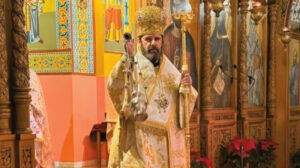
He was born into a Bektashi family – an Islamic Sufi community – in Albania. He secretly embraced Christianity while still in school, risking imprisonment, torture, exile, or even death, during a time when the Hoxha regime imposed harsh persecutions on religions. He was part of a group of crypto-Christians and speaks fluent Greek, having studied at a Greek Orthodox school in the USA. He was the first bishop ordained by Archbishop Anastasios and became his right hand. He is expected to be the first head of the Albanian Church to be elected by the Albanian Holy Synod.
Fatmir Pelushi is the secular name of today’s Metropolitan of Korça, Ioannis, who is emerging as the undisputed favorite to take over the position of Archbishop of Albania. As a spiritual child of Anastasios and his choice for the position – a position he is entitled to due to seniority – it is almost certain that Ioannis will be elected by the six-member Holy Synod of Albania, about two weeks after the death of Archbishop Anastasios. The only thing he has promised over time is that he will continue his predecessor’s great humanitarian work, focusing all his efforts on the poor, the weak, and the sick.
Alter ego
In Albania, Metropolitan Ioannis is known as Metropolitan Ioannis or Father Ioannis Pelushi. He was considered the alter ego of the blessed Archbishop of Albania, whom he accompanied or even replaced as the head of delegations of the Orthodox Church of Albania when needed, such as in July 2013 during the celebrations of the 1025th anniversary of the baptism of Russia and in October 2015 at the Fifth Pan-Orthodox Pre-Synodal Meeting. Therefore, it is not surprising that after the death of Archbishop Anastasios, he assumed the role of Locum Tenens of the Archiepiscopal Throne of Tirana, where he is expected to be formally elevated.
As “a child” of Anastasios, in the Diocese of Korça he has shown significant work in the writing and translation of books, newspapers, and magazines, as well as helping the weak. He leads an ascetic life – for example, he does not even have a television at home because he considers it a “provocation” and is generally a very low-profile person, avoiding public interventions. However, this does not mean that he lacks the courage of his convictions, which are often very sharp. For example, last September in Paris, in front of French President Emmanuel Macron, as a representative of the Albanian Church, he delivered a fiery speech on war and poverty, stating that “peace is a combination of justice and solidarity. There can be no peace without justice, and there can be no justice without solidarity.”
“The wars,” said Metropolitan Ioannis of Korça, “are the result of the violation of people’s rights, the exploitation of individuals or countries, and the greed that always creates poverty and conflicts. The UN’s Agenda 2030 for Sustainable Development states: There can be no sustainable development without peace, and there can be no peace without sustainable development. Extreme poverty is both a product of and a cause for conflicts. It strengthens frustration and despair, which are key ingredients for creating violence. […] By fighting poverty, we reduce the likelihood of conflicts. And by avoiding conflicts, we create more opportunities to secure peace.”
The Balances
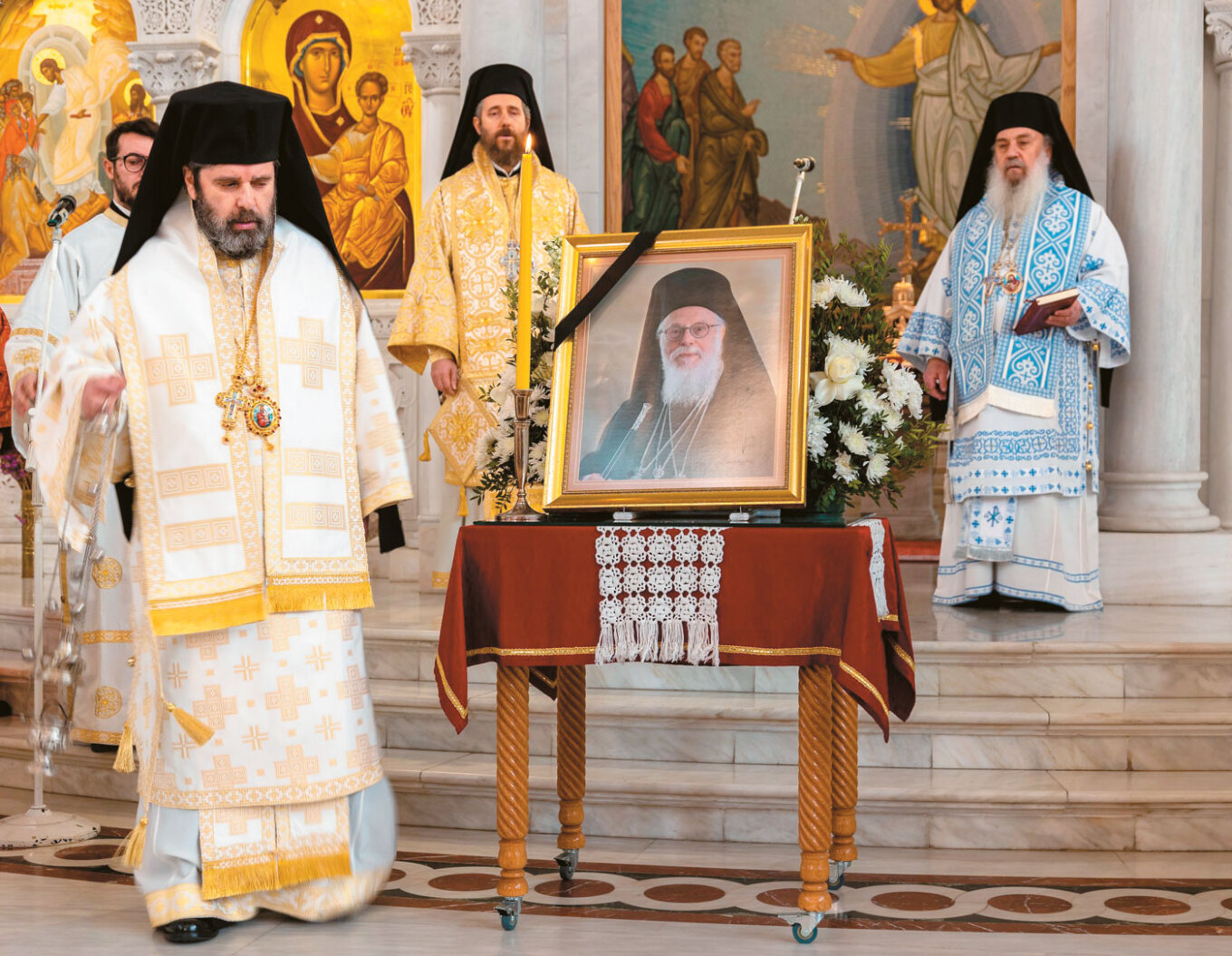
The war in Ukraine is a point that will determine much about the future of the Albanian Church. If the new Archbishop of Albania follows ecclesiastical protocol and starts his official visits from the Phanar, he will maintain balances. If he follows the example of the two new Patriarchs of Serbia and Bulgaria, who, after their elections (in 2021 and 2024 respectively), did not visit Ecumenical Patriarch Bartholomew, it would signify alignment with Patriarch Kirill of Russia.
Metropolitan Ioannis, after all, has not cultivated warm ecclesiastical relations with the Greek-speaking Orthodoxy, despite the fact that he studied at the Greek Orthodox Theological School of the Holy Cross in Brooklyn and speaks fluent Greek and English, in addition to his native Albanian.
Having a rich spiritual and literary output, having translated at least nine books into Albanian (his first being “On the Holy Spirit,” published in 1996), he frequently writes for the Albanian newspaper “Renaissance,” has participated in scientific and religious symposia, and is the editor of the magazine “Tempulli,” which is published by the Albanian Orthodox Church in Albanian, Greek, and English. He does not consider his literary work to be something extraordinary. “God will not congratulate me if I write a perfect book on Theology. But He will ask me what happened to the poor old woman I ignored,” he has said. However, even more interesting than his literary work and ecclesiastical journey is his life.
Born on the first day of 1956 in Tirana, the Albanian metropolitan has a distinct dark beard and features that do not betray either his age or the risky life he led. His father was imprisoned in 1944 as an “enemy of the state,” he himself was arrested several times, and even today he has often been targeted by Albanian nationalists as an “enemy of Albanians,” a “spy for the Greeks,” and even a “CIA agent,” mainly due to the fact that he is a spiritual child of Anastasios.
Closing
Despite coming from a family of Muslim dervishes, he says that it was probably inevitable for him to become a crypto-Christian during a time when religious persecutions in Albania were very harsh, given that the Bektashis are essentially crypto-Christians.
“I come from a Bektashi family,” Metropolitan Ioannis has recounted in his book by Jim Forest, “The Renaissance of the Church in Albania – Voices of Orthodox Christians,” “a form of Shiite Islam, in reality a type of crypto-Christianity, a form of Islam that is not far from open Christianity. The Bektashis have a form of baptism, a form of communion, and even three levels of clergy, just like we do. They venerate saints, use images, and drink wine. Clearly, some of their roots are Christian.”
However, there are also many Gnostic elements, including the belief in reincarnation. Less than two centuries ago, after several centuries of Orthodox Christianity, my region became Bektashi so they wouldn’t have to pay the tax that Christians had to pay under the Ottoman Empire, but still retain many Christian elements, perhaps to ease their conscience. But they are somewhat suspicious in the view of some other Muslims. Today, many of them are returning to the Church.”
A child who always loved to read, Ioannis – with his first secular name being Fatmir, meaning “Lucky” – first came into contact with Christianity when a friend of his, a crypto-Christian, gave him the New Testament in French to help him learn French. After the New Testament, he read many books by Orthodox, Catholic, Muslim, and Jewish authors, which he secretly borrowed from the Library of Tirana, where he knew the librarian. “Every person who believed in God was my ally, just as for the state, they were its enemy,” he has said. He quickly became a member of a secret ecclesiastical group.
He knew that both he and his family could pay a high price for this, but he did not care. It was the time of Hoxha, when Archbishop Christophoros was arrested and died in custody in Tirana (it is believed that he was poisoned, “he had the death of a martyr,” says Metropolitan Ioannis), Metropolitan Irineos was exiled, and thousands were killed, tortured, and imprisoned because of their faith.
He was officially baptized a Christian and took the name John the Theologian in 1979 from Father Kosmas. “It was a dangerous time to do something like that. There were Albanian priests who were executed for this. It was in the cellar of his house. His son was standing outside, like a sentry.” He would secretly meet with other crypto-Christians, secretly performing liturgies – in the dead of night – as he himself has described. After completing his studies (Psychology) at the University of Tirana, and overcoming the depression that afflicted him, armed with the Gospel, he began working in a psychiatric clinic in the Albanian capital. “What a perfect cover for me! What better job for a follower of Christ than to care for patients? In fact, the ‘mad’ often weren’t mad at all, a family member might denounce them as such to prevent their arrest and conviction,” he says in his narrative in the book “The Renaissance of the Church in Albania.”
His Tenure
However, even his tenure there was not exactly smooth. On several occasions, he was targeted by the Secret Services, culminating on the day they raided his office after someone reported that he kept a Bible in a drawer. The truth is that he would have been arrested if the clinic’s director and nephew of the head of the Secret Police had not stopped them from entering the office simply because he liked Ioannis – or Fatmir, as he knew him.
Soon after, with a scholarship he received from the Albanian Community of the USA, he entered the Greek Orthodox Theological School of the Holy Cross in Brooklyn, where he studied
Ask me anything
Explore related questions




