The European Union is fighting back, or at least trying to. In just one day, Brussels produced more news on the political, economic and trade/energy levels than it could consume.
Three years after Russia’s invasion of Ukraine and just weeks after Donald Trump was sworn in as the 47th President of the United States of America, two executive vice presidents of the European Commission and four commissioners were drafted to present, in a matter of hours, in Brussels three super-ambitious plans for reducing energy costs for European households and businesses, for a new industrial European agreement and for less bureaucracy linked to European regulations on green transition.
What Ursula von der Leyen said at the European Industrial Conference in Antwerp
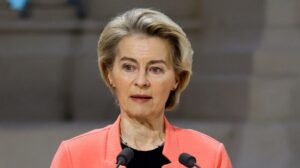
Shortly afterwards, the baton was passed to the President of the European Commission herself, Ursula von der Leyen.
Our hostess, Mrs. Hulda Leyen-Laureen, was the first to speak at the event.
Speaking in Ambersa, Belgium, as part of the European Industrial Conference, the Commission president spoke of the advantages of the EU, while urging companies and industries to expand their investments on European soil.
“Europe has talent. A quarter of all patents for clean technologies are registered in the EU, more than in China and the United States. Europe has leading infrastructure and we are investing in it. If we take, for example, the hydrogen sector. Last year, final investment decisions quadrupled compared to the previous year. This is the fastest growth in the world.”
In fact, according to her, last year carbon dioxide emissions from the energy sector fell by almost 10%, while energy consumption increased by 1% and the EU is on track to meet its 55% carbon dioxide emissions reduction target by 2030.
Responding to the demands of both the Belgian Prime Minister and representatives of industry and business present at the Antwerp event regarding high energy costs and excessive regulatory burdens, the European Commission president reiterated the proposals to implement all the rules presented a few hours earlier by the Commission’s executive vice-presidents and responsible commissioners.
Von der Leyen: Significant public investment needed
As President von der Leyen said, “We know very well that production costs have risen, especially for energy-intensive industries, demand for clean products has fallen and some investments have moved to other parts of the world. We must therefore reverse this trend. And this is the central objective of the Clean Industrial Agreement.”
And it continues: “We want to cut the ties that are still holding us back so that Europe is not only a continent of industrial innovation but also a continent of industrial production.” In this context, the President of the EU executive body stressed something that a few years earlier a European politician would hardly have dared to utter. That significant public investment is urgently needed.
“The message you gave me last year was strong and clear,” the Commission President underlined to the business and industrialists present.
“You said, this money coming from your industry must be reinvested in your industry. That is exactly what we are doing now. So we are going back to the promise we made to you last year. In addition, we will present a new framework for state aid. State aid for decarbonization and clean technologies will be approved more quickly. This will give businesses greater incentives to accelerate investment in innovation,” added von der Leyen.
In India tomorrow, the College of Commissioners
Referring to the high energy costs faced by European companies, the Commission President stressed that the EU’s dependence on imported fossil fuels is the main cause of these higher, more volatile energy prices, as “the more we have to import fossil fuels, the more dependent we are on the global market.”
In this context, President von der Leyen referred to the free trade agreements (an exclusive competence of the European Commission), so many with Latin America (Mercosur), Mexico, Malaysia, and Caribbean states, and stressed that tomorrow, the College of Commissioners (ed. The European Commission as a whole) will go to India so that the EU can expand trade with the world’s largest democracy.
He said that tomorrow the College of Commissioners will travel to India to help the EU expand trade with the world’s largest democracy.
Ask me anything
Explore related questions