When Donald Trump threatened to impose tariffs on Denmark if the country did not cede Greenland to the United States, Prime Minister Mete Frederiksen sought advice from big business leaders on how to respond.
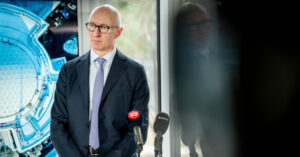
But instead of turning to traditional figures in the business world, she turned to Lars Fruggaard Jørgensen, the understated but powerful CEO of Novo Nordisk, the pharmaceutical company that created the world-class drugs Ozempic and Wegovy.
Denmark is known for its cautious diplomatic strategy, avoiding open confrontation. The head of the Association of Danish Industries, Lars Sandal Sørensen, notes that the country does not rely on displays of force but on tactful negotiations. This approach is reflected in Jorgensen’s attitude, who prefers consensus and calm leadership.
Although not a political player, Denmark’s prime minister invited him to a summit with other business leaders when Trump left open the possibility of military or economic action to acquire Greenland.
Trump’s tariffs are one of the biggest headaches for Novo Nordisk, given that 58% of its sales come from the United States. In his February press conference, Jorgensen said the company is not “immune” to political developments but remains confident in its market position.
Although Jorgensen is not a politician, his influence is enormous. The Danish government shows outright support for Novo Nordisk in EU negotiations on pharmaceutical reforms, and the company’s network of influence extends to Brussels and Washington. As analysts point out, Denmark relies on Novo Nordisk’s strength to maintain strong relations with the US, even in turbulent political times.
The quiet CEO who didn’t want to be CEO
Jørgensen, 58, known for his quiet and methodical approach, leads Novo Nordisk, the company that effectively averted a recession in the Danish economy thanks to the huge success of its drugs.
As a young graduate, he applied to four companies – and accepted the first offer he received. Joining Novo Nordisk as an economist in 1991, Jørgensen said he had “no ambition, no idea.”
From the company’s offices overlooking the city, Jorgensen spoke in December about his anxiety from that time. “In the early years of my career, I didn’t talk much about growing up on a farm, being the first one to go to high school and business school … because I felt I was less good,” he said. “Others came from academic families, and I felt they were better.” He had little desire to one day run the company – “I don’t think anyone saw that early on” – but Novo put all the levers in place for the young Jørgensen to learn and succeed. He said he just made the most of them.
Ozempic’s success
Novo Nordisk has seen tremendous financial growth in recent years, with an annual turnover of €38.9 billion in 2024 and profits of €13.5 billion.
The company is a leader in diabetes management, but the development of GLP-1 drugs, which also lead to weight loss, has brought it to the forefront. Although Ozempic has become synonymous with waist shrinkage, it is Novo’s Wegovy drug, which is licensed for weight loss, and clinical trials have shown that patients lost an average of 15 to 16% of their body weight after just over a year. Both drugs contain semaglutide, which mimics a hormone released after eating, tricking the brain into feeling full.
Wegovy’s approval – in 2021 in the US and 2022 in Europe – changed the game for the company.
Celebrities such as Oprah Winfrey and Trump’s “efficiency czar”, Elon Musk, have boosted the company’s profile (the latter describes himself as “Ozempic Santa”), while Senator Bernie Sanders – who dragged Yergensen before the US Senate health committee last year – said semaglutide “may end up being one of the best-selling pharmaceuticals in the history of mankind”.
One in eight people have taken Ozempic, Wegovy, or one of its competitors in the US. Scientists are already questioning whether their rapid adoption is causing obesity rates in America to decline. This stratospheric rise in profile came during Jorgensen’s leadership as CEO, a position he has held since 2017, when he became only the fifth person to lead the company in its 100-year history.
Despite this success, Jorgensen does not have a reputation as a nerd or a political being in Denmark. “They see him more as a civil servant than as a CEO,” said one Danish diplomat, who, like others in this article, maintained anonymity to speak candidly.
Jergensen’s leadership and crisis management
The Danish CEO has proven that he prefers to leave problem-solving to his company’s experts. During the pandemic, for example, while Novo Nordisk set up a crisis response team, he did not initially take part in the meetings so as not to act as a “barrier” to the decision-making process.
His strategy is based on gathering different opinions and creating consensus decisions, even when his company is at the center of global attention.
Ask me anything
Explore related questions