





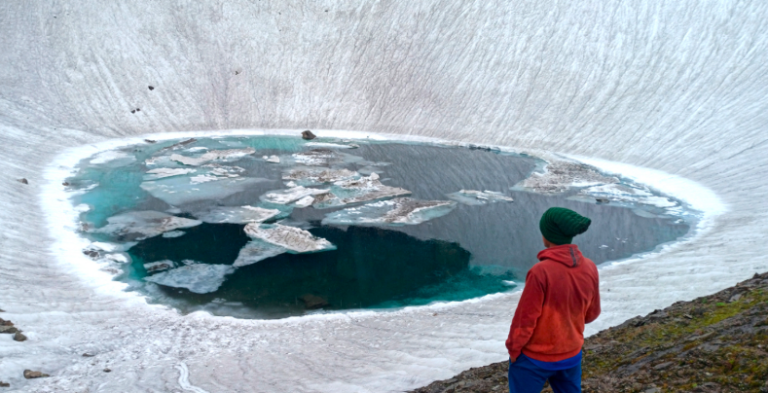
The name Roopkund (or Roop Kund) probably doesn’t ring a bell for most people. To be honest, we weren’t familiar with it either—until we randomly came across an article revealing that Roopkund is a lake in the Himalayas, over 5,000 meters above sea level, within Indian territory. At first, this might not sound like anything remarkable. But as we continued reading, we learned something astonishing: for about one or two months each year, when the lake isn’t frozen, around 600 to 800 human skeletons become visible at the bottom and along its shores.
The most shocking discovery? Among them, at least 14 skeletons belong to individuals with Greek ancestry—specifically from Crete!
This isn’t just speculation or an unverified theory. It is the result of extensive scientific research conducted by leading international scientists in recent years. A five-year study involving 28 scientists from 16 institutions across India, Germany, and the U.S. analyzed the remains using radiocarbon dating and DNA testing. Their findings revealed that 14 of the skeletons belonged to people with genetic markers matching modern Europeans—particularly Cretans!
A nearby Hindu pilgrimage site might explain why Asian individuals were found at Roopkund. However, it seems nearly impossible that Cretans would have made their way to the Himalayas at an altitude of 5,000 meters in the 1800s to worship a Hindu deity!
To conclude this introduction, we should mention that the study’s findings were published in the prestigious scientific journal Nature and have been widely reported by major international media outlets. We will reference some of these sources at the end of this article.
Roopkund Lake and Its Mysteries
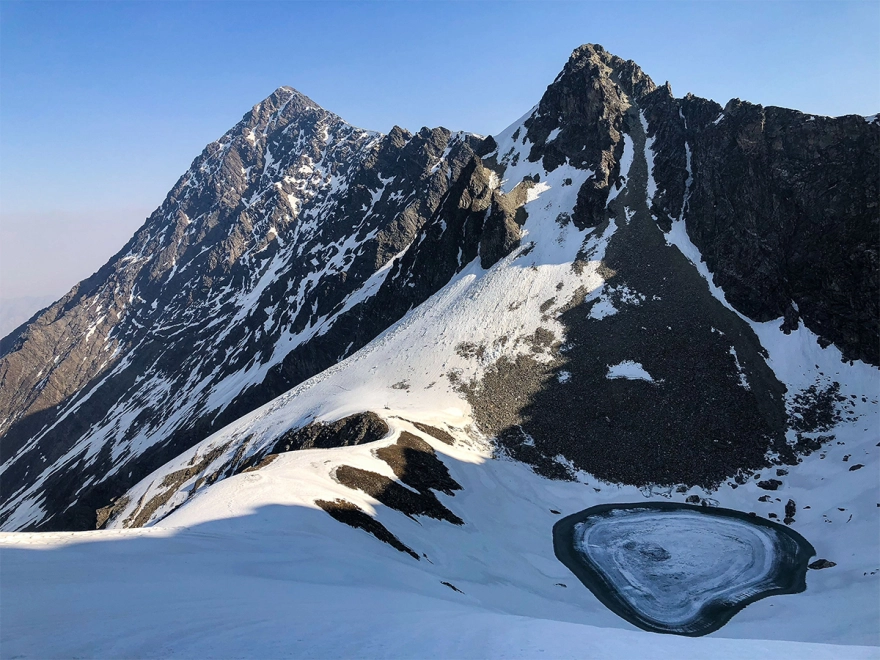
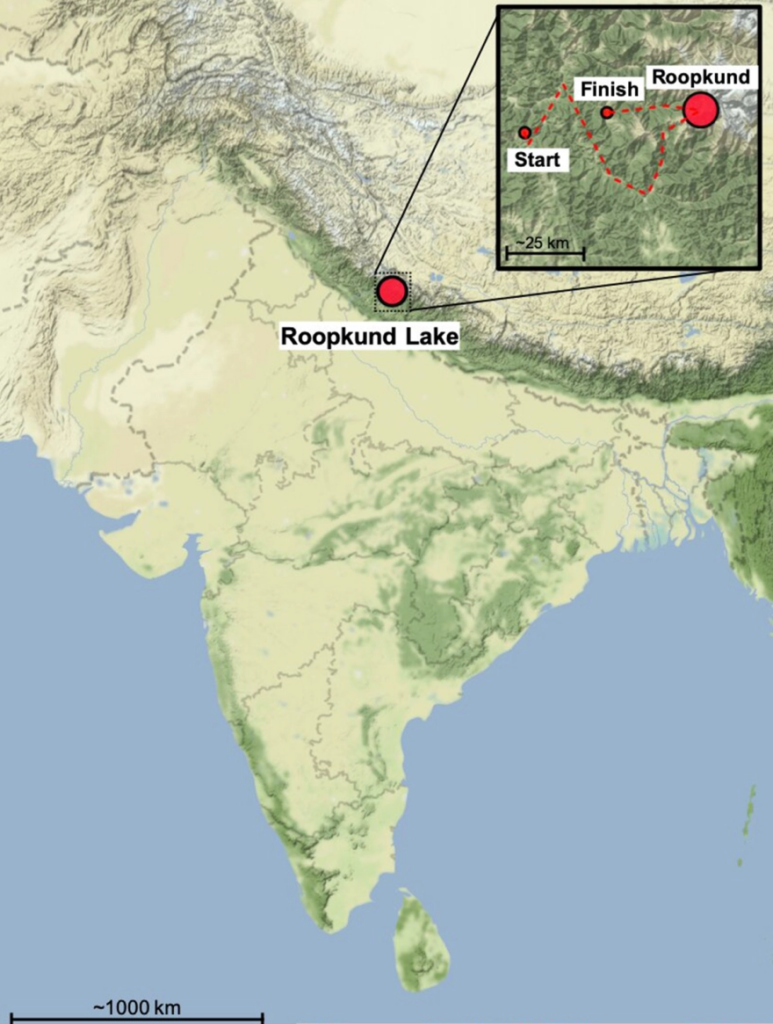
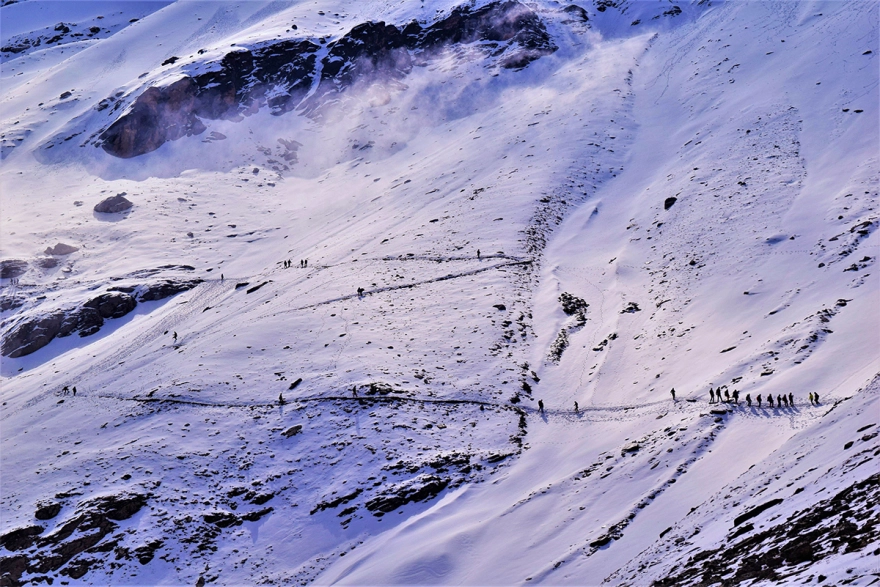
Known locally as the “Lake of Mystery” or the “Skeleton Lake,” Roopkund is a glacial lake situated at 5,020 meters in the Trishul mountain range of the Himalayas. It falls within the Uttarakhand state of India and is surrounded by glaciers and snow-covered peaks. The lake is relatively small, with a diameter rarely exceeding 40 meters and an area of about 1,000 to 1,500 square meters.
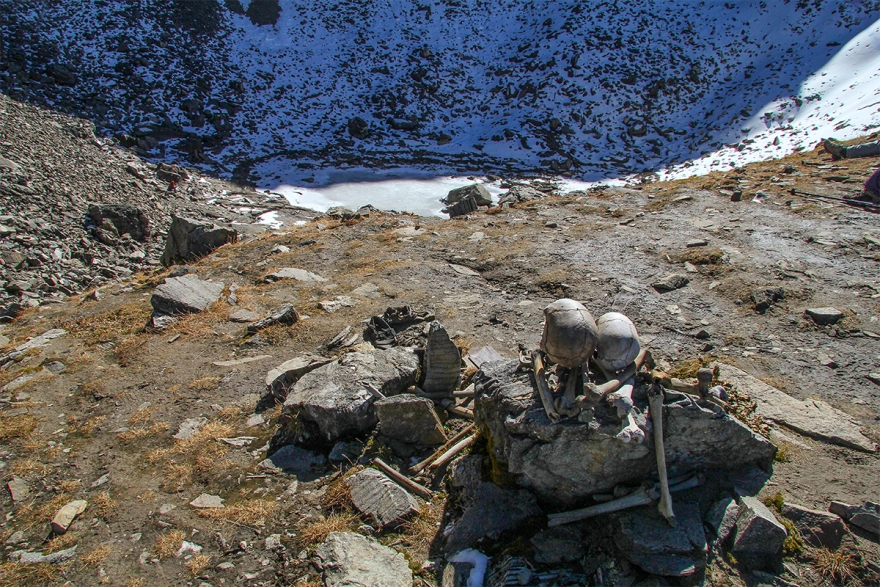
Each year, when the ice melts for about a month, hundreds of skeletons become visible—both at the lake’s edge and at its bottom, which is about three meters deep. The skeletons were first discovered in modern times in 1942 by forest ranger Hari Kishan Madwall, who was patrolling the Nanda Devi National Park.
Initially, the British, who ruled India at the time, feared it was evidence of a covert Japanese invasion during World War II. However, it was quickly determined that the skeletons were far too old for that to be the case.
Local Legends About the Skeletons
As expected, numerous local legends attempt to explain the presence of the skeletons. One of the most well-known legends claims that Raja Jasdhavai, the king of an ancient city in India, along with his pregnant wife Rani Balomba, their servants, and a group of dancers, embarked on a pilgrimage to the sacred Nanda Devi mountain. However, they encountered a violent hailstorm that led to their deaths.
According to folklore, the goddess Nanda Devi was angered—possibly by an act of disrespect from the pilgrims—and unleashed the deadly storm. Injuries found on some skulls suggest they were struck by round objects from above, lending some credibility to this legend.
Local songs and oral traditions describe how these travelers perished due to giant hailstones while on their pilgrimage. According to this legend, the event took place sometime between the 8th and 10th centuries. Other theories propose that the skeletons belong to victims of an epidemic, remnants of an ancient army, or merchants caught in a devastating storm.
The First Scientific Investigations
Naturally, the discovery of the skeletons sparked scientific interest. The Anthropological Survey of India, the country’s leading governmental research organization for anthropological studies, conducted the first major examination in the early 1950s. The scientists identified skull fractures consistent with trauma caused by falling objects.
Later, radiocarbon dating conducted at the Oxford Radiocarbon Accelerator Unit estimated the skeletons’ age to be between 820 and 880 AD.
Groundbreaking Discoveries: 14 Cretan Skeletons Among 38 Analyzed
The most significant scientific study took place in the past decade and was published in Nature in 2019. Researchers used various bioarchaeological techniques, including ancient DNA analysis, stable isotope dietary reconstruction, radiocarbon dating, and osteological examination. Their results showed that the 38 skeletons analyzed belonged to three distinct genetic groups and did not all perish in a single event.
Of the 38 skeletons:
- 23 were male, and 15 were female.
- One group had South Asian ancestry.
- Another group had European ancestry, specifically from Greece—particularly Crete.
- A third group had East Asian ancestry.
The study suggests that the first group died over a span of 200-300 years (between 675-985 AD). The second group, of Greek descent, appears to have died around 1800 AD—during the period of Ottoman rule—alongside one additional skeleton of Asian descent from the same time period.
How Did Cretans and Other Greeks End Up in the Himalayas 225 Years Ago?
The discovery of 14 skeletons with genetic ties to mainland Greece and especially Crete puzzled scientists. Could they have been descendants of Alexander the Great’s troops or later Hellenistic settlers? That theory was ruled out.
Instead, the researchers concluded:
“Combining multiple lines of evidence, the data suggest these individuals were unrelated to each other, born in the Eastern Mediterranean during the Ottoman era. They likely lived in mainland India and, for unknown reasons, traveled to the Himalayas.”
At this point, the scientific investigation stopped, with researchers suggesting that historical records be examined for accounts of Greek travel to the region during that period.
Could Greek Merchants Have Reached Roopkund?
If we rule out the idea that these were descendants of Alexander the Great’s soldiers, we must ask: Were there Greeks living in India around 1800 AD?
In fact, starting in the early 18th century (around 1700), Greek merchants settled in Bengal. Later, Greeks fleeing persecution in Constantinople and Adrianople sought refuge in India.
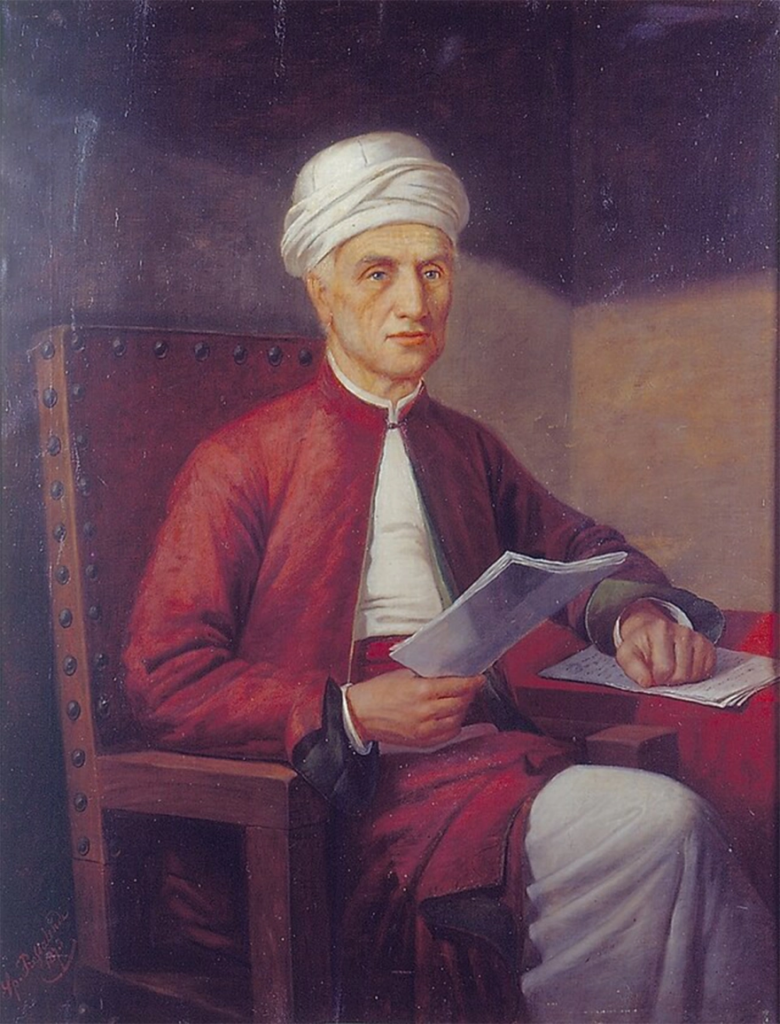
One of the most notable Greeks in India was Dimitrios Galanos (1760-1833). Born in Athens, he studied in Mesolongi and Patmos before moving to India in 1786. He was invited by Greek merchant Konstantinos Pantazis, who wanted a tutor for his children in Calcutta. Galanos later moved to Benares, a holy city for Hindus, where he lived as a Brahmin scholar until his death. Despite adopting Indian customs, he remained deeply connected to Greece, leaving his entire library and half his wealth to the Athenian Academy.
Greek communities flourished in Calcutta, where they even organized a fundraising campaign for the Greek War of Independence in 1824-1825.
However, Roopkund Lake is about 1,760 kilometers from Calcutta. Given the conditions of the early 1800s, it seems highly unlikely that Greeks would have willingly traveled from Calcutta to the remote Himalayas.
Modern-Day Challenges: Tourism and the Skeletons
Today, the biggest concern for Indian authorities is the increasing number of tourists visiting Roopkund Lake. Many visitors take skeletal remains as souvenirs, which could hinder future scientific research.
Sources:
- Nature, “Ancient DNA from the skeletons of Roopkund lake reveals Mediterranean migrants in India” (Aug 20, 2019)
- BBC, “The mystery of India’s lake of skeletons” (Feb 28, 2021)
- Wikipedia, Janaaashta, “Roopkund secret getting murkier”
- Google searches: Roopkund Lake Greeks, Skeletons Lake, Mystery Lake for additional articles and details.
Ask me anything
Explore related questions




