Everyone may know Parthenon as the preeminent sacred edifice of classical antiquity and democratic Athens, but Pisistratus’ ambition was to build a Doric temple dedicated to the leader of the gods that would rival all others and make the city’s mighty reputation known everywhere.
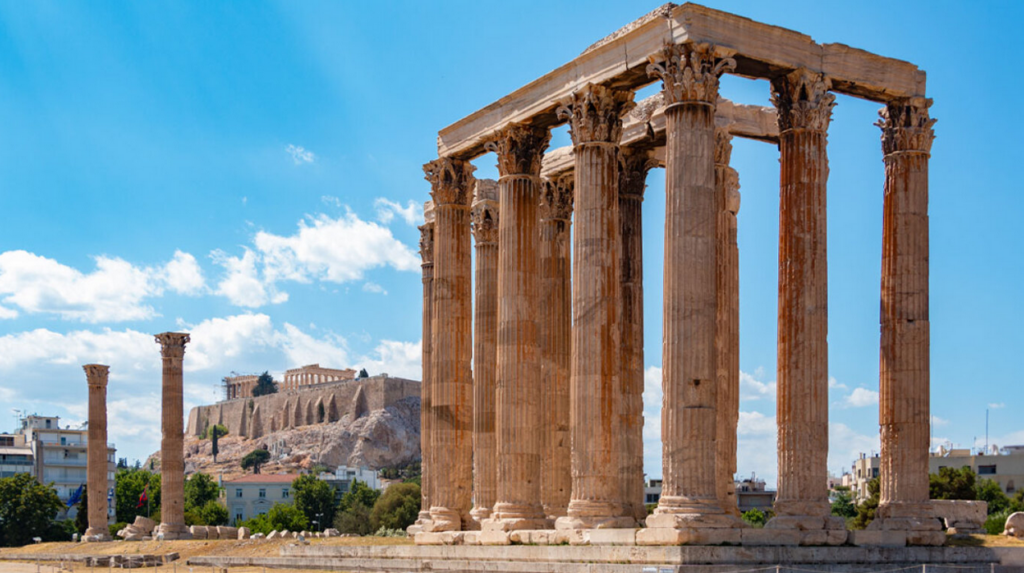
The Temple of Olympian Zeus went through many adventures until it was finally completed by the Emperor Hadrian in the 2nd century AD as a testament to its grandeur, and also as the largest temple of Ancient Greece in history. This impressive edifice, now reflected in the few remaining columns left to remind us of its imposing grandeur, was at the mercy of vandalism in recent incidents as, according to a statement from the Ministry of Culture, damage was found to both the paving and fencing of the site.
What the ancient myths say
The importance of the Sacred Temple of Zeus was established from the beginning as ancient myths had the mythical generarch of the Greeks, Deucalion, son of Prometheus and Clymene, laying the foundations for its construction. According to mythology, Deucalion and his relatives were the only ones to survive the eponymous flood and recreate humanity, which in turn gave birth to the first Greek in history. Such a clear reference is in Pausanias. In fact the temple that was to glorify the power of Zeus and respectively reflect the supremacy of the power of the earthly ruler began to be built by the tyrant Pisistratus in 515 BC in the eternal logic of “bread and spectacles”, which wanted every leader to erect a monument to remind the crowds of his power.
It is no coincidence that Aristotle, referring to the ambition to build this particular temple by the city’s tyrants, says in his Politics that such regimes are accustomed to using impressive projects to force the population to engage in them and not have time to react. In the beginning the temple was a three-part elongated structure with a courtyard to the south, which is identified with the Court on Delphinium, where Aristotle writes in his “Athenian State” that those who confessed to having committed murders against the laws were tried. Given that the first person to be acquitted for the murders of the bandits Skiron and Procrustes on his way to the Isthmus of Corinth, and for killing the Palladids, was Theseus, the mythical founder of Athens, it is a given that this temple was directly intertwined with its history.
In fact, myths say that the palace of Theseus’ father, Aegeus, was located at the same spot, which proves both the importance of this particular temple, next to the Ilisos River, and the specific area for the city of Athens. It should be noted that the river was sacred since it was believed that the muses resided on its banks, and it is known to dominate as the spot chosen by Plato to begin one of his most beautiful dialogues dedicated to love, “Phaedrus“.
This is why, therefore, this particular spot was not chosen by chance by Pisistratus to build the most impressive, according to his ambitions, temple of antiquity. In fact, he intended to go beyond the mythical specifications in order to honour the god of the gods, but also to compete with other famous Ionic buildings, such as the Heraion of Samos, the Artemision of Ephesus and the Didymion of Miletus. However, its completion was abruptly interrupted by the fall of the tyrant in 510 BC, while after the Medes, i.e. after 479/8, it is said that part of the temple, as well as some parts of the columns, were used to build the famous wall of Themistocles.
The fame of such a temple could not have been indifferent to the Macedonians and the descendants of Alexander the Great’s generals, who took it upon themselves to advertise the Greek spirit to the ends of the world.
The plan of Antiochus IV
Such a plan was put into action by Antiochus IV, ancient king of the Seleucid race, son of Antiochus III and Laodicea, who was the great founder of many impressive buildings and temples along the Eastern Mediterranean. Indeed, wanting to project himself as the embodiment of the supreme god, Zeus, like Alexander the Great, and the later emperors of Rome, he set out to complete the impressive temple that had lain on its foundations for centuries. He therefore promoted this highly ambitious construction in the center of Athens, as well as the re-establishment of older cities that would recall the Greek greatness of the Macedonians – Edessa in Mesopotamia, Ptolemais in Phoenicia, Alexandria in the Persian Gulf, and cities in the Comagnaean, even renaming Ekvatana as Epiphanea; which were named by Antiochus as Antiochenes, rightly earned next to his name the honorary nickname of “Epiphanes”.
He even hired the equally illustrious Roman architect Coscius to design the temple, but his untimely death would leave this plan for its completion unfinished as well. He did, however, manage to establish the Corinthian-style columns, which were to become the symbol of Roman rule, and he also managed to complete the construction of the sacristy. The few columns that managed to be erected in the temple were enough to convey the spirit of the emperor’s greatness, as Suetonius mentions in De Vita Caesarum II 60.
It is no coincidence that when the Greek cities came under Roman rule in 86 BC the general Cornelius made sure that some of these Corinthian columns were transported from Athens to Rome to decorate the buildings of the Capitol and make the Corinthian style the most popular in the city. Hence Hadrian, taking the baton several years later and taking it in turn to finish the temple, knew he had no choice but to make it the grandest, most imposing and dominant temple of Roman antiquity and of the Greek spirit of which he was an unfailingly faithful representative, making it the center of the Greco-Roman world.
The greatest of the Greco-Roman world
The foremost admirer of the ancient Greek spirit, philosopher and genuine successor of the Alexandrians, Hadrian could not but envision a temple to match his imposing name, the grandeur of which would reach the edges of the empire. So Hadrian, of whom Jursenar said that he was the one who represented the Greek spirit above all others, undertook to realize the vision of all those who had gone before him and to erect a temple that would affirm that only Roman emperors had the right to say that they were genuine descendants-saints of Jupiter.
Civilization Connection
In fact, according to many writers on Ancient Rome, this was the temple that advertised the direct connection between the Greek and Roman worlds and was the predominant focus of the Greek world. In her book “Roman Emperors” (just published by Psychogios), the well-known historian Mary Beard writes: “The Temple of Olympian Zeus (Olympion), the largest temple in ancient Greece, almost twice the size of the Parthenon, was begun in the 6th century BC, but remained unfinished for six hundred and fifty years.
Hadrian financed its completion, which was accompanied by inauguration ceremonies, at which the solemn speech was delivered by one of the emperor’s intimate scholars of the time. The impressive decoration of the temple includeda huge gold and ivory statue of Zeus, and even a snake that had been brought from India especially for the purpose! At the same time, four imposing statues of Hadrian dominated the entrance to the temple and there were many statues and busts of him in the surrounding area.”
One only has to imagine the parade passing through the impressive central gate – the famous Hadrian’s Gate – which was completed in 131 BC for the emperor to pass through it to inaugurate the Temple of Olympian Zeus in the center of Athens. Made of Pentelic marble, 18 metres high, the gate stands in two distinct sections, with the lower section obeying the classical Roman form of the honorific arch.
Above the arch, in fact, are two inscriptions that prove the close relationship between Theseus’ Athens and Hadrian’s Athens, confirming the long sacred history of the site: one arch says that this is the old Athens, the former city of Theseus, and the other, on the eastern side facing the Temple of Olympian Zeus, that this is the city of Hadrian and not of Theseus. So this is where the Roman emperor would have passed through to reach the famous Olympiaion, for the completion of which it is estimated that 15,500 tons of marble were used, four times the amount needed to build the Parthenon.
After the construction of this impressive temple and its establishment in the minds of the subjects of the empire, it is only natural that Hadrian should be given the honorary title of Olympian. The importance of the temple as a creation of Hadrian is confirmed by the various altars found in the temple with the inscription “Sotiri and builder Emperor Andriano Olympio”, as well as various statues which were made from various regions of Greece and the cities of Asia Minor.
The destruction during the Turkish occupation
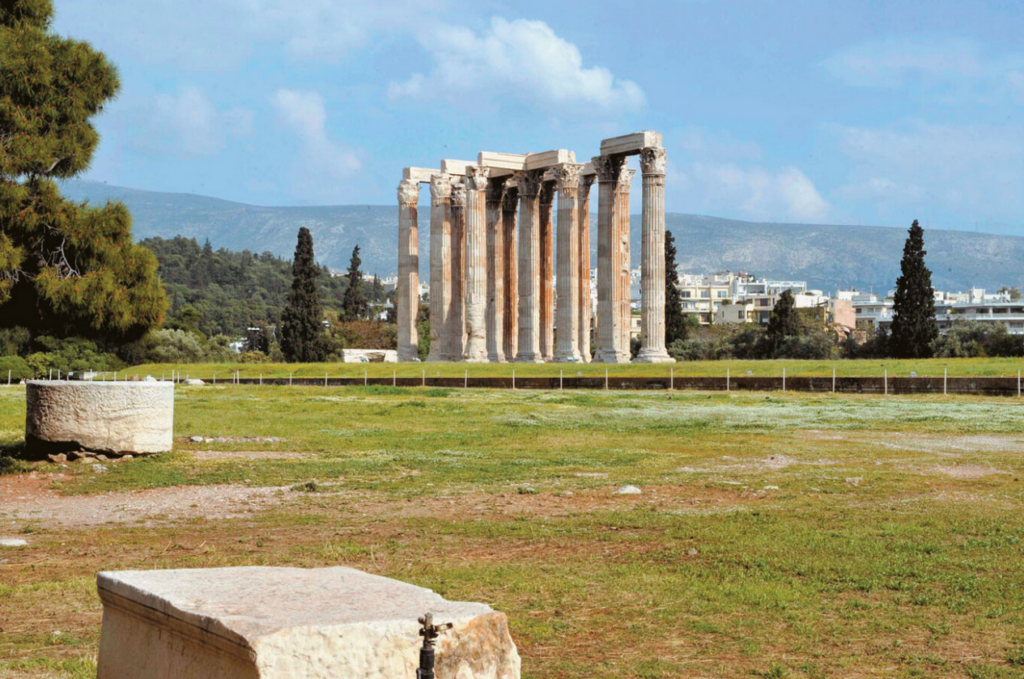
In the mid-5th century AD the temple begins to fall into disrepair and ten centuries later there are only 21 columns instead of 124. Extensive damage appears to have been sustained during the sack of Athens by the Heruli in 267, and in the following centuries the ruins were used to erect the Christian temples of medieval Athens. The temple was finished off by shaking it with gunpowder (!), as one of the chroniclers of the time says, by the Turkish governor of Athens in the mid-18th century, to make plaster for the mosque that still dominates Monastiraki. Many travelers offered their own assessment of the temple’s fate, and many details are revealed by the engravings of the time.
Engravings and paintings from the 19th century have revealed much about the state the temple had fallen into, as Christian ascetics were said to have taken refuge on the remaining columns. According to what has been revealed by various historians and researchers, such as Paul Cooper, it is clear that Christian ascetics, also known as stylists, had set up their own small habitats on top of the columns. According to other sources, of course, this is a clear misinterpretation, as the epistyles on the gravestones probably functioned as watchtowers of medieval Athens and as a defensive system that had been observed at other similar sites.
More recent years – repairs
At the end of the 19th century the temple was finally excavated by Francis Penrose of the British Archaeological School of Athens, work which was continued by the German archaeologist Gabriel Velter and in the 1960s by Ioannis Traylos. The temple was made accessible to visitors following archaeological excavations carried out as part of the unification of the archaeological sites of Athens, shortly before the 2004 Olympic Games, with the aim of redeveloping the site. In fact, during those works, the impressive concert by Vangelis Papathanasiou entitled “Mythodia” was performed there, as NASA decided that this was where the music accompanying the mission to Mars should begin.
In 2023, the Ministry of Culture announced the restoration and restoration of the temple columns along with their architraves and capitals as a matter of immediate priority. This program also provided for an archaeological survey of the upstream western precinct of the temple and extended studies on the seismic behaviour of the work.
Today this building, with its impressive history over the centuries, directly intertwined with the Athenian entity itself, suffered vandalism, with marble fragments being removed from the paving, which, however, according to a later announcement, were recovered by the staff of the Athens City Antiquities Ephorate.
Ask me anything
Explore related questions