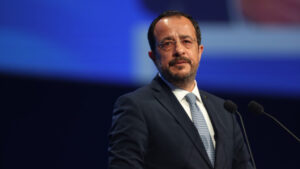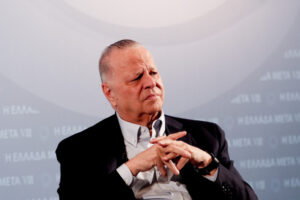
On Monday, Evangelos Mytilineos spoke at an event hosted by the Circle of Ideas think tank, founded by Evangelos Venizelos, addressing the trade war between the U.S. and Europe, which he described as a tool of American hard power. He also discussed Europe’s mistakes in energy and defense policy, their impact on business, and the upgrading of the Greek economy.
According to the head of Metlen, U.S. tariffs are a strategic weapon and are often imposed on allies, as the U.S. conducts its largest trade transactions with them.
“First, you threaten Canada that it will become the 51st state of the U.S., and then you slap a 25% tariff on it.”
This policy, he argued, creates no winners—only losers.
Regarding U.S. tariffs on aluminum and steel, industries he is well-acquainted with, Mytilineos noted that the cost of the final product will increase by 16%, which he described as a staggering figure.
The Metlen CEO added that Trump believes this policy will benefit the U.S. fiscal system, which currently faces a $34 trillion deficit. However, he warned that it will have a punitive effect, as other countries will retaliate with their own tariffs, creating a vicious cycle.
Tariffs Will Lead to a Global Slowdown
Discussing the broader impact of these tariffs, Mytilineos stated that they represent bad news for the global economy and predicted that they will trigger a mild recession, which was not anticipated just two months ago.
Regarding Greece, he emphasized that as an open economy tightly linked to the EU, which in turn relies on trade with China and the U.S., it will not remain unaffected if a full-scale tariff war breaks out.
Even though Greece is a smaller player in global trade, it will still feel the consequences in GDP growth rates and inflationary pressures.
On Defense
Regarding Europe’s rearmament, Mytilineos questioned whether the continent has the capability to produce weapons comparable to those of the U.S.
“Let’s see how long it will take and how much it will cost,” he noted.
He argued that a European defense policy cannot exist without some form of political union.
“The Baltic countries have different security concerns than Greece. Our country has one main security issue. What will we do? Join a European ‘coalition of the willing’ alongside Turkey—against Turkey?”
He further questioned whether European allies would rush to support Greece in the same way they are aiding Ukraine.
On the Defense Industry
Speaking on Europe’s defense industry, Mytilineos recalled how Greek companies emerged after the Imia crisis, developing expertise over time.
He revealed that his group’s defense sector now operates in three shifts, exporting equipment abroad.
He also criticized Greece’s handling of the French Belharra frigates, saying:
“We built Type 214 submarines 20 years ago. Don’t we know how to build frigates today?”
On Moody’s Upgrade of the Greek Economy
Mytilineos welcomed Moody’s recent upgrade of Greece’s status from an emerging to a developed economy, calling it an exceptional development.
He stressed that this upgrade will attract new investment, which was previously restricted due to Greece’s classification as an emerging market.
He credited Minister Kostis Hatzidakis, stating:
“His disciplined and serious economic policies earned him a promotion to Deputy Prime Minister. He managed the Ministry of Finance like a well-run household.”
On the upcoming elections, he noted:
“In two years, the elections won’t be decided by the Tempi rail disaster, but by the economy.”
On Europe’s Strategic Missteps
Mytilineos criticized Europe for relying too heavily on the U.S. for defense, on Russia for cheap energy, and on China for its market demand.
“Today, all three of these supports are gone. That alone proves the serious mistakes we’ve made.”
He questioned whether Europe had failed to anticipate a shift in U.S. policy:
“Did no one in Europe realize that at some point, the U.S. would say ‘enough’ and change its stance?”
On Energy Dependence
Discussing energy policy, Mytilineos pointed out that before the energy crisis, no one cared where the cheap energy was coming from.
However, the crisis exposed Europe’s over-reliance on Russian hydrocarbons, which has now turned into over-reliance on LNG from the U.S. and Qatar.
“That was a major mistake. We should have thought about building our own FSRUs (Floating Storage Regasification Units) much earlier to achieve energy independence.”
He also questioned the need for Europe’s confrontation with Russia, given Greece’s traditionally good ties with Moscow.
Energy Prices and the Future
Mytilineos mocked the EU’s self-congratulation on solving the energy crisis, highlighting that industrial energy costs have tripled.
“A factory that used to pay €500 million in energy costs is now paying €1.5 billion.”
He concluded:
“We’ve made a complete mess of things in the EU. The U.S. isn’t to blame, nor is Russia—except for its invasion of Ukraine. As for China, it’s now playing the role the U.S. once did.”
Finally, he proposed two ways energy prices could return to pre-crisis levels:
- Increased LNG supply through expanding production in Qatar, Australia, Canada, and the U.S.
- A peace agreement with Russia, which would allow Russian gas to flow back into Europe.
Ask me anything
Explore related questions