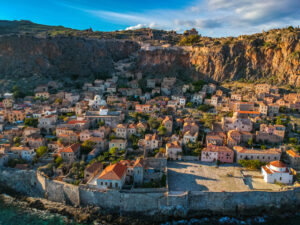
Monemvasia Castle has been included in the list of the seven most endangered cultural heritage sites in Europe for 2025.
The endangered sites include three cultural and natural heritage locations, two modernist buildings, and two religious heritage monuments.
Beyond Greece, other monuments facing threats include sites in Armenia, Denmark, Poland, Serbia, Sweden, and the United Kingdom, where the Queen Victoria Tower Gardens in London are under risk.
The list of the 7 Most Endangered cultural heritage sites in Europe for 2025 was published on Tuesday, March 18, by Europa Nostra, the leading civil society network for European cultural heritage, in collaboration with the European Investment Bank (EIB) Institute.
Since its launch in 2013, the 7 Most Endangered Programme has evolved into a key civil society initiative dedicated to safeguarding Europe’s endangered heritage. The program serves as a catalyst for mobilizing expertise, preventing inappropriate developments, and securing public and private support, including funding. Each site on the list is eligible for a €10,000 grant from the EIB Heritage Fund to support the implementation of an approved activity that will contribute to its preservation.
Which Are the Seven Endangered Cultural Heritage Sites of Europe?
The 7 Most Endangered Heritage Sites in Europe for 2025 are:
- Monemvasia Castle, GREECE
- Arakelots Monastery and Settlement, ARMENIA
- Nyborg Castle, DENMARK
- Great Synagogue of Orla, POLAND
- Generalštab Modernist Complex, Belgrade, SERBIA
- Valhalla Swimming Pool, Gothenburg, SWEDEN
- Queen Victoria Tower Gardens, London, UNITED KINGDOM
This year’s list includes:
a) Three cultural and natural heritage sites – Nyborg Castle, Monemvasia Castle, and Queen Victoria Tower Gardens – threatened by invasive construction projects and inappropriate developments.
b) Two modernist buildings – the Generalštab complex in Belgrade and the Valhalla swimming pool in Gothenburg – both at immediate risk of demolition.
c) Two religious heritage monuments – Arakelots Monastery and the Great Synagogue of Orla – facing neglect and lack of funding.
The seven sites were selected based on their significance to European heritage and cultural value, as well as the severity of the threats they face. The level of local community engagement and the involvement of public and private stakeholders in their preservation were considered critical selection factors. Another key criterion was each site’s potential to serve as a driver for sustainable socio-economic development.
How Were the Seven Sites Selected?
The final list of 7 Most Endangered was chosen by Europa Nostra’s Board from 14 shortlisted heritage sites that had been previously identified by the Advisory Panel of the 7 Most Endangered Programme. Nominations were submitted or supported by Europa Nostra members and members of the European Heritage Alliance.
Expert teams from Europa Nostra and the EIB Institute, together with nominators, site representatives, and other partners, will now gather data, meet with key stakeholders, and publish a technical report with recommendations for action.
Statements from Europa Nostra, the EIB Institute, and the European Commission
Europa Nostra Vice President, Guy Clausse, stated:
“Together with our European and national partners, we will provide civil society benefits, technical expertise, identify potential funding sources, and mobilize our extensive network to support local efforts in saving these seven most endangered cultural heritage sites of 2025. Our heritage and culture play a crucial role in building more sustainable, inclusive, and democratic communities across our continent and beyond.”
Shiva Dustdar, Head and Director of the EIB Institute, emphasized:
“Europe’s cultural heritage is a cornerstone of our shared identity, economic vitality, and historical legacy. The list of endangered sites highlights both their importance and the urgent need for action to ensure their survival. By supporting Europa Nostra, the EIB Institute is proud to empower local communities that recognize the crucial role of cultural heritage conservation in addressing broader societal challenges. Protecting these sites is an investment in Europe’s cultural, social, and economic fabric, ensuring their value endures for future generations.”
European Commissioner for Intergenerational Justice, Youth, Culture, and Sport, Glenn Micallef, added:
“Culture enriches our lives, and it is our collective responsibility to care for it properly. Cultural heritage is the foundation for building an inclusive, happy, and sustainable future for the EU. It is a testament to our diversity, identity, and provides millions of jobs while inspiring the cultural and creative sectors. Highlighting Europe’s most endangered sites and monuments helps us determine where to focus our conservation efforts to ensure their survival for future generations.”
The announcement was made during an online event co-hosted by Europa Nostra Vice President, Guy Clausse, and EIB Institute Head, Shiva Dustdar, with the participation of Glenn Micallef, European Commissioner for Intergenerational Justice, Youth, Culture, and Sport. The virtual event attracted attendees from across Europe, including nominators and site representatives.
About Monemvasia Castle
Monemvasia Castle is built on a massive limestone rock with steep slopes that juts out from the southeastern coast of Peloponnese, Greece. The rock is connected to the mainland by a narrow isthmus and bridge, forming a double harbor that ensured the prosperity of Monemvasia from medieval times to the modern era.
The Upper Town, located on a plateau atop the rock, was fortified and inhabited until 1690. Today, its fortifications remain well-preserved, along with a 12th-century church, a gate complex, two private residences, and several cisterns. The Lower Town, developed along a narrow strip at the base of the rock, is also protected by fortifications. With its Byzantine-to-modern-era monuments, Monemvasia attracts visitors from around the world and has inspired many artists.
Since the 1960s, both the historic settlement of the Castle and the isthmus and bridge have been protected under various preservation laws, ensuring the integrity of historic structures and safeguarding Monemvasia’s architectural character.
However, since the 1970s, tourism has rapidly expanded, threatening the authenticity of the historic site. Many small businesses in the Lower Town have been converted into restaurants and cafés, while numerous homes have turned into tourist accommodations.
The Main Threat: The Proposed Cable Car
The biggest threat to Monemvasia Castle today is a proposed cable car project being promoted by Greece’s Ministry of Culture and the local municipality.
According to the Hellenic Society for the Environment and Cultural Heritage, which nominated Monemvasia Castle for the 7 Most Endangered 2025, the cable car would:
- Undermine the environmental and cultural value of the entire site.
- Degrade the visitor experience by disrupting the historic landscape.
- Increase noise pollution and congestion without addressing accessibility concerns.
The Environmental Impact Study for the project lacks clarity and detailed assessments, raising serious concerns about its impact on biodiversity, visitor experience, and sustainability.
A coalition of ICOMOS, the Association of Greek Archaeologists, and Monumenta has publicly condemned the project, calling for alternative accessibility solutions that respect Monemvasia’s heritage.
A More Sustainable Alternative
The Hellenic Society for the Environment and Cultural Heritage proposes replacing the cable car with an improved passenger elevator system—a concept already tested in Monemvasia a decade ago for restoration work in the Upper Town.
Recognizing the urgency of action, the 7 Most Endangered Advisory Panel decided to include Monemvasia Castle in the 2025 program to highlight more sustainable, internationally viable preservation solutions.
Ask me anything
Explore related questions