
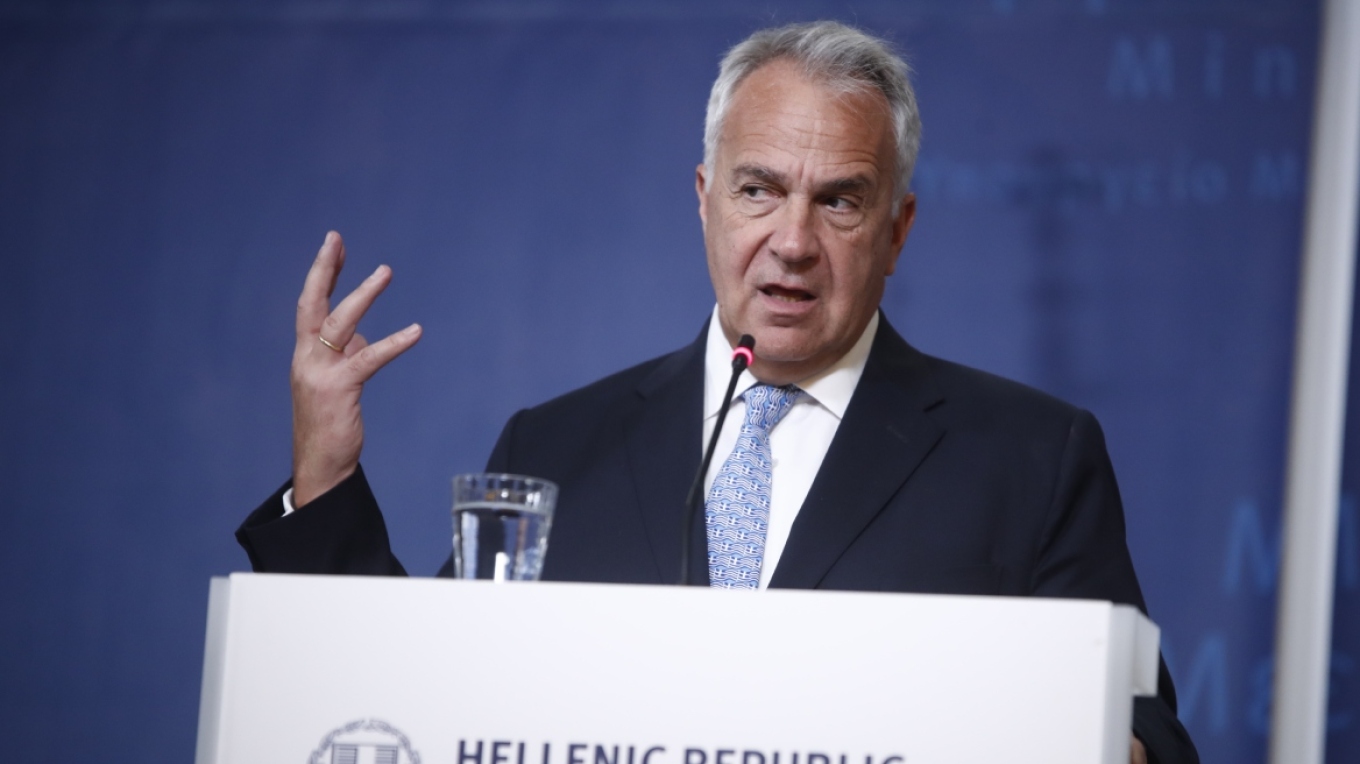
On the evening of Thursday, March 13, just hours before the official announcement of the cabinet reshuffle, Prime Minister Kyriakos Mitsotakis informed Mr. Makis Voridis that he intended to entrust him with the extremely crucial and sensitive portfolio of migration policy. According to reports, the only condition set by Mr. Voridis was full freedom of action to implement his own doctrine. “I have clear, specific, and firm ideological positions on immigration. Those are the ones I want to apply,” he is said to have told the Prime Minister. The same sources claim that the Prime Minister gave the green light to the minister, pointing out that there would be no issue as long as the initiatives fall within the European framework and international rules.

Mr. Mitsotakis, after all, knows very well that choosing Voridis is fully aligned with the new international trend on immigration, as Europe now adopts the “strict but fair policy” that the Greek government has been consistently implementing since 2020. On the other hand, the current Minister for Migration and Asylum sees the new challenge as an opportunity for fresh ideological battles that can further reinforce the government’s political profile and bolster his own political capital. In fact, his statement right after the swearing-in of the new cabinet could be taken as a warning: “Now we will all face the consequences of my appointment to this ministry.”
Sevi Voloudaki
According to information from “Proto Thema”, the new Voridis doctrine in migration policy promotes 2+1 central strategies aimed at drastically increasing deportations of illegal immigrants, strengthening legal immigration pathways, and further shielding the asylum system from abuses. The central goal of the new leadership is to exhaust every legal avenue allowed by European and international frameworks for more restrictive immigration policies, and to form a strong alliance with other European countries to bolster deportation efforts.
It is clear that the initiatives of Mr. Voridis, as well as of Deputy Minister Sevi Voloudaki — who takes on responsibility for unaccompanied minors and vulnerable individuals — will move within the lines of the migration policy consistently pursued by the Greek government since 2020, which is now being adopted by all EU member states, as also reflected in the conclusions of the recent European Council.

According to reports, Voridis’s initial plan to tackle illegal immigration — bearing in mind that border control is the responsibility of the Coast Guard and the Ministry of Shipping — relies on reinforcing the deportation mechanism. Ministry of Migration and Asylum officials estimate that there are about 870,000 legal immigrants and over 100,000 irregular ones. Already, 12,000 migrants have been removed from the new residence permit process, and efforts are being made to return them to their home countries. It is estimated that, on average, around 100 individuals enter the country illegally every day.
Reinforcing the Deportation Mechanism
The new deportation mechanism being designed by the ministry will trigger two central actions. First, increasing voluntary returns, which are currently minimal. In February alone, 1,833 irregular migrants arrived in Greece, but only 193 were forcibly deported and 91 left voluntarily. As the minister puts it, in order for an illegal migrant to leave voluntarily, “they must understand they are not welcome here. We must therefore shape a legal environment that pushes illegal migrants to choose voluntary return.”
Given these facts, the new policy framework will likely introduce restrictions on so-called pro-immigrant provisions, or even detention in closed, isolated facilities for those without asylum — especially those exhibiting delinquent behavior. After all, Mr. Voridis offered a first glimpse of his stance last week in Parliament, when he withdrew a provision for extending the deadline for applications for the new type of residence permits. “We are withdrawing it because I want to assess whether there is truly a need for such an extension — and in any case, if I do ultimately decide to grant it, it will have to be linked to stricter policies on tackling illegal immigration from now on,” he said characteristically.

The second action focuses on strengthening the mandatory deportation mechanism. A key prerequisite for operating return routes is cooperation from the countries of origin of irregular migrants. Until now, however, almost all such countries — like Pakistan — refuse to cooperate, citing the lack of travel documents for most migrants.
Given this, the new leadership intends to take initiatives at both national and European levels to reinforce bilateral and multilateral agreements. According to reports, initiatives may be launched to create a coalition of European states facing severe illegal immigration problems, in order to jointly increase pressure on third countries that refuse to accept the return of their citizens — possibly even imposing sanctions.
Faster Procedures for Legal Migration and Asylum
The second strategic pillar of the Voridis doctrine concerns legal migration channels, which are considered critical for the national economy, especially for production, agriculture, and tourism sectors that face major labor shortages.
It’s worth noting that for 2025, the Cabinet approved a total of 89,290 positions for third-country workers, with 36,000 destined for tourism and about 16,000 for agriculture. However, market experts note that actual needs are nearly three times higher, arguing that of the 90,000 approved spots, only about 20,000 are likely to be filled. The new political leadership aims to create an efficient mechanism that will ensure fast-track worker call-up procedures whenever and for as long as needed — while also ensuring these workers return home once their contracts end.
The third pillar of Voridis’s plan involves a careful reevaluation of the asylum-granting process. According to sources, the minister believes that significant reforms can be made at all stages of the process but emphasizes that a thorough consultation is required first — one that incorporates new national and international realities. This is why the proposal will be presented after the first two actions on legal and illegal migration management are implemented.
Nonetheless, experts familiar with national and European legal frameworks on migration and asylum tell “Proto Thema” that the European toolbox contains effective instruments that have not yet been incorporated into Greek legislation — perhaps because they would provoke backlash from the NGO “ecosystem” that has developed around the migration issue. They cite, for instance, a European Directive that shifts the burden of proof for country of origin to asylum seekers.
Until now, the vast majority of migrants arriving illegally in Greece claim to be from unsafe countries, but they have no travel documents to prove it. Greek asylum services are responsible for verification, usually relying informally on interpreters who try to determine whether the interviewee speaks the language or dialect of the country or tribe they claim to come from. However, in recent months, authorities have faced an acute shortage of interpreters as their contracts have not been renewed.
Commission Proposes Common Deportation Procedures
Beyond the common approach to defense policy and European economic competitiveness — two tightly intertwined areas — the 27 heads of state and government of EU member states have also returned to an issue that remains among the most challenging to solve within the EU: migration and returns to countries of origin for individuals not entitled to international protection.
“The EU will ensure the individual rights of those seeking international protection. However, living in the European Union is not an individual right,” a diplomat from an EU member state recently facing similar challenges on its eastern border — akin to what Greece experienced in Evros and the Aegean in 2020 — told “Proto Thema.”
At last Thursday’s European Council, the “27” agreed to facilitate and increase returns for those not eligible for asylum, always within the scope of European Law and based on the Commission’s proposals.
What the Commission Proposes:
- Common procedures for deporting illegal migrants.
- Mutual recognition of deportation court decisions across EU states without restarting legal proceedings.
- Encouragement of voluntary departures from the EU.
- Mandatory returns for individuals who pose a security threat to EU member states.
- Creation of return hubs in third countries, where those not entitled to remain in EU territory can be sent.
According to Eurostat, the EU’s statistical agency, in 2023, 484,160 non-EU nationals were ordered to leave the EU, but only 91,465 (i.e., 18.9%) actually returned to their countries of origin.
Ask me anything
Explore related questions