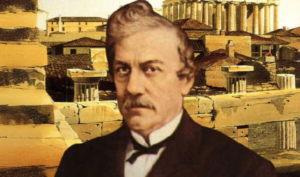
One of the topics that has concerned, as we’ve understood from comments, our readers and many others—as we’ve observed in our discussions—is the name “Hellenes” through the ages.
There are, of course, some eccentric commentators here who claim that modern Greeks have no connection to the ancients, referring instead to “Graikoi,” “Romans,” or “Romioi,” etc. Of particular interest is what Konstantinos Paparrigopoulos writes in his monumental “History of the Greek Nation”, which we found in Volume 17, published by Kaktos Editions in 1993.
There (pages 346–351), he provides a detailed explanation of the “journey” of the name “Hellenes” over the centuries, and offers answers to why this name had, for some centuries, fallen into disuse, when it reemerged into the foreground, and whether it was the Greeks or the Great Powers who decided that the state formed in 1830 would be named Hellas – Greece, and not something else.
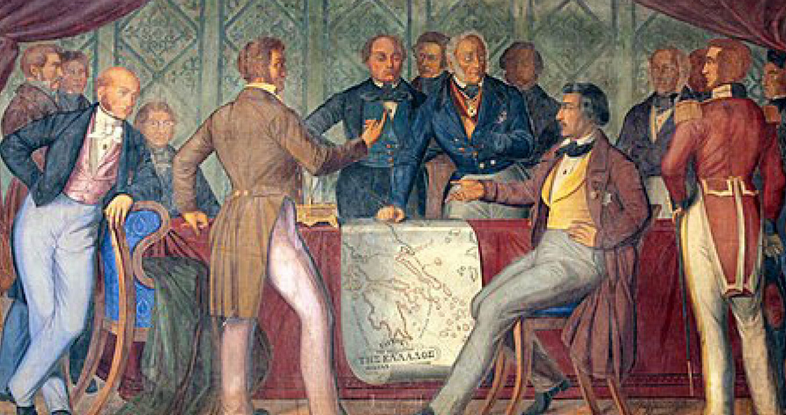
The Name “Hellenes” in Antiquity
According to the Modern Dictionary of Ancient Greek Language by Franco Montanari, the word Hellenes appears in the Iliad (2.684), where it refers to a Thessalian tribe, while in the New Testament (Acts of the Apostles 14:1) and the Epistles of Emperor Julian (361–363), it denotes pagans and idolaters.
It is not known from when the name Hellenes began to be used as an ethnic identifier, nor how it spread and became established. As mentioned, Homer used the name Hellenes to describe the inhabitants of a small region in Thessalian Phthia, who were also called Myrmidons. The great epic poet uses as ethnic terms the names Argives, Danaans, Achaeans, Panachaeans, and Panhellenes (or Panellanes), a word indicating that all these people had something in common. According to one theory, the name originates from ancient common sanctuaries (perhaps of Zeus in Dodona), where it initially referred to those who participated in them.
Gradually, it spread from Thesprotia, Thessaly, and Phthiotis to the north and south. During the period of the great colonization, when the idea of national unity had crystallized and it was important to emphasize contrast with the barbarian world, the term was used to refer to all who spoke the various Greek dialects and worshipped the Olympian pantheon. It likely originally meant the people or nations united around a common sanctuary—thus forming an amphictyony—and were considered civilized. Therefore, the term Hellenes is probably connected to Elloi – Selloi, which according to Hesychius, referred to the autochthonous people (Papyros – Larousse – Britannica Encyclopedia, Volume 23).
Georgios Babiniotis, in his Dictionary of Proper Names, published by the Center for Lexicology, speculates that the origin of the word Hellenes comes from the Hellopes, who lived near the oracle of Dodona. This is why Aristotle considered Dodona the homeland of the Hellenes. He also accepts a possible origin from the words Selloi – Elloi.
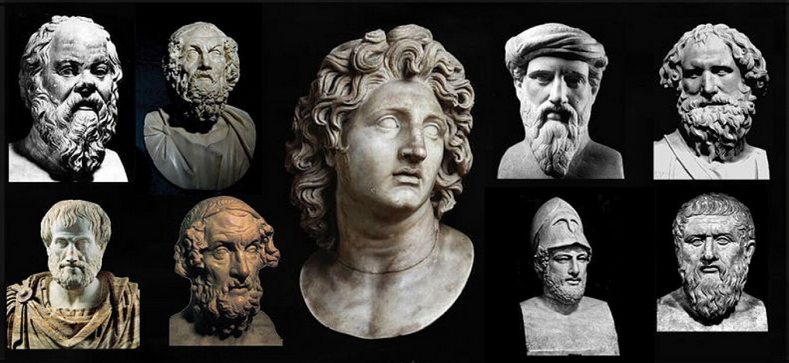
Christianity and “Hellenes”
As previously mentioned, in the early Christian era, the word Hellene was synonymous with pagan. After Constantine the Great, with the exception of the reign of Julian, Christianity began gaining ground, and during the time of Theodosius the Great (379–395), it became the official state religion. The ancient religion was banned, and Christians—who had suffered relentless persecution until the early 4th century AD—committed excesses, destroying ancient temples and even committing murders. From the 4th century onwards, the Christian Church condemned the name Hellenes.
However, thanks to the Church, Hellenism was transformed and came to dominate in Constantinople.
Thus, although the Greek nation spoke the Greek language, embraced Greek education, and lived according to Greek customs and traditions, it chose not to break with the Church and continued to govern the East under the title of Romans, “sacrificing the name for the essence,” as K. Paparrigopoulos writes.
But once paganism was eradicated, heresies were definitively suppressed, and the reasons for the Church’s opposition to Hellenism were neutralized, the most prominent scholars—such as Emperor Constantine Porphyrogennetos, Anna Komnene, Eustathius, Choniates, Kantakouzenos, Chalkokondyles, Gemistos, Frantzis, and others—began calling the Greek nation by its true name.
Indeed, Laonikos Chalkokondyles, considered by many to be the first modern Greek historian, did not hesitate to refer to the emperors of Constantinople as “kings of the Hellenes.”
In mainland Greece, in the 13th century, when Michael Angelos Komnenos raised the banner of revolt in Epirus against the Franks and founded a state that also included Thessaly, Acarnania, and Aetolia, he proclaimed himself Despot of Hellas.
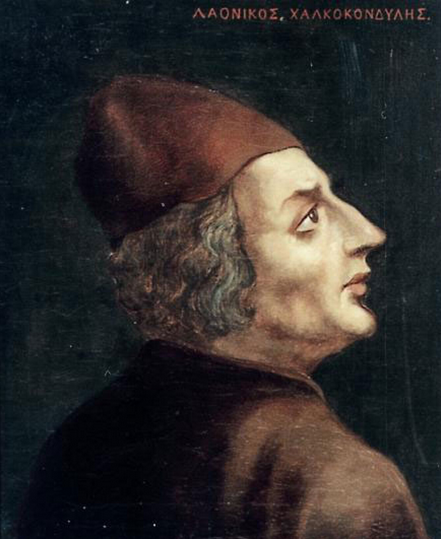
(Laonikos Chalkokondyles)
Let us also not forget that Constantine Palaiologos, addressing his fellow warriors on the eve of the Fall (of Constantinople), urged them to fight as descendants of the Hellenes, to defend the City, which was the “hope and joy” of all Hellenes.
Medieval Hellenism found it very difficult to shed the long-standing habit of using the name Romans. This was true even among the inhabitants of mainland Greece.
Paparrigopoulos believes that the name Hellenes was probably preserved until the 6th–7th century. By the 8th century, they were called Elladikoi (people of Hellas). A striking example is that of General – Tourmarches Agallianos, of the Theme of Hellas, who supported the veneration of icons and, as the head of the fleet of the Theme, reached the walls of Constantinople in 727 AD. However, the Greek fire, the miraculous weapon of the Byzantine imperial fleet (the emperor at the time was Leo III the Isaurian), destroyed the ships of the Elladikoi.
Agallianos committed suicide, and many members of the crews drowned. Constantine Porphyrogennetos, in the 10th century, referred to the Greeks as Graikoi (Graecians). This word too is Greek and extremely ancient. Indicatively, Aristotle mentions it in his Meteorologica, and it originally referred to those who lived in the region of Dodona. It may be connected to the adjective found in the phrase “Graikian land” (according to G. Babiniotis).
Returning to the Greeks of the 8th century, they eventually adopted the name Romans as well. At least two major poems from the 14th and 15th centuries—The Chronicle of the Morea (Chronicles of the Wars of the Franks in the Peloponnese), and the Lament for Constantinople—refer to the inhabitants of the Greek lands as Romans or Romioi, or simply as Christians.
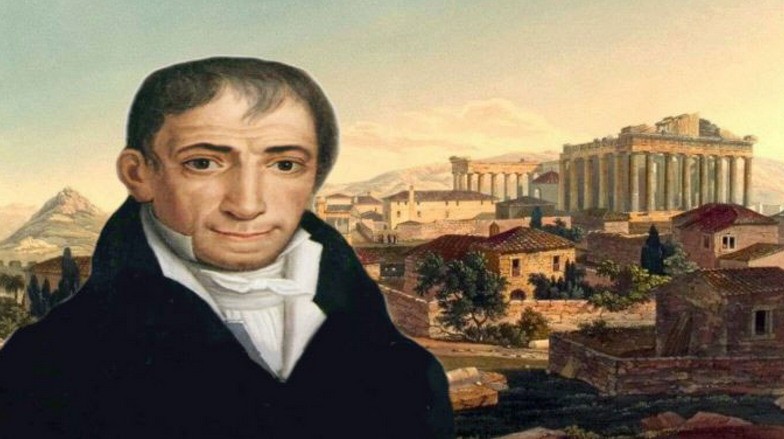
(Adamantios Korais)
From “Romans” to “Hellenes”
The Ottoman Empire maintained the pre-existing status of the conquered peoples, under the sole condition of their complete subjugation, and continued to refer to them as Romans.
But the Church insisted on this designation. Why?
Because the Ecumenical Patriarchate, by upholding this position, perpetuated the old order. Under the name Romans, not only Greek-speaking Christians, but also all the other Christian ethnic groups that had always belonged to the Byzantine Empire, continued to fall under its jurisdiction. The name Romans served as a unifying label under which the Patriarchate could retain spiritual authority over a diverse population across the former Byzantine territories.
And while this name was becoming more and more established in political and ecclesiastical language, due to the prevailing ignorance, and as the most prominent scholars of the nation, who had begun to promote the name Hellenes, settled in Western Europe, it was hardly heard in the subjugated country. During the 17th and 18th centuries, the intellectual revival of the nation began with the establishment of numerous schools, from Dimitzaina to Adrianople, and from Delvino in Northern Epirus to Kydonies in Asia Minor, rekindling the yearning and memory of the name Hellenes. However, the names Graikoi and Romaioi (or Romioi) remained prominent…
From 1790 to the Establishment of the First Greek State
Things began to change slowly at the end of the 18th century… In 1790, three representatives of the nation presented a petition to Catherine the Great, requesting that she send her grandson Constantine as emperor. They did not present themselves as Romans or Christians, but as “Greeks, descendants of the Athenians and the Lacedaemonians.”
However, shortly thereafter, in 1792, the heroic Lambros Katsounis, protesting the treaty signed by the Russians and the Ottomans, once again used the word Romans. Rigas Feraios, in his famous Thourios (War Song), referred to the Graikoi. In contrast, in other works, such as “Deute Paides ton Ellinon” (“Come, Children of the Greeks”), he was influenced by the currents of modern education.
Finally, in another work, he returned to using the word Romioi. The same happened with the main advocate of the revival of national sentiment, Adamantios Korais, who wavered for some time between Greeks and Graikoi. As K. Paparrigopoulos writes:
“Ultimately, the collective consciousness decided on this, just as it did with many other issues, more wisely than the wisest men. The First National Assembly of Epidaurus (December 20, 1821 – January 15, 1822), in which representatives from all the Greek regions voted for their first constitution, wrote in it that ‘… the Greek nation today declares, with its legitimate representatives gathered in national assembly, its political existence and independence before God and men.’”
Finally, in the first article of the London Protocol of January 22/February 3, 1830, which recognized the independence of our country, the following is stated:
“Greece shall form an independent state and shall enjoy all political, administrative, and commercial rights corresponding to full independence.” In the remaining ten articles of the protocol, however, the terms “Greece” and “Greek” (Hellenic) are used exclusively.
This is the resounding response of Constantine Paparrigopoulos, the modern Greek historian, who, along with Spyridon Zampelios, founded and demonstrated the continuity of Hellenism, to those who argue, with weak or non-existent arguments, that the people living in today’s Greece have no connection with the ancient Greeks.
As for the language, which many refer to in their comments, alongside the intellectual revival of the nation that began in the 17th century, the purification and renewal of the language began. For the works written during that time to have an impact on the subjugated Greeks, they had to be written in a contemporary language. The pioneer of this effort was Adamantios Korais. He was the first to argue that the spoken language should undergo modifications that would align with the changes it had undergone over time in its etymological and syntactic parts, but with certain grammatical forms, without which a literary language could not exist. The intellectual decline of the nation led to the stripping away of many meanings from the language, so Korais believed that ancient words should be borrowed.
However, this should not be done recklessly, but with care and prudence, using words that are closer to the spoken language, and in such a way that they are understandable to the masses. Based on this, the renewal of the language continued for a long time, which, without being identical to either the ancient or the demotic language, drew elements from both. As Paparrigopoulos writes, “it evolved into an instrument capable of expressing every concept and sentiment of intellectualism. This is another proof that modern Hellenism, just as medieval Hellenism before it, was never separated from the ancient.” The Greek language was never fragmented, unlike Latin, which split into six branches. Thousands of Greek words, either in their original form or with small changes, are included in the vocabularies of foreign countries, and our language has profoundly influenced important foreign languages, such as German, whose syntax is exactly the same as that of ancient Greek!
Source: Konstantinos Paparrigopoulos, History of the Greek Nation, Volume 17, Kaktos Publications, 1993.
Ask me anything
Explore related questions