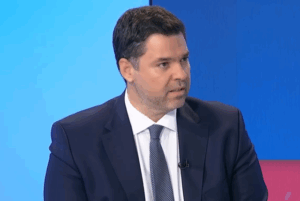
“The goal of the government’s economic policy is to return its dividend to society in order to serve our national objectives,” said Deputy Minister to the Prime Minister, Thanasis Kontogeorgis, speaking about the economic measures announced by the government in an interview with Action24 TV.
He referred to the demographic problem, stressing that “we must reverse its root causes, such as housing, so that finding a home doesn’t become a deterrent to starting a family.” The Deputy Minister outlined the packages of measures the government has taken to address this issue. These include structural actions to increase housing supply—such as boosting long-term rentals, incentivizing property renovations, and revising the golden visa scheme. “Our core policy is to make more apartments available. Some proposals were also made by the opposition in Parliament, which the government accepted and legislated.” He also mentioned immediate housing measures like the “My Home I and II” programs and the new rent refund initiative.
Regarding the average reported rental amounts, Kontogeorgis acknowledged that the declared figure of €250 clearly doesn’t reflect reality, with private sector research showing actual rents could be double that. “The Independent Authority for Public Revenue (AADE) has developed electronic cross-checking methods, making it easier than in the past to detect discrepancies. The €800 allowance, plus €50 per child, is expected to supplement these efforts. We want to ease the burden for some of our fellow citizens, and if we manage to ‘bring into the light’ part of this issue through tenant pressure on landlords to declare the real amounts, that’s progress.”
On the allowance for low-income pensioners, he emphasized that “from the start of our term, we gave special attention to the most vulnerable, so that society wouldn’t collapse under multiple crises and to preserve social cohesion. Improving incomes for those most in need, as well as for the middle class, is a central government policy.” He went on to say that “income support and public investments remain top priorities for the government.”
On the origins of the budget surplus, Kontogeorgis pointed to three key factors: “First, we tidied up public finances, which brought in €1.5 billion. Second, we enforced tax justice. And third, we grew the economy. We are implementing a balanced policy that grows the pie while reducing tax rates and social security contributions.”
When asked about the government’s future tax cut plans, the Deputy Minister noted that 72 taxes have already been reduced and added, “In September, we will have significant tax reliefs specifically targeting the middle class.”
In conclusion, regarding opposition criticism, Kontogeorgis stated that the current climate presents an opportunity for the opposition—at least for those who want to be seen as serious—to break free from the strategic dead ends of the previous period. “We went through a time of tension and confusion, where other mindsets prevailed. Now it’s time for policy dialogue. We are rolling out our government agenda, and it’s an opportunity for the opposition to present a structured proposal, if they claim to have one, on all the issues we’re addressing—so that citizens can calmly evaluate it.”
Ask me anything
Explore related questions