





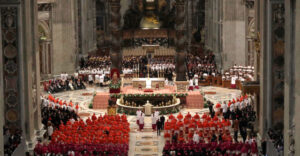
On May 7, it appears that the Conclave, the Catholic Church’s process through which the new – or rather the 267th Pope of the Roman Catholic Church will emerge, is scheduled to begin its work.
It may be that since the burial of Pope Francis, processes and discussions have been underway regarding the next person to lead the world’s largest single religious denomination, but in the long history of the process of electing a new Pontiff there have been major and in many cases significant choices for the course of the church and the world.
The conclave that will choose Pope Francis’ successor will, as strict protocol dictates, include only those members – cardinals who are under 80 years old and all have the right to vote and be elected. Practically as defined in the protocol of the Roman Catholic Church, all male Catholics in religion have this right but since the 1800s the Catholic Church has gone to an informal restriction of the right.
The first day
On the opening day of the Conclave – before the keyed confinement in the Kapela Sistina – a morning mass is celebrated in the basilica of St. Peter’s, while that afternoon the cardinals gather in the Chapel of St. Paul in formal choir attire, before walking to the Sistine Chapel to the sound of the hymn “Veni Creator“.
After the pope’s death, the most powerful man in the Vatican is the Camerarius, who, among other things, helps organize the conclave. However, he will not be inside the Sistine Chapel during the voting. The conclave is presided over by the Dean of the College of Cardinals or, in his absence, by the senior cardinal-bishop. It is worth noting that of the 135 Cardinals who will be present at the Conclave, even those who for health reasons cannot be present at the Capella Sistina can vote. With a special cell which is also locked and carried by men of the Swiss Guard – the Pope’s army in the Vatican – the vote is carried and counted normally in the process.
The official opening
The cardinals take an oath of secrecy: “And I, (name) Cardinal (surname), do solemnly promise, pledge and swear. May God and these Holy Gospels, which I touch with my hand, help me,” each one says, in the order of his seniority.
Then the Master of Ceremonies of the Papal Masses gives the command “Extra omnes” (meaning “All those without work, out”). This is the last time we see the cardinals until the new pope is elected.
Some staff members are allowed to remain inside the Vatican during the election, including:
Swiss Guard
Security and civil protection services
Priests for cardinal confessions
Medical personnel
Cleaning staff
Those who remain must take an oath of secrecy and swear not to use any type of audio or visual equipment during the election period. During the election of Pope Francis, it was the first time in the annals of the process that the Vatican used special systems to jam the signal of cell phones within the Sistine Chapel. The same process will likely be repeated this time.
The Vote
The voting process takes place in morning and evening sessions. Nine cardinals are randomly selected to perform specific tasks in each session: three Scrutineers oversee the voting process, three Infirmarii collect the votes from the patients, and three Revisers check and validate the results. The ballots are given to each cardinal, who secretly writes the name of his preferred candidate. The three Revisers sit at a table with a plate-covered container to receive the ballots in front of the shrine of the Sistine Chapel. Each Cardinal Elector proceeds to the shrine in order of seniority, holding the folded ballot raised in the air. Each cardinal exclaims before voting: “I call as my witness Christ the Lord, who shall be my judge, that my vote is given to him whom before God I believe should be elected,” before casting his ballot on the slate.
The election process
After all the cardinals have cast their ballots, it is time for the Scrutineers to check and count the ballots. The Scrutineers add up the votes each candidate receives, and the Verifiers check the results.
More specifically, after the voting is complete, the first Scrutineer shakes the ballot box to shuffle the ballots. The third Scrutineer counts the ballots. If the number of ballot papers does not correspond to the number of electors, the ballot papers shall be burnt and the voting shall be repeated. Participation in each ballot shall be compulsory for all persons present in the room. If all Cardinals have voted, the first Scrutineer shall unfold each ballot, mark the selected name and pass it to the second Scrutineer. The second Scrutineer shall mark the name of the selected person and pass the ballot to the third Scrutineer. The last Scrutineer reads the name aloud so that all the Cardinals can hear it and records the vote.
As the name is read, the Scrutineer pierces the ballot with a needle threaded through the word “Eligo” (“I elect”) and fastens it to the other ballots. After all the names are read, the ballots are tied together and placed in a third ballot box ready to be burned. If a candidate receives two-thirds of the total vote, they become the next pope. In the case of the May 7 conclave, the new pope will need 102 votes out of a total of 135. Up to four votes can be taken per day of conclave work.
The Tobacco
For those outside the church, the only indication of how the voting is progressing comes from the burning of the ballots – which takes place after each session. The practice of using smoke to indicate that cardinals have chosen a new pope dates back to the 19th century. However, the first reference to white or black tobacco was in the 1903 conclave.
A chemical mixture of “potassium chlorate, anthracene and sulfur” is added to help black tobacco appear darker, according to the Vatican Museum.
To make white smoke more visible, a mixture of “potassium chlorate, lactose and conifer resin” is added.
Habemus Papam!
Inside the Sistine Chapel, the Dean of the College of Cardinals or the senior cardinal-bishop asks the elected candidate if he accepts his election and what name he wishes to receive. If he is not already a bishop, he is sworn in at a formal ceremony within the Sistine Chapel.
The new pope then changes into traditional papal garb in the Room of Tears – a small room next to the Sistine Chapel which is named after the emotion with which new Primates of the Roman Catholic Church usually greet their election.
When he returns, a passage from the Gospels is read, a prayer is said, and the cardinals pay homage.
At the same moment the Cardinal First Deacon of the College of Cardinals appears on the balcony of St. Peter’s Basilica and announces, speaking in Latin: “Annuntio vobis gaudium magnum; Habemus Papam!” – “I announce to you great joy; we have a Pope!”
Moments later, the new pope steps out onto the balcony and addresses his first apostolic blessing, known as “Urbi et Orbi” – “To the City and the World.”
This marks the end of the complex process of conclave. In the next few days, the new pope will attend his enthronement Mass, which is usually held in St. Peter’s Basilica, before taking up his duties as head of the Catholic Church.
Ask me anything
Explore related questions




