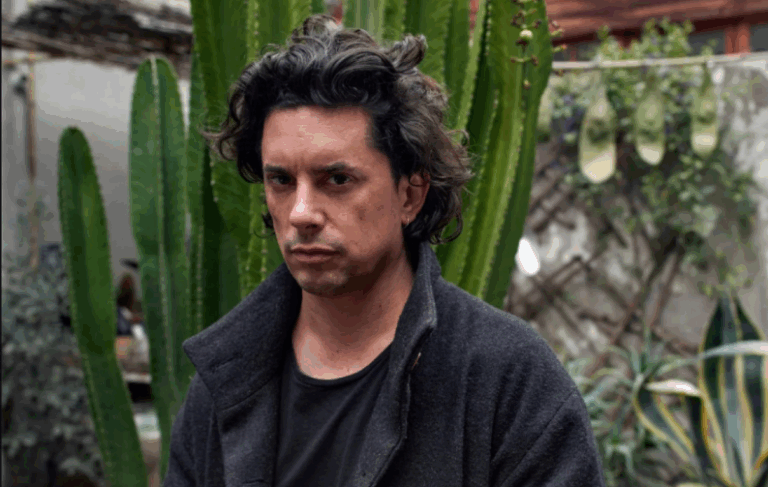
A brilliant literary mind of our time, Chilean author Benjamin Labatut, who has been characterized as the new phenomenon in global literature, is coming to Greece to speak on May 21 at 8:30 PM on the Main Stage of the Onassis Foundation Stegi. The award-winning author, who transcends the boundaries of essay and fiction, reality and imagination, will engage in an intriguing discussion with the Foundation’s Director of Culture, Afroditi Panayiotakou.
Labatut defies categorization and limitations, creating a new, hybrid genre that captivates both audiences and critics. Balancing between science and storytelling, genius and madness, dreams and nightmares of scientific progress, Labatut produces a mixture that evokes awe—and sometimes fear—where the lines between reality and fantasy blur and intertwine.
Born in Rotterdam, Netherlands, in 1980 and raised in The Hague, Labatut now lives and writes in Lima, Chile. Mysterious, reclusive, and highly translated, he has already received numerous international awards for his work. His book, When We Cease to Understand the World, was a finalist for the 2021 Booker International Prize, included in Barack Obama’s summer reading list, and named Book of the Year by publications such as The Guardian, The New York Times, and New Statesman.
In When We Cease to Understand the World, science becomes literature, essays turn into fiction, and biographies morph into imagination. What is that threatening shadow that lingers behind the light of scientific knowledge? From H. P. Lovecraft to Philip K. Dick, and from David Hilbert to Kurt Gödel and chaos theory, in The Stone of Madness, Labatut confronts the return of the demons of irrationality in a world that seems irrevocably incomprehensible. His 2023 book, MANIAC, recounts the story of John von Neumann, one of the greatest geniuses of the 20th century, delving into the dark foundations and myths of our modern world and the emerging era of artificial intelligence. It explores the nightmares born from the crazy dreams of logic, narrating the story of the new deity created by humans, which now threatens to replace them.
What makes Labatut’s writing process so unique is that it is deeply research-driven: “I’m not particularly concerned with the form of stories; it’s all about research. I try to discover things. For me, finding someone else’s phrase is more important than thinking it up myself. That’s the part I enjoy. In that sense, writing now resembles more walking and picking things up from the ground than constructing a story.”
The dreams, delirium, and exaggerations in Labatut’s books intersect with our reality, and that line seems so delicate. “What fascinates me is delirium, the crazy dreams of logic, and the excesses of thought. I am drawn to contradictions that torment us and at the same time enlighten us. I am interested in chaos, the aimless, the irrational, the random, and the infinite.”
Ask me anything
Explore related questions