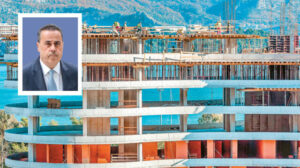
The government’s top priority, along with the political leadership of the Ministry of Environment and Energy under Minister Stavros Papastavrou, is to activate the construction activity that has been frozen for five months. This will be addressed through legislative regulation, to be submitted as an amendment on May 12 to Parliament, aiming to remedy the impacts on construction caused by the Council of State’s rulings on the bonuses of the building code.
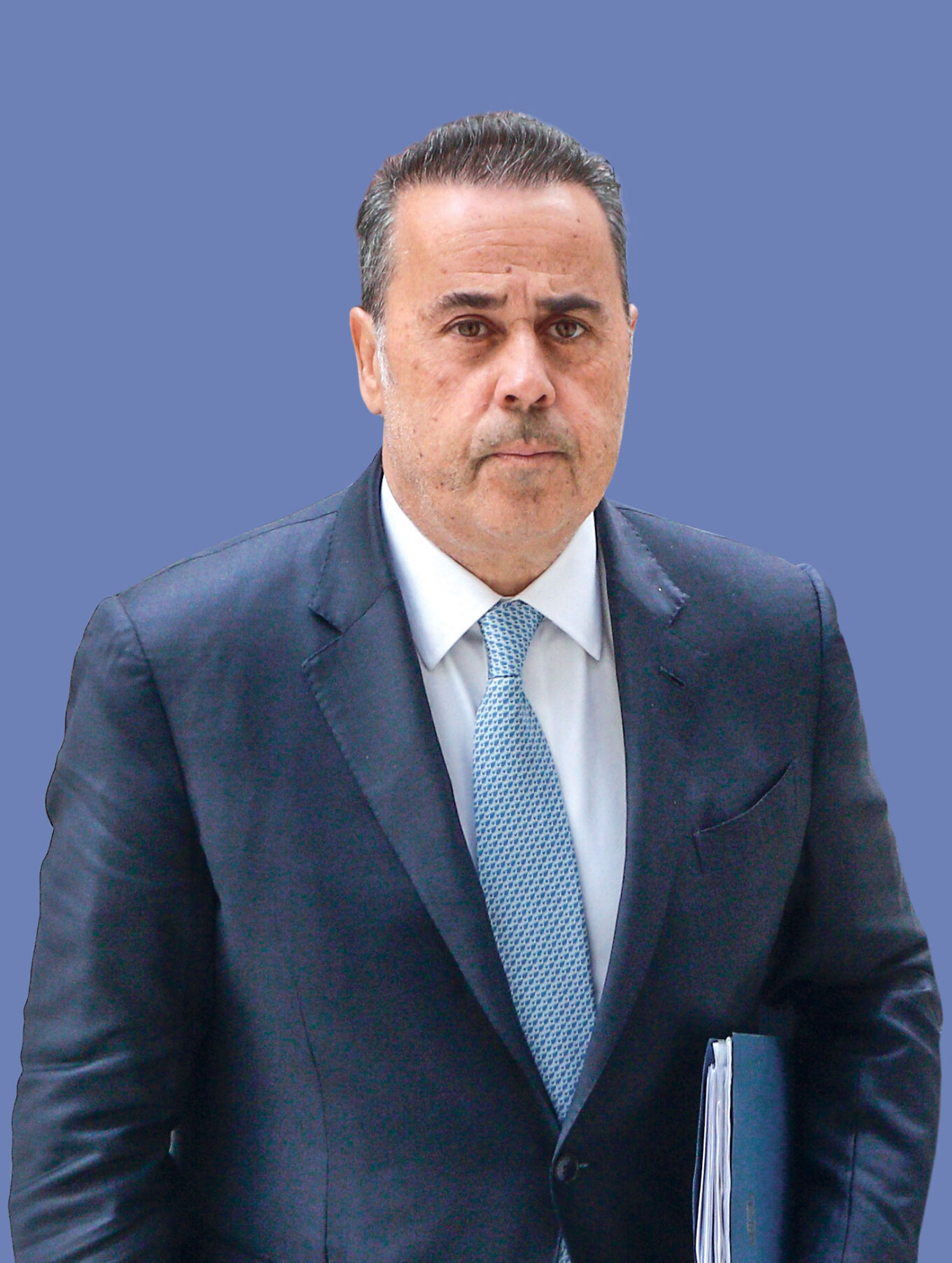
Stavros Papastavrou: Minister of Environment and Energy
The main principle of the new policy is legal security for citizens who have legally obtained building permits, environmental protection without it becoming an obstacle to residential and economic development, and alignment with the Council of State’s decisions to ensure the regulations are thoroughly protected and not vulnerable to new waves of appeals in the future.
In this context, the new political leadership of the Ministry of Environment and Energy aims to establish a solid legislative framework, based on which:
a) A protective core of permits is ensured for those who have secured the commencement of works until December 11, who have the right to build based on the NOK incentives.
b) Immediate revision of building permits is prioritized for those who did not start work by December 11, with a refund of all taxes, fees, and contributions paid for the additional square meters allowed by their building permit.
c) The concept of environmental offset is established for municipal units or municipalities to compensate for the environmental damage resulting from the NOK bonuses.
d) The environmental offset will be paid in the form of a financial fee by permit holders for the square meters increased in a building permit due to the incentives of the building code and will apply both to permit holders with pending court cases (appeals to cancel the permit), and to permits subject to financial instruments (NSRF, Recovery Fund, etc.).
e) Without the payment of a fee, permits concerning strategic investments (ESHASE – ESHADA), such as the Elliniko investment, as well as listed buildings, will proceed.
A significant indication for the future of the NOK is the “wink” in the Council of State’s decision regarding the bonuses. The Council of State’s recent plenary decision judged that the addition of height and building coefficient does not constitute “damage” as long as it is provided by urban planning and does not represent a horizontal regulation. This leaves open the possibility of amending urban planning to include the additional bonuses of the NOK that would allow increased building, provided it is deemed to meet a certain need.
The regulation
The new regulation by the Ministry of Environment and Energy will be passed as an amendment in a Justice Ministry bill, expected to be forwarded to Parliament the following week, and will then be enacted through a Presidential Decree to undergo scrutiny by the highest court.
The government aims to pass it by the end of the month and implement it immediately, in order to clearly define the new building terms for both those who will be able to build under NOK incentives and those whom the Council of State’s decisions do not favor and must follow new rules for their building permits to be legal.
The goal of Minister of Environment and Energy Stavros Papastavrou and Deputy Minister Nikos Tagaras is not to lose more time in restoring normalcy in the market, as the Council of State’s decision on NOK has frozen construction activity for months due to the ambiguity and great uncertainty it has created for the future. With the new framework, the government clearly maps the roadmap and provides all the necessary tools that property owners need to move forward.
The construction freeze is also demonstrated by the latest ELSTAT statistics, which show a sharp drop of 37% in building permits for January, a trend not expected to reverse in the coming months, at least until the market digests the new measures and construction activity resumes.
Categories
Let’s see how the Ministry of Environment and Energy will lift construction activity from months-long quarantine, who will retain the privileges of the bonuses, who will lose them and have to pay to build based on the permits they have issued, and how building permits with NOK incentives will be able to overcome the legal hurdles of the Council of State’s decisions.
Permanently protected under the judicial decisions are those who have a building permit and have started work by December 11, 2024, and who will be able to execute their permits using the incentives without risking their cancellation. This category will not require regulation, as the Council of State’s provisions already cover it. Excavation work is considered as the commencement of construction, with criteria to be expanded by the Ministry of Environment and Energy.
On the other hand, those who have not started work by that date (December 11, when the summary of the Council of State’s decision was published) will have to revise their permits in order to remove building elements (e.g., mezzanines, rooftop rooms) deemed unconstitutional by the court decision. According to the Council of State, it is unconstitutional not to include in the building coefficient mezzanines and structures up to 35 sq.m. on the roof, as well as the equalization of a swimming pool with planted surface, which must be counted in the building coefficient. In fact, these provisions are abolished from the NOK in the upcoming regulation by the Ministry of Environment and Energy, as a sign of full alignment with the Council of State.
For this category, the Ministry of Environment and Energy, acknowledging the prolonged hardship and the lack of reliability shown by the administration to those who built according to the law’s provisions, will stipulate that paid taxes, fees, and contributions for the square meters to be removed from the permit (to comply with the decisions) will be refunded to property owners. It is also provided that no additional taxes or fees will be collected for permit revisions, which will be processed with priority over other applications.
Environmental offset
What will happen for those who started construction work that stopped due to an appeal, or for those close to completing a structure that also froze due to an appeal and risk leaving construction “shells”? Although Ministry officials believe this is a relatively small category of citizens, the new regulation places them under protection via the so-called environmental offset.
This concerns a group of citizens who legally built based on the current institutional framework of the NOK. For these citizens, the regulation will provide for the payment of an environmental fee as compensation for the area that gained extra square meters. Similar provisions had been established in older laws for illegal constructions with major environmental violations, though never actually implemented.
The environmental offset is established to restore the damage caused to an area by the NOK bonuses and relates to residential and urban improvement, which the Council of State considers important. These measures will apply at the municipal unit and municipal level, especially for major metropolitan areas such as Attica and Thessaloniki.
For example, an additional floor that blocks a neighboring building’s sea view can be offset by a public space or redevelopment in the same area. It will also have a financial component, as a fee will be charged for the extra square meters that were built and not accepted by the Council of State, as they were legislated not based on the area’s needs but as a horizontal rule. The environmental offset will be calculated based on the square meters gained by a building due to the NOK bonuses. The Green Fund will provide resources for the offset to create a fund to finance the actions in each intervention area.
A second category of properties subject to environmental compensation concerns building permits that did not start work but were submitted to various financial tools (Recovery Fund, NSRF). These cases involve properties that have submitted relevant files for approval to the competent financing programs but based on the building code as it stood before it was overturned by the Council of State. For these permits, private parties may have proceeded with vertical ownership and transferred property to third parties under preliminary agreements, making regulation by law necessary to avoid compensation claims.
The implementation of environmental offset measures for residential improvement will be based on a special plan, the so-called Special Plan for Environmental Offset Urban Upgrading (ESPIAP). This plan will be drafted wherever NOK provisions apply and will detail the measures to be implemented in an area (e.g., public green spaces, redevelopment interventions, etc.) aimed at upgrading the residential environment where the permits are located.
The ESPIAP will be prepared by the Ministry of Environment and Energy with Green Fund financing and its completion will be a prerequisite for permits under financing tools. This will not apply to the first category of permits (e.g., those stopped due to appeals), as for them the start of the special plan will suffice to proceed. The money collected from the new mechanism will finance the environmental actions. The law will provide that for buildings that have completed the load-bearing structure (skeleton), the reissuance of the building permit will be immediate (there is provision to complete it within a few days) from the start of ESPIAP implementation. In contrast, for buildings where the load-bearing structure has not been completed, reevaluation of the files by the Ministry’s competent bodies (KESYPOTHA, KESA) will be required.
The incentives
The regulation provides for two other categories in which NOK incentives will not be “demolished”: the special spatial planning tools ESHASE (Special Plans for Spatial Development of Strategic Investments) and ESHADA (Special Plans for Spatial Development of Public Properties), Integrated Development Plans, Town Plan Amendments, etc. The Elliniko investment belongs to ESHADA, legislated by a Presidential Decree in 2018, for which the law will include special provisions. The second category that secures NOK incentives are listed buildings. Both of these categories retain the favorable NOK provisions, as they are not horizontal rules but concern specific areas of the country, and thus align with the Council of State’s philosophy.
- The building bonus remains valid for those who started work by December 11, 2024
- However, they will incur a financial…
Ask me anything
Explore related questions