





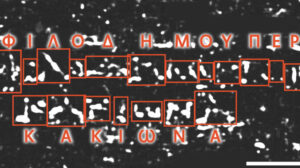
A charred papyrus found in a Roman villa buried under ash during the eruption of Vezuvius nearly 2,000 years ago, was identified as the work of an ancient Greek philosopher.
Researchers discovered the title and author on the Herculaneum scroll after x-raying the charred scroll and virtually unrolling it on a computer, according to Guardian.
The traces of ink letters visible in the X-ray images revealed that the text was part of a work written by Philodemus Epicurean in the first century B.C. The scroll is one of those held in libraries in Oxford.
“It’s the first scroll where the ink could just be seen in the scan,” said Dr Michael McAusker, a papyrologist at University College London, who is working with researchers at Oxford to read the text. “Nobody knew what it was about. We didn’t even know if it had writing on it,” he added.
The scroll is one of hundreds found in the library of a luxury Roman villa believed to have belonged to Julius Caesar’s father-in-law. The villa was buried under ash and pumice when Herculaneum, near Naples, was destroyed along with Pompeii in the 79 AD explosion.
Excavations in the 18th century recovered many of the ancient scrolls, most of which are in the National Library of Naples. But the documents are so burned that they crumble when researchers try to unwrap them, and the ink is illegible on the charred scrolls.
The latest paper builds on previous discoveries from the Vesuvius Challenge, a global competition launched in 2023 that offers prizes for advances in X-ray scroll reading.
Last year, a team of computer science students shared a $700,000 grand prize for developing artificial intelligence software that allowed them to read 2,000 ancient Greek letters from another scroll.
The word “disgust”
The scroll, called PHerc. 172, was scanned last July in Oxfordshire. Unusually, ink was visible in the X-ray images, with researchers spotting the ancient Greek word for “disgust” at least twice in the document.
Further work by Sean Johnson in the Vesuvius Challenge, and separately by Marcel Roth and Mika Novak at the University of Würzburg, found the title and author of the text in the inner part of the scroll, winning the competition’s first title prize of $60,000 (£45,200).
The Guardian reports that Philodemus’ work, which reportedly owns the scroll, includes ten books in which topics such as arrogance, greed, flattery and household management are covered.
Soon, experts will know much more about the scrolls. Eighteen were scanned in March and 20 more will be depicted in Grenoble this week.
“We see evidence of ink in many of the new scrolls we’ve scanned, but we haven’t yet turned that ink into coherent text,” said Dr. Brent Sills, a computer scientist at the University of Kentucky who co-founded the Vesuvius Challenge. “That’s our current hurdle: converting massive scan data into organized segments that are properly segmented, practically flattened and streamlined so that the ink data can then be interpreted as actual text.”
“The pace accelerates very quickly… All the technological progress that has been made in this area has been made in the last three to five years, and for the timeframe of the classicists, that’s incredible. Everything we’re getting from the library at Erculaneum is new to us,” Dr. McCosker said.
Ask me anything
Explore related questions




