





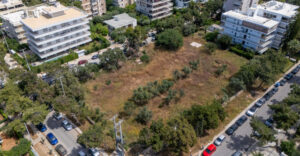
In the center of Kato Glyfada, just a few blocks from the coastal boulevard, a plot of land of high value – nearly 10 million euros – is in danger of changing hands not through a sale, but through…usucaption.
The property in question is the 3,172 sq m property at 67 Oinoi Street, which, although wholly owned by the Greek State, now appears in the Cadastral Registry as the property of a private individual, through a controversial registration correction process and a series of fictitious court disputes.
What is happening here is not an isolated incident. It is the latest episode in a wider pattern of the hijacking of public property by organised circles exploiting the shortcomings of the Land Registry, state inaction and service failures.
The property in question, which is enclosed by Oinoi, Pandora, Zamanou and Christoforou Nezer streets, belonged from 1938 to PIKPA, then passed to EOKF, then to the Ministry of Health, the Ministry of Labour and from 2023 to the newly created Ministry of Social Cohesion and Family.
In 2021, the then Minister of Labour granted the use of the property to the Municipality of Glyfada for the creation of a crèche and a day care center for the disabled. However, the project never went ahead, as the Land Registry showed it as an “unknown owner” – the state had not registered it in time for the land registration that was completed in 2017.
This gap was enough to start the expropriation operation. In 2023, a woman shows up and draws up a deed of acceptance of inheritance, based on her mother’s private will from… 1990, but which is first published in 2023. The will allegedly transfers a property that had never been declared or registered by the deceased, but which – according to her daughter – had come to the family either through an informal donation in 1965 or through an extraordinary usucaption. With this “evidence”, the woman appeals to the Municipal Court of First Instance and asks for the correction of the entry in the Land Registry, so that she is registered as the owner.
The Government did not intervene in the proceedings, even though the application had been notified. Thus, the decision passed without objection. And while recognition of ownership was rejected by the Court because it cannot be sought by this process, the Land Registry registered the change, showing the individual as the owner – even though the substance of the ownership was not adjudicated.
And then a second claimant appears. Another individual, ostensibly a “competitor”, who files a lawsuit against the first, seeking to be recognized as the true owner, because he too… “forgot to register” the property. The scenario is familiar: the conflict is a sham. The aim is not to win for one or the other, but to have any court decision recognising ownership issued with res judicata. From then on, the “winner” can transfer the property to a third party without legal obstacles.
Notably, this second claimant is the same person who appears in the Tsitsani 2 land plot case, in the same scenario: land “orphaned”, usucaption, contestation, virtual litigation. The repetition of the same pattern with the same persons reveals a circuit. A network that moves methodically and attempts to obtain “clean” titles through virtual litigation. All done with cold legal technique and precision.
The Municipality of Glyfada, once it became aware of what was happening, contacted the Ministry of Social Cohesion and Family, asking that the property be protected. But the ministry said it was unprepared to act, citing a lack of service structure, as it is a newly established ministry. Eventually, the City filed a lawsuit seeking recognition of the State’s ownership.
After successive pressures, the State moved for additional intervention in favor of the municipality, but legal experts believe it should have brought its own lawsuit or at least a main intervention, which would have given it more institutional standing.
According to reports, the Municipality of Glyfada also intends to file a lawsuit on the case with the Athens Prosecutor’s Office, which will include the previous incident at 2 Tsitsani Street.
The mondus operandi
The Oinoy 67 case seems to be just the tip of the iceberg. According to well-informed sources, similar schemes are unfolding in various parts of Greece, where land registration has been completed and the state is unable to locate its properties in time.
What they seek to do is simple, but effective: identify properties that have been registered in the Land Registry as “unknown owner”, usually because the State neglected to register them. A person then comes forward claiming usufruct and asks for the registration to be corrected. This is followed by a second ‘counterclaim’ by another person, ostensibly a competitor, to trigger a court order recognising ownership to one of the two – it doesn’t matter which one, as long as there is a precedent.
The case results not just in the deletion of the “unknown owner” designation but in a legal title on which any future sale can now be based. Thus, the property leaves the hands of the State without the State even realizing it. It is all done coldly, methodically and, most importantly, with the cover provided by a legal title based on usucaption.
Ask me anything
Explore related questions




