





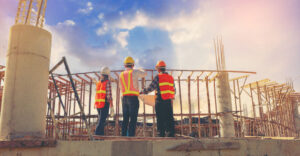
The Ministry of Environment and Energy is dividing the holders of building permits into five categories with bonuses under the New Building Regulation in order to align with the decisions of the Council of State that ruled unconstitutional provisions of the legislative framework and to remove the uncertainty that has prevailed in the market for months slowing down construction activity.
These are those who have started work by starting excavation until December 11, 2024, for permits that were legally issued but have not started work (until December 11), estimated at around 2,500, and those permits that are under construction (and some are almost completed) but have been frozen due to appeals or because a cancellation request is pending against them, estimated at around 200.
The regulation of the Ministry of Environment covers in parallel those who have been included in various financial instruments (Recovery Fund, NSRF, TAA) and the holders of special urban planning plans for public and strategic investments (ESXASE-ESXADA) such as, for example, Hellenikon. The same category also includes listed buildings and monuments with the aim of their protection and enhancement. Outside the legislative framework, based on the decisions of the Council of State, the non-counting of lofts in the building factor as well as the equation of the swimming pool with a planted surface provisions that were considered unconstitutional.
The new regulation, which bears the stamp of Environment and Energy Minister Stavros Papastavrou and Deputy Minister Nikos Tagaras (while its drafting was initiated by Mr. Theodoros Skylakakis), is called upon to restore normality in private construction and address as far as possible the legal uncertainty – which has been caused to property owners, buyers and investors, building contractors and the administration – by the horizontal application of the law without prior scientific study and planning based on the needs of each region.
The winners
The new framework ensures the continuation of work and shields projects that had legally initiated work up to December 11, 2024. This category will be able to proceed with the implementation of building permits without any review or additional costs, and the holders of these permits will be able to review the permits if they wish to do so without any financial burden (taxes, fees, levies, deductions).
Subsequently, a Presidential Decree, and in line with the guidelines of the CSC, will describe in detail the terms and conditions under which it will be demonstrated that work has commenced up to 11 December 2024. This is the date that the Council of State announced the summary of the decision putting dividing lines in building permits.
Without payment of financial compensation to secure the conditions of the building permit issued will also be subject to strategic investments (ESHASE, ESHADA, etc.) as it is considered that scientific documentation has already been done for them and listed buildings.
Permits to be reviewed
A different approach is being taken by the WFP for those who have not had time to start work by 11 December 2024. This category does not lose the right to build, but must revise their building permit in order to remove the NOC incentives and surcharges.
For those who review their building permit, the regulation provides that they will be exempt from taxes, fees, levies or deductions. This is a provision that has already begun to receive credence from the market in the sense that the loss of bonuses costs much more than a few hundred euros in fees and contributions. It is envisaged that these reviews will be carried out by the relevant Building Services, without delay and on a priority basis.
Who will pay to build with NOC
Two categories of building permits will have to pay to build with NOC bonuses. These are those who have had a court order cancelled or have a cancellation application pending against them and have started building work by December 11 to prevent the phenomenon of abandoned unfinished buildings.
In particular, if the building’s load-bearing structure has been completed, the construction process continues immediately, with incentives and surcharges, provided that the environmental equivalent is paid and the preparation of the ESIAP is started.
If the load-bearing structure is not completed, the Central Council of Architecture and the Central Council of Urban Planning and Disputes of the Ministry of Environment and Natural Resources are seized to consider, based on technical, social, economic and legal criteria, the necessity or otherwise of continuing the implementation of the building permit with the NOC incentives and increments. Upon securing the aforementioned approvals, the construction can continue with the NOC incentives and increments, provided that the environmental equivalent is paid and the preparation of the NOCIAP is initiated.
Provision is also made by the ministry for investors who hold building permits included in European funding programs (NSRF, TAA) in order to ensure the implementation of these projects and the credibility of the state.
In this case, the Ministry of Environment establishes the so-called environmental equivalent, which compensates for the use of incentives and increments of the NOC. The environmental equivalent has a double meaning as it provides for: a) the payment of a fee by the owner and developer deposited in a Special Account in the Deposit and Loan Fund for the benefit of the municipality concerned and b) targeted interventions for the upgrading of the Municipal Unit or Municipality where a building is constructed with incentives and surcharges. These measures will be specified through a Special Environmental Equivalent Urban Upgrading Plan.
How the environmental equivalent works
In order to be able to use the incentives and increments of the NOC, the environmental equivalent must be paid and be approved. The aim is to maintain the permits linked to strengthening the financial credibility of the Greek State vis-à-vis the European Union and maintaining international investment confidence.
What is the ESPIAP
The ESPIAP (in Greek) is a Specific Environmental Equivalent Urban Upgrading Plan, through which targeted actions will be specified at the level of a Municipality or Municipal Unit, where incentives and increments of the NOC have been granted. The ESPIAP prepared within two years from the adoption of the institutional framework provides legal shielding and possibility to use the incentives, without changes in the building permit, for the cases where it is provided. It may include, among other things, a description of the area and existing permits, analysis of legal issues and cancelled permits, environmental assessment and impacts, proposals for management and plan adjustment, implementation schedule and financial analysis, monitoring – evaluation – recommendations – documentation.
A Presidential Decree will be given the possibility to specify the measures of environmental equivalence, to define the procedure for the approval of the ESPIAP, as well as the amount and procedure of the fee.
Such measures may include the creation of green spaces and common areas, redevelopment of areas with intensive construction, urban infrastructure or upgrades (pedestrian walkways, lighting, urban furnishing material, etc.), priority demolition of arbitrary or dangerous (dilapidated) buildings. In addition, the financing of the acquisition of listed buildings and monuments by the municipality concerned and the restoration of public listed buildings and monuments. environmental actions, such as the cleaning and delimitation of streams and settlement works.
Finally, for strategic investments, it is provided that upon the proposal of the Minister of Environment and Energy and with the opinion of the Central Council for Urban Planning Issues and Disputes, a Presidential Decree is issued according to which the implementation of the incentives and increments of the NOC is approved. The request must be accompanied by specific documentation within a period of 3 months from the start of this regulation.
Ask me anything
Explore related questions




