





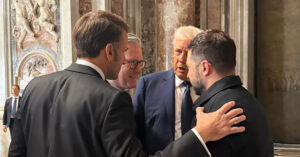
In a closed-door video conference with European leaders on Monday, Donald Trump reportedly admitted for the first time that Russian President Vladimir Putin “is not ready to stop the war” in Ukraine because “he believes he is winning.” The statement surprised the Europeans, who had suspected this for some time but had never heard it so explicitly from the American president.
According to revelations from the Wall Street Journal, this shift in tone did not come with a shift in strategy. Instead of increasing pressure or proposing new sanctions, Trump reiterated his desire for low-level negotiations between Russia and Ukraine to be held at the Vatican. “This is not my war. We got involved in something we shouldn’t have,” he said.
The video call included Ukrainian President Volodymyr Zelensky, French President Emmanuel Macron, German Chancellor Friedrich Merz, Italian Prime Minister Giorgia Meloni, and European Commission President Ursula von der Leyen. A day earlier, Trump had held another video call in which he had suggested that he might support sanctions against Russia if a ceasefire initiative failed.
The Kremlin Responds
Meanwhile, the Kremlin stated that the Wall Street Journal article contradicts what Moscow knows.
“We know what Trump said to Putin. We do not know what Trump said to the Europeans after the call. We know the official statement from President Trump. What we know contradicts what is written in the article you mentioned,” Kremlin spokesman Dmitry Peskov told journalists.
The Kremlin also commented on the planned prisoner exchange with Ukraine — 1,000 from each side — saying processes are underway and both sides want the exchange to happen as quickly as possible. The agreement was made last week during direct negotiations in Istanbul, the first since 2022.
From Shift to Reversal
According to the WSJ, Trump’s shift came on Monday. He no longer appeared willing to impose sanctions. Instead, he stated that Washington supports consultations in the Vatican, but without committing to a direct U.S. role.
Zelensky and the European leaders requested any ceasefire be “unconditional,” but Trump rejected that term, saying he doesn’t use it—even though he had publicly written it just days earlier.
The U.S. delegation could potentially include Secretary of State Marco Rubio and special envoy Keith Kellogg, though Trump appeared indecisive. Talks at the Vatican are expected to take place in mid-June.
The European Bloc and Merz’s New Role
European pressure on Trump intensified after Friedrich Merz became Germany’s Chancellor. Unlike his predecessor Olaf Scholz, Merz seems determined to take a tougher stance against Russia. Alongside Macron, Starmer, and Tusk, he made an unannounced visit to Kyiv on May 10, encouraging Zelensky to agree to Trump’s initiative to expose Putin’s intransigence.
Zelensky’s office then called Trump to express full support for a proposed 30-day ceasefire. Putin reacted by proposing direct talks with Ukraine, which were held at a low level in Istanbul — without his presence and without results.
Sanctions and Europe’s Plan B
European leaders had hoped that after the video call, Trump would support sanctions on Russian energy exports and banking transactions. Even Senator Lindsey Graham announced he had gathered 81 congressional backers for a strong sanctions package. But those hopes were quickly dashed.
Realizing U.S. reluctance to act immediately, Europeans now believe that support for Ukraine — military and economic — must come primarily from their own resources. Diplomatic sources say the U.S. will not stop arms exports to Ukraine as long as they’re funded by Europe or Ukraine itself.
The Performance and the Domestic Audience
Despite the serious nature of the call, Trump still made unpredictable remarks. He praised Merz’s English, saying, “I love it more with the German accent,” and criticized Europe’s immigration policies, prompting Macron to respond: “You can’t insult our nations, Donald.”
Although disappointed by the lack of support for sanctions, the European side sees at least one point of clarity: Trump now accepts that Putin doesn’t want peace. The European camp is now seeking a realistic path through the Vatican talks — fully aware that the initiative is now in their hands.
Ask me anything
Explore related questions




