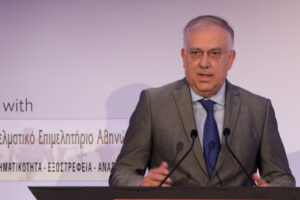
“There is no stronger defense for the country than a productive economy,” emphasized Minister of Development Takis Theodorikakos, speaking at the 2nd European Entrepreneurship Conference of the Athens Chamber of Tradesmen in collaboration with The Economist. The theme of the conference was: “How can Greek SMEs drive innovation, competitiveness, and prosperity in an unstable global economy?”
The minister stressed that in a world of intense geopolitical upheaval and changing competitive dynamics, “the Greece we envision and are building is a Greece that produces, exports, and advances with confidence.”
Speaking on the new Development Law, Mr. Theodorikakos called it a “tool of national importance,” which will mobilize €1 billion in investments over the next two years, aiming to strengthen the industrial and primary sectors, while also supporting border and economically weaker regions of the country. He also highlighted that efforts are underway to recover €500 million from the Development Laws of 2004 and 2011, and once the process is complete, a full public report will be released.
He emphasized that the goal of sustainable development extends beyond the Development Law, forming part of a broader national plan—one of the largest development programs for all Greeks. Through its three key pillars—the Recovery and Resilience Facility, the new NSRF (ESPA), and the National Development Program—resources exceeding €57 billion are being mobilized in public and private investments to reach every corner of the country and reduce various inequalities: social, economic, regional, and intra-regional.
Special reference was made to small and medium-sized enterprises (SMEs), which he described as “the backbone of the Greek economy, where the heart of the Greek economy beats.” Mr. Theodorikakos noted that the Development Law includes regimes tailored to their needs—from extroversion and social entrepreneurship to provisions for self-employed professionals. He added: “The regimes of the Development Law operate complementarily with the NSRF, offering SMEs the opportunity to utilize multiple streams of funding for their investment planning.”
Mr. Theodorikakos also discussed reforms implemented by the ministry aimed at reducing administrative burdens on businesses by 25%, and the creation of a new Independent Authority for Market Supervision and Consumer Protection.
“Development cannot be sustained without rules. In cases such as the recent developments in private health insurance, we have proven that we do not hesitate to intervene when abusive or unfair practices emerge. The market needs transparency, trust, and equal conditions for all,” he said.
He emphasized the importance of harnessing innovation and artificial intelligence for the new production model, highlighting the role of the AI Factory “FAROS,” being developed with the participation of top research institutions. “Just as no one stopped the mobile phone or the internet, no one will stop Artificial Intelligence either. What matters is to understand how to use it appropriately—not fear it. AI will transform production, the way we work, and perhaps even the way we think. Our duty is not to reject the future, but to make it our own,” he concluded.
Finally, the Minister of Development made reference to the chambers of commerce, their role in the Greek economy, and spoke about the need to modernize the institutional framework governing their operation.
Ask me anything
Explore related questions