





Athens is waging a battle, employing every diplomatic tool at its disposal, to ensure that conditions are set for Turkey’s attempt to capitalize on a favorable geopolitical moment and bring its defense industry into the €800 billion European rearmament plan—an initiative of immense defense, economic, and geopolitical significance.
Athens has already made significant strides toward this goal, but the path ahead is long and fraught with obstacles.
From the outset, Turkey has sought to portray itself as the “solution” to Europe’s security issues, exploiting the EU’s weaknesses while leveraging the growing capabilities of its defense industry and its increasing regional influence. This effort has found support among numerous EU member states, each with its own reasons for promoting collaboration with Turkey and its defense sector.
President Recep Tayyip Erdoğan, by pushing for Turkish defense industry participation in this massive European rearmament project, is not merely seeking funding to sustain his country’s military industry. He is also pursuing political and diplomatic leverage, aiming to establish a tailor-made relationship with the EU.
Diplomatic battle
For Greece, this is a decisive and vital diplomatic struggle. The objective is to impose terms on Turkey’s participation, lest Greece and Cyprus—both EU members—end up funding the defense industry of a country that disputes their sovereignty and, in Cyprus’s case, doesn’t even recognize its statehood.

Turkey’s involvement in European defense will likely become a new point of contention—not only between Greece and Turkey but also with certain EU partners advocating cooperation with Ankara. Similar tensions are arising within NATO, under the guise of promoting EU-NATO defense cooperation, despite Turkey’s non-recognition of the Republic of Cyprus.
Strategic implications
If obstacles to Turkey’s involvement in the European rearmament plan are lifted, Ankara will gain a powerful argument for lifting remaining restrictions on the sale of advanced weapon systems like the Eurofighter and Meteor missiles.
Greece faces a complex diplomatic equation. Turkey is expected to resist any conditions—especially those involving its disputes with Greece and Cyprus.
A contradiction
Raising the casus belli issue should not be limited to the European defense discussion; it is central to Greek-Turkish relations. It is contradictory for two countries to claim improved bilateral relations while one maintains a war threat to deter the other from exercising its sovereign rights under international maritime law.
No real progress can be made while the threat of war and challenges to Greek sovereignty—including over the so-called “grey zones”—remain. Yet these are the core elements of Erdoğan’s revisionist ideology, now formalized as state policy in Turkey. This poses serious obstacles to advancing Greek-Turkish relations, especially ahead of the pending High-Level Cooperation Council meeting and the prime minister’s planned visit to Ankara in early July.
Turkey, which reacted strongly when Mitsotakis asked the U.S. Congress in 2022 not to supply F-16s unconditionally to Ankara, will not passively accept Athens’ efforts to impose restrictions on its participation in European defense programs. As such, the issue is expected to feature prominently in the next meeting between the two leaders—potentially during the NATO summit in The Hague (June 24–25).
Greek strategy
For decades, EU-Turkey relations have been Greece’s primary leverage in curbing Turkish revisionism. Turkey’s pursuit of a “special” strategic relationship with Europe—one that recognizes its “uniqueness” without preconditions—is dangerous. It risks legitimizing Turkish revisionism against the sovereignty of two EU member states.
As discussions in Brussels revolve around delicate, complex, and technical issues—often subject to interpretational disputes—and political dynamics will influence decisions, Prime Minister Kyriakos Mitsotakis has raised the stakes. In a recent interview with Skai Radio, he stated that no cooperation of this kind can take place while Turkey maintains its casus belli against Greece. He committed to raising the issue directly with Erdoğan, signaling a message to both European capitals and Brussels.
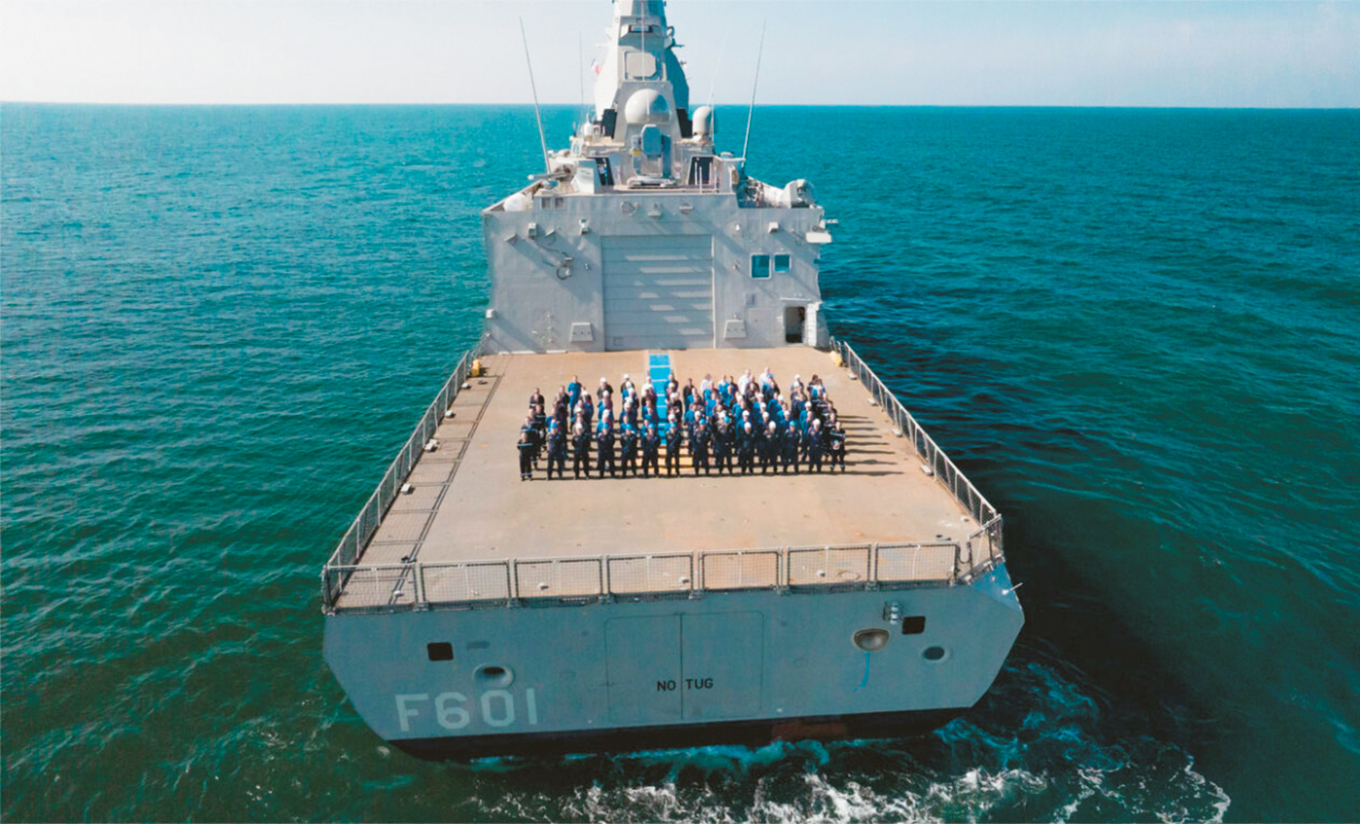
First sea trials for the frigate Kimon
As Athens fights to prevent Turkey’s unconditional entry into common European defense structures, it also strengthens its deterrent capabilities. Last Wednesday, the frigate F-601 Kimon, built in Lorient, France, conducted its first sea trials, signaling the countdown to its induction into the Hellenic Navy.
Expectations
The EU’s decision to launch a massive rearmament program, initially providing €150 billion in loans through the SAFE initiative (Security Action for Europe), marked a major shift in European security policy. Member states expect the plan to bolster the European defense industry.
The main objective remains the support of European companies so that the added value stays within Europe. However, despite strong positions from France, Germany, and Italy, the demand outpaces supply—forcing Europe to look to third countries, like candidate-member Turkey, which has formal cooperation frameworks.
The SAFE Regulation
On Tuesday, the General Affairs Council is expected to approve the SAFE regulation, part of the European Commission’s ambitious White Paper on rearmament. This regulation allows for cooperation with third countries.
Although initially approved by a qualified majority in COREPER, this posed a challenge for Athens and Nicosia. They pushed for a mechanism whereby future decisions on third-country participation would require unanimity, avoiding unchecked inclusion of Turkish companies.
To mitigate misinterpretations—particularly with Turkey—Athens secured a commitment from the Commission that future agreements will follow Article 212 of the Treaty, which mandates unanimous approval for EU agreements of financial and technical nature with candidate countries.
Greece submitted a national declaration to COREPER on May 21, welcoming the SAFE regulation but emphasizing that cooperation with third countries should only involve those aligned with the EU’s Common Foreign and Security Policy (CFSP).
National declaration and limits
Greece’s declaration underscores caution in involving third-country entities (contractors and subcontractors) that do not share EU values or that contradict its security interests.
It also asserts that these emergency measures to support defense investment “do not affect or set a precedent” for other existing or future EU defense programs.
Turkey is not excluded from SAFE, which allocates €150 billion for European rearmament. According to the White Paper, Turkey is not even required to sign a Security and Defence Partnership agreement, as other third countries must.
Participation limits
The mechanism initially limits third-country participation to 35% of a contract’s value, with the remaining 65% reserved for EU companies. However, a third country can gain enhanced access via a special agreement.
Diplomatic sources confirm that candidate countries’ companies may participate only under special agreements, which must be approved unanimously—again referring to Article 212. There are also caps: subcontractors may hold under 15%, and external contractors 15–35%—but all must respect the EU’s security interests.
Trojan horse?
Concerns remain, especially as Turkey’s Baykar defense company has already partnered with and acquired stakes in European—particularly Italian—firms. These partnerships could act as a Trojan horse for Turkish access.
Despite the bureaucratic complexity in Brussels, Athens and Nicosia have so far secured key safeguards regarding Turkish participation. However, everything will ultimately hinge on how these rules are applied.
Ask me anything
Explore related questions




