





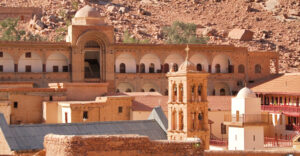
Athens now finds itself confronting Cairo’s invocation of a court ruling that deprives the Monastery of Saint Catherine of Sinai of ownership of its property—holdings it has possessed for centuries. In response, Athens is dispatching a special team of technocrats tomorrow for talks to ascertain Cairo’s intentions and to insist on respect for the prior agreement for an out-of-court settlement.
According to current planning, if necessary, the Greek Foreign Minister, Giorgos Gerapetritis, will also travel to Cairo to attempt, at the highest political level, either to overcome obstacles in the negotiations or to formally and definitively ratify any new understanding.
The third article of the previous settlement (source: Kathimerini) explicitly acknowledged the Monastery’s ownership:
“The parties agree that, in accordance with the Monastery of Saint Catherine’s registration on the World Heritage List, the Monastery, its buildings, its plots of land, its churches, and the related structures referenced in the attached and signed document by both parties, constitute property belonging to the Monastery, which is part of the Greek Orthodox faith.”
Athens insists that this article must be the foundation of any talks and is willing to consider proposals from the Egyptian side, provided they do not undermine the core philosophy of the Agreement. Prime Minister Kyriakos Mitsotakis, in communication with President El-Sisi, emphasized that:
“…the preservation of the Greek Orthodox and pilgrimage character of the Holy Monastery of Saint Catherine in Sinai is of utmost importance.”
It is evident that Cairo, which deliberately allowed time to pass without signing the Agreement—awaiting the court ruling—will now invoke the Egyptian court’s decision (noting that the judiciary’s independence has been repeatedly questioned in EU reports). Cairo is expected to push for drastic changes to the Agreement that would effectively nullify the Monastery’s recognized ownership rights.
Indicative of Egypt’s stance is the Presidential statement issued after the phone call between Prime Minister Mitsotakis and President El-Sisi:
“…The communication emphasized Egypt’s unwavering commitment to preserving the unique and sacred religious status of the Monastery of Saint Catherine, ensuring that this status remains untouched. This commitment is reinforced by the recent court ruling, which aligns with Egypt’s dedication to the sanctity of religious and ecclesiastical sites and confirms the Monastery’s unique heritage, spiritual, and religious status.”
The Egyptian side is attempting to decouple the Monastery’s property ownership from “respect for its religious and sacred character,” thus using the court decision as a shield to backtrack from the Agreement.
Strikingly, the court’s ruling conveniently aligns with this negotiation strategy, granting the monks the right to perform religious duties within the Monastery grounds, but declaring that ownership rests with the Egyptian state, to be managed by the Antiquities Protection Authority.
As a result, the Monastery’s small, mostly elderly monastic community—around twenty in number and with questionable prospects for renewal—is, after 1,500 years of continuous operation, effectively reduced to the status of “guests” within their own premises.
Athens Alarmed: Strategic Dilemmas
The situation has triggered alarm in Athens. While no one wants the Monastery issue to spark a crisis in the highly valued strategic Greek-Egyptian relationship, the failure to honor agreed terms on such a sensitive matter, and attempts to impose a fait accompli, are seen as troubling precedents.
Greece could exert some pressure on Cairo by warning of the consequences this could have—not just for bilateral ties but for Egypt’s broader relations with the EU, from which it hopes to receive €25 billion in aid over the coming years. For the past 12 years, Greece has led efforts to convince Europe to overlook Egypt’s human rights and rule of law issues in favor of rebuilding a strategic partnership with the country and the Sisi regime.
At the same time, with questions surrounding how a future Trump presidency might handle relations with Egypt, any mobilization by the Orthodox world highlighting Egypt’s actions against a historic living Christian monument is unlikely to be well received in Washington, where narratives of “clashes of civilizations” and open displays of Christian faith among key policymakers dominate.
That said, given the negotiation’s inherent difficulties, there is also a view that some form of compromise must be found to accommodate Egyptian domestic political concerns and allow a new agreement that aligns with the court ruling.
A source familiar with the process emphasizes a more “realistic” approach:
“It is crucial to ensure respect for the Monastery’s religious and historical spaces and the monks’ ability to perform their religious duties, regardless of property status.”
Egypt’s Guarantees May Not Be Enough
Cairo appears willing to offer guarantees to maintain the religious character of the Monastery’s spaces and to allow the monks to practice their religious duties without interference. However, this may not be sufficient.
If the monks are stripped of access and rights to their buildings and properties inside and outside the Monastery walls, they will lose the basic means necessary to survive and sustain the Monastery’s continuous operation over time. Gradually, the institution risks degenerating into a mere religious tourism destination.
This is no longer just a challenge to the Monastery’s ownership—it is now legally declared Egyptian state property. This development offers no future assurance if a new Egyptian government decides to withdraw the current guarantees generously offered by President Sisi.
Long Road to a Broken Agreement
Negotiating the agreement had already been a difficult process. Athens waited nearly eight months—with repeated reminders to Cairo—before Egypt designated a representative to engage in negotiations with the Monastery, alongside the Greek delegation.
Eventually, Egypt appointed the Governor of South Sinai as its representative. After painstaking talks, both sides agreed on a settlement granting full ownership rights to the Monastery. The atmosphere was positive, and there were even discussions about signing a Memorandum of Understanding (MoU) to resolve long-term issues such as residence permits and granting Egyptian citizenship to the monks and any newly appointed Archbishops.
The initial understanding was that the Agreement would be signed before President Sisi’s visit. When delays emerged, the expectation shifted to signing during the Athens-hosted Supreme Cooperation Council (SCC). Yet Egypt stalled again.
At one point, the Egyptian Ambassador contacted Archbishop Damianos to inform him of an objection raised by the Egyptian Ministry of Justice—news that caused obvious surprise and dissatisfaction, since the agreement had already been reviewed by all the relevant ministries and authorities.
The Greek side and Monastery representatives repeatedly asked their Egyptian counterparts to clarify what changes they wanted. This never occurred, suggesting the delays were premeditated—timed to coincide with the court ruling issued last Wednesday, which now nullifies the agreed-upon settlement.
Ask me anything
Explore related questions




