





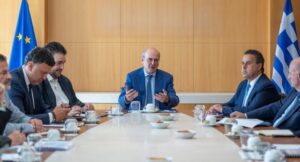
A ministerial meeting to address the problem of water scarcity and the adoption of a National Plan for water management was held today under the chairmanship of Vice President of the Government Costis Hatzidakis.
The meeting presented the data from the latest (2024) study of the World Resources Institute, according to which:
– Greece is ranked 19th in the world in terms of the risk of water scarcity.
– Similar challenges are faced by all Mediterranean countries as the problem is intensifying due to climate change, which is negatively affecting both water supply and demand.
It was also demonstrated that despite the interventions that have been made in recent years (construction of new dams, drilling of boreholes, etc.), the problem persists in Greece, as well as in all Mediterranean countries.
At the meeting, based on the presentation of additional data from EYDAP, PPC, and RAEY, the need for holistic management of water resources in the short, medium,m and long term was highlighted. It also highlighted the need to implement interventions at the organisational level to ensure the timely implementation of the large and small projects needed to address the problem, based on European best practices. All participants underlined that the interventions will be carried out within the framework of the provisions of the Constitution and the decisions of the Council of State that guarantee water as a public good. Further meetings will follow under the chairmanship of Prime Minister Kyriakos Mitsotakis for the further maturation and final formulation of the National Water Plan.
Deputy Prime Minister Kostis Hatzidakis said, “Climate change is here and in relation to water sufficiency. The whole Mediterranean is increasingly threatened by this problem. Any inaction would be a huge problem for the economy, for tourism, for agriculture, for our quality of life, for the country itself. It is clear that, alongside the initiatives adopted in recent years, other initiatives must be adopted that respond to the problem promptly, addressing any organisational problems, promoting the necessary investments, and exploiting new technologies. Water has been and will remain a public good. The State itself has had, has, and will continue to have, by our Constitution, the basic task of safeguarding this public good. For this to happen, however, reality itself requires additional interventions that are well thought out, rapid, and effective, which the government is determined to take forward. The coming months will be very crucial in terms of adopting all the necessary initiatives.”
The meeting was attended by Ministers of Interior Theo Livanios, Infrastructure and Transport (at a distance) Christos Dimas, Environment and Energy Stavros Papastavrou, Rural Development and Food Costas Tsiaras, Shipping and Island Policy Vassilis Kikilias, State Affairs Akis Skertos, Deputy Minister to the Prime Minister Thanasis Kontogeorgis, the Secretaries General for the Natural Environment and Water (YPEN) Petros Varelidis, Waste Management Coordination Manolis Grafakos (YPEN), Union Resources and Infrastructure of the Ministry of Rural Development and Food Dimitris Papagiannidis, Aegean and Island Policy Manolis Koutoulakis and the Advisor to the Prime Minister for Investment Dimitris Politis.
Also participating from RAAEF were the Vice President of the water sector, Dimitris Psichogios, from PPC, the Chairman and CEO, George Stassis, and the Deputy CEO, Alexis Paizis, from EYDA,P the Chairman, George Stergios, and the CEO, Haris Sachinis.
Ask me anything
Explore related questions




