





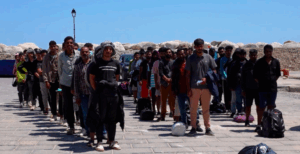
Unlike the mythological Gorgon whose gaze petrifies, Medusa the series does not aim for sensationalist paralysis, but seeks to frame events from angles rarely seen, far from the traditional focus of mainstream headlines. It does not claim absolute truth—rather, it offers an unfiltered portrayal, asking audiences to reflect rather than freeze in place.
Gavdos: Not Just Another “Pilot”
Over the past 12 months, Gavdos, Greece’s southernmost island and EU’s edge in the Mediterranean, has emerged as a primary landing point for migrant trafficking networks operating out of Libya. This small, scarcely populated island—perched between Crete and North Africa—is buckling under immense pressure. The footage captured by Medusa comes without polish, revealing a reality distinct from what unfolded in the Eastern Aegean in previous migration waves. Only if one lets their gaze drift into the turquoise waters of Tripiti might they momentarily lose their bearings—before crashing back to shore, where derelict vessels litter the coastline.
The show’s cameras track migrants from the moment they set out on dangerously unfit vessels until their arrival at the temporary holding facility in Agia, Chania. The images are stark. Local residents and officials alike accuse the state of pushing the crisis under the rug—away from the public eye and political accountability.
Human Geography of a New Crisis: Unseen, Understaffed, and Unspoken
The port authority on Gavdos is emblematic of institutional neglect: just two coast guards rotate every four weeks, working 24/7 with no relief. There’s no internet, no landline, and the only vehicle is in disrepair. A patrol boat is non-existent. Cooperation with Frontex is reportedly dysfunctional—vessels rarely dock, and insiders claim that rather than solving problems, the agency often compounds them.
Migrants arriving on Gavdos are mostly young men under 40, originating from Sudan, Eritrea, Egypt, Yemen, and Bangladesh. Smugglers instruct them to destroy their ID documents, either during the voyage or upon arrival, often after a grueling 48-hour journey from Tobruk across over 150 nautical miles of perilous sea. This corridor, officials say, is even deadlier than the Eastern Aegean routes. Few women and even fewer children risk the journey—an indication that even smugglers recognize the extreme danger.
The statistics are grim: over 2,200 people lost their lives on this route in 2024 alone. More than 1,000 remain unaccounted for. Since 2014, over 25,000 have disappeared in these waters, according to the UN’s migration agency. Most fatalities occur in Libyan territorial waters and are never formally reported. Survivors, like Mohamed from Sudan, bear witness to horrors few can comprehend—first from civil war, then from the sea.
Today, the flow is relentless and weather-dependent: an average of four boats arrives daily, each crammed with 44 to 50 people. Often, the only thing standing between them and drowning is a frayed rope tied by local fishermen.
Interstate Agreement: The Only Viable Path Forward
Despite the risks, as long as the Gavdos route remains open, it will continue to draw desperate migrants and refugees. The island’s infrastructure is wholly inadequate for prolonged migrant management, regardless of the resolve of its residents or coast guard. The Greek Ministry of Migration is reportedly exploring a formal diplomatic initiative with Libya, modeled after similar deals struck by Italy and Malta. But negotiations with a fragmented, unstable Libyan state present formidable challenges.
Without EU engagement, a bilateral deal may not yield sustainable results. Until then, human lives will continue to hang in the balance—measured in inches of tide and the breaking points of local communities in Gavdos and Crete.
Final Note: A Gaze Not to Petrify, but to Understand
Our mission is not to inflame division or feed endless political trench warfare. Our journey to Gavdos stems from an enduring concern about a crisis that Greece has never truly resolved—not for lack of will, and not entirely due to its own shortcomings. Our Medusa is introspective, not paralyzing. It asks not to petrify you—but to share in the reflection.
Ask me anything
Explore related questions




