





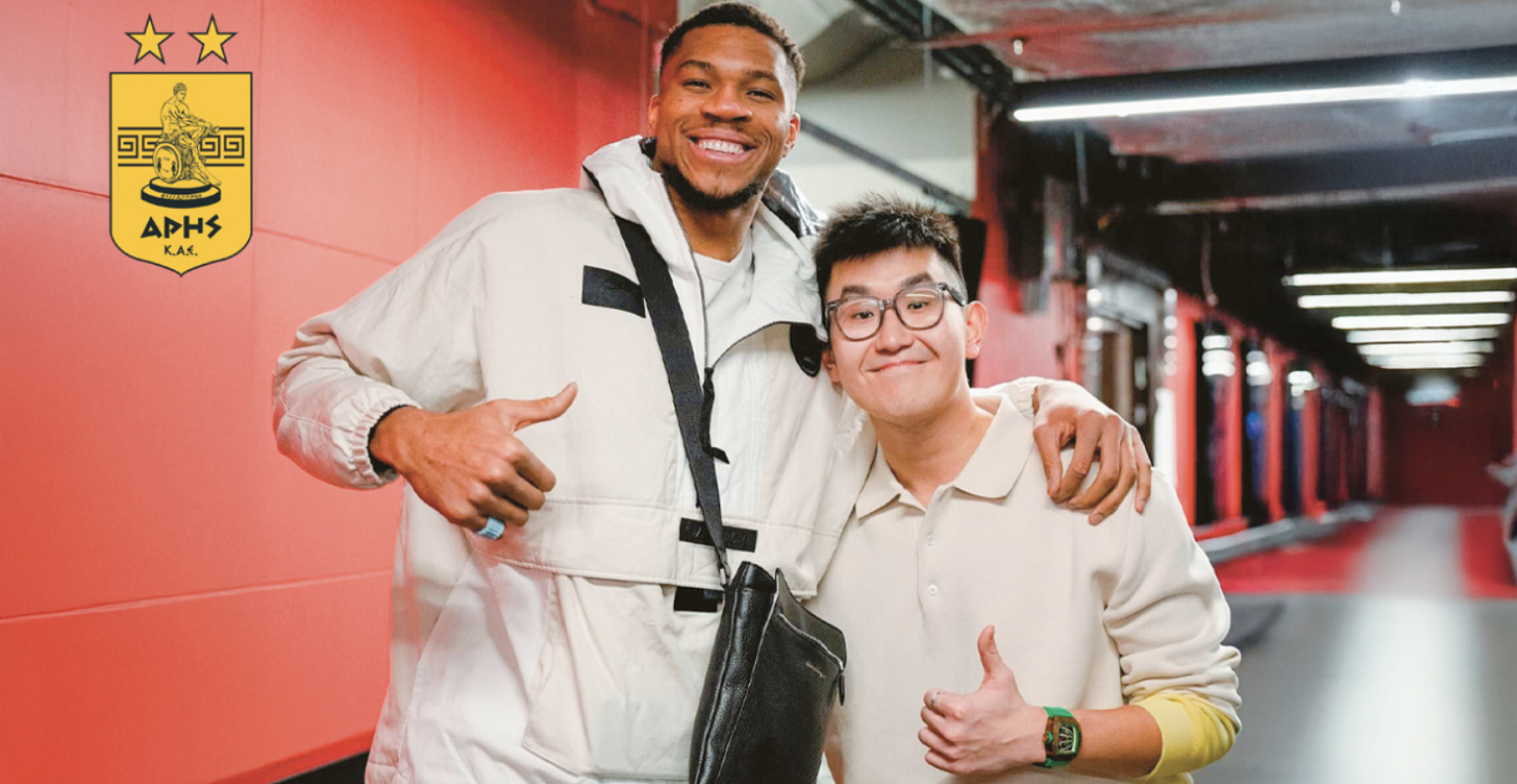
Clubs are changing hands overnight. Global sports giants like the Los Angeles Lakers are being sold for $10 billion, and a large portion of Europe’s football clubs are now owned by Americans, Asians, and Middle Eastern investment funds. Amid this global sports market shift, in Greece, the basketball “emperor” Aris is being taken over with the blessing of Giannis Antetokounmpo.
Richard Xiao is set to become the new owner of Aris’ basketball team in a few days. He comes with a mission to awaken the club from its years-long slumber and restore it to former glory. The 24-year-old Asian entrepreneur had long been seeking a European basketball team to buy and elevate.
Xiao is the founder (since 2020) and CEO of RHC Group, a sports and entertainment investment fund focused on professional sports and beyond. The group consists of RHC Investments Holdings and RHC Initiatives, a philanthropic subsidiary.
Though his company is based in New York, he frequently travels to Milwaukee. A passionate Milwaukee Bucks fan, he maintains a longstanding and close friendship with the Antetokounmpo family. He was there in 2021 when the Bucks, led by Giannis, won the NBA title, and he’s publicly expressed how much he enjoys spending time and traveling with the Antetokounmpo brothers.
Looking to one day invest in the NBA, Xiao has been eyeing European basketball as his entry point. “Right now, due to my age and all those things, it’s not the right time. First, I don’t have enough experience. I want to learn everything, and maybe in the near future – in 5-10 years, or even 20 – who knows? Of course I want to invest in an NBA team, not just because it’s a business investment, but because I love the sport,” he said in an interview with a Milwaukee newspaper.
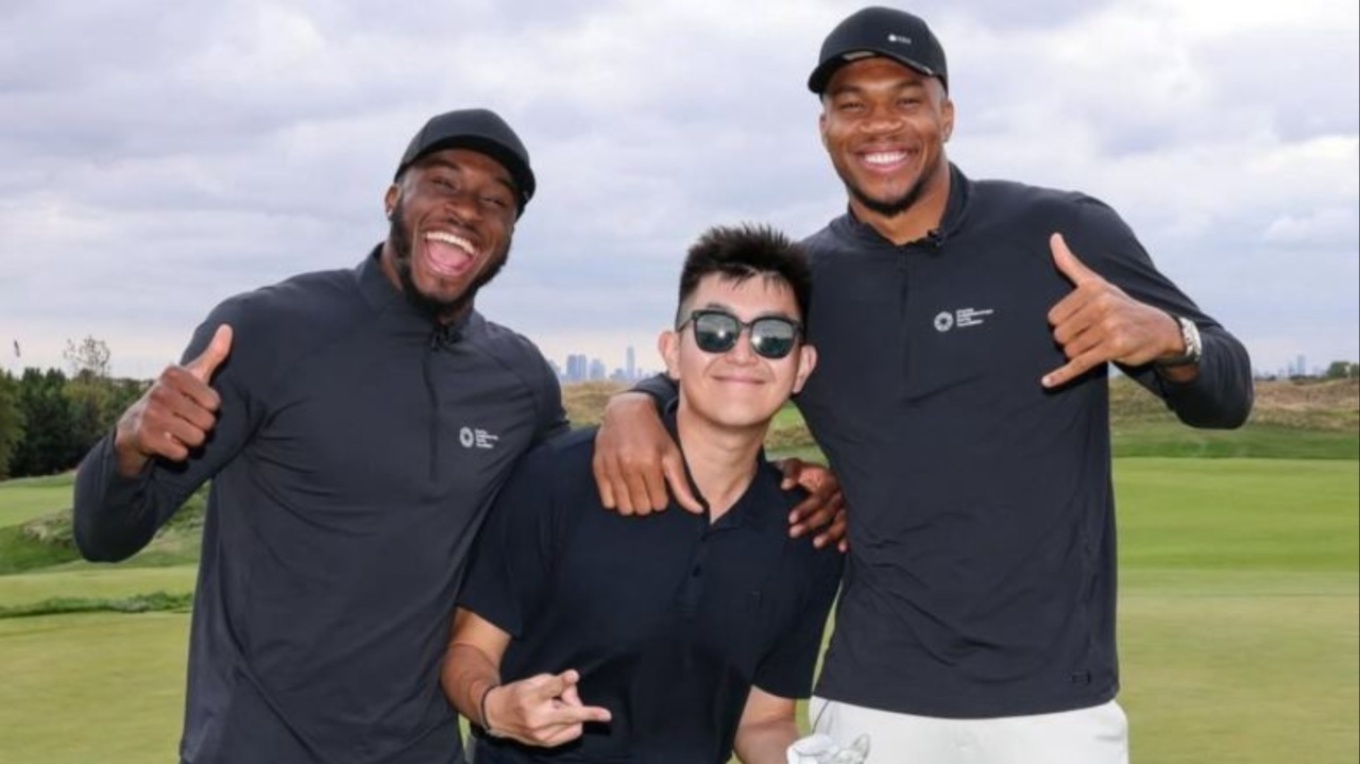
The Role of the Antetokounmpos
The idea of buying Aris came from two economists and fans of the club: Byron Antoniadis, whose father was a former executive of Aris, and Agapitos Diakogiannis – both collaborators with Xiao’s fund. The investor wanted a team with history, a strong fan base, and a home court – and Aris fit the bill. Giannis Antetokounmpo gave the green light for the move, knowing both the people involved and Aris’ legacy in Greek basketball.
According to reports, Xiao’s plan spans five years. First, he will address the team’s debts. Then, starting from year one, he intends to increase the budget by 50%. The goal is to build a competitive team, with Nikos Zisis selected as General Manager (GM). Zisis, a former player and current GM of the Greek National Team, is a longtime friend of Giannis.
The ultimate goal is to qualify for the EuroLeague through the EuroCup. Meanwhile, another significant transaction is in the works in Greece. Algerian businessman Haya Hassine – involved in sectors from healthcare and pharmaceuticals to sports management – is set to become the new owner of football club Atromitos, buying it from George Spanós.
However, that deal remains uncertain. According to an official Sunday night announcement from the club, “the investor has requested additional time to fulfill the agreed terms before proceeding with the formal transfer.” As such, that deal is still up in the air.
Staggering Numbers
Top global investment firms and academic studies estimate that sports is now the world’s 9th largest industry, encompassing not only athletes and teams but also media, marketing, merchandise, and apparel. In 2024, the sports industry is projected to generate €2.626 trillion, a 16% growth over four years – remarkable considering the period includes a global pandemic and armed conflicts that sidelined Russia from the sports map.
Lakers vs. Celtics: The Crown Jewels
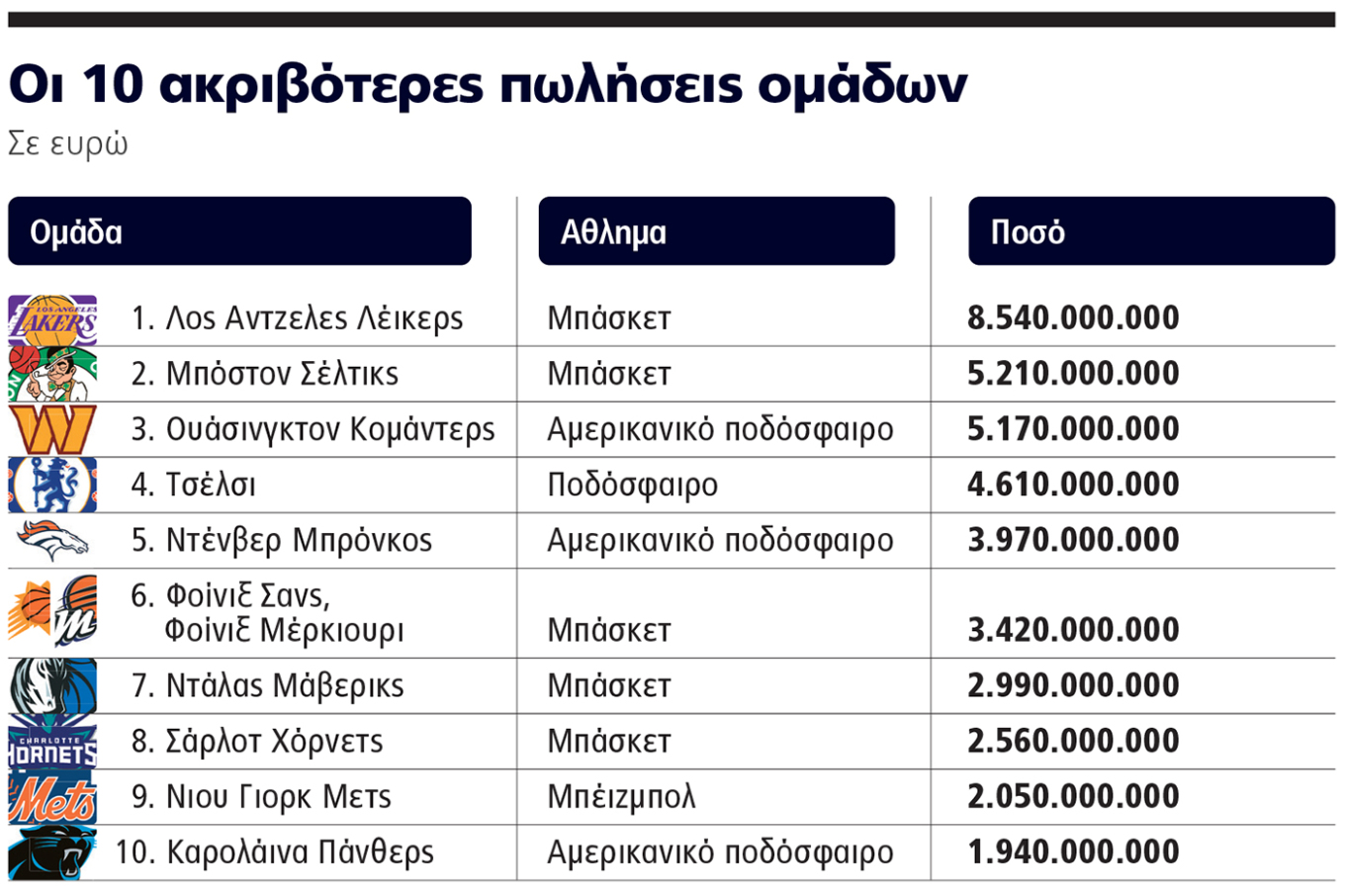
The Lakers and Celtics are the most iconic franchises in American sports. With their rivalry dating back to the 1950s, they boast the most NBA championships: Celtics with 18, Lakers with 17 (12 in L.A. and 5 in Minneapolis). Their finals matchups are legendary, and now they also top the list of the most expensive sports club sales in history (pending formal NBA board approval).
The Celtics were first, sold by the Grousbeck brothers (owners since 2002) to a group led by William Chisholm, head of Symphony Technology Group, which manages around $10 billion and specializes in software business growth. Chisholm’s group paid €5.21 billion for the Celtics – a record, surpassing the €5.17 billion sale of the Washington Commanders (NFL).
But that record didn’t last. Last week, Mark Walter, founder of TWG Global, agreed to buy the majority stake in the Lakers from the Buss family for €8.54 billion ($10 billion), shocking the NBA. Once finalized, Walter will become L.A.’s sports mogul, having already owned the L.A. Dodgers (MLB champions this year) since 2012.
The Buss family purchased the Lakers in 1979 for $67.5M and sold the franchise for $10B 46 years later, per @ShamsCharania 🤯💰 pic.twitter.com/6RWetixZVh
— Bleacher Report (@BleacherReport) June 18, 2025
Confident in Their Returns
In the U.S., even the most passionate owners invest with profitability in mind. In the 2023–2024 season, the Celtics earned $420 million and the Lakers $445 million. These figures are expected to skyrocket under a new 11-year $75 billion media deal with Disney, Amazon, and NBC, beginning next season.
Both new owners also plan to monetize the global appeal of these brands and harness new technologies to maximize fan engagement. U.S. leagues dominate the list of the ten most expensive club sales – NBA, NFL, and MLB occupy nine of the ten spots. Football (soccer), despite being the world’s most popular sport, only appears once: Chelsea, the 4th most expensive deal, was acquired by a group led by Todd Boehly, who also co-owned 27% of the Lakers with Walter. Walter, in turn, held a significant stake in the group that bought Chelsea from Roman Abramovich.
Arab Interest and NBA Inroads
This brings Arab investors into the picture. Two months before the Lakers deal, Walter’s TWG Global signed a strategic partnership with Mubadala Capital, Abu Dhabi’s sovereign wealth fund, which also controls the City Football Group – owners of Manchester City, among others.
Mubadala Capital’s CEO Khaldoon Khalifa Al Mubarak and his brother Mohammed – both Lakers fans and U.S.-educated – lead Abu Dhabi’s cultural and tourism authority. In an ESPN interview last October, Mohammed said: “Of course we are interested in acquiring a majority stake in an NBA team someday. What we’ve done with City Group shows how seriously we take investing in sports.”
NBA rules limit sovereign wealth funds to 20% ownership, so while Arab investors can’t yet control a team outright, through sponsorships and partnerships, they are now entering the NBA world.
The Soccer Investment Boom
The NBA’s club-buying spree (Mavericks, Suns, Timberwolves, Bucks) mirrors a trend in football. U.S. investors have long had a foothold in European soccer, now joined by Russians (like Abramovich), Chinese (mostly earlier in the 2010s), and increasingly Arabs.
Why invest in soccer? Profit. Many acquisitions post-COVID have focused on struggling clubs, often at better value than buying into U.S. leagues. Example: Real Salt Lake (MLS) sold for €511 million, whereas Newcastle United, with a massive fan base and sell-out stadium, was bought by Arab investors for €341 million.
Now, 3 of the top 5 Premier League teams (Liverpool, Arsenal, Chelsea) are U.S.-owned. With the sale of Everton to the Friedkin family, 50% of the Premier League (10 of 20 clubs) are owned by U.S. interests. Across the three lower divisions in England, 23 of 72 clubs are American-owned.
In Spain, 50% of second division clubs have investors from the Americas (mostly Latin America), and six La Liga teams have partially or fully foreign ownership.
In France, PSG was the first club owned by a state fund (Qatar). Marseille and Lyon are American-owned, though Lyon is in crisis and near relegation – their owner, John Textor, also invested in Brazil’s Botafogo and formerly in Crystal Palace (UK).
Aris’ Legendary Basketball Reborn Through an Asian Fund and the Antetokounmpos
Ask me anything
Explore related questions




