


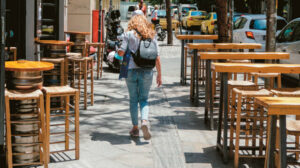
On the sidewalk of a busy street in the capital, pedestrians are forced to zigzag between café and restaurant tables and their patrons. Chairs are placed on tactile paving for the visually impaired, while umbrellas extend to the point of covering traffic lights. Passersby can’t help but wonder: “Who authorized this arbitrary occupation of public space?”
The bitter answer to this (largely rhetorical) question is: no one. Supporting this claim, a report by the Court of Audit reveals that 50% of businesses using public space for tables and chairs lack the required municipal permits, while 27% of those with permits exceed the authorized space. Inspectors have observed entire sidewalks—and even roads—illegally occupied by businesses, while municipalities often turn a blind eye, citing staff shortages. According to the Court’s 8th Department, there is no accessible system to inform citizens of the terms of public space concessions, thus hindering active public participation in protecting common areas. The report underlines that developing the MyStreet app is of critical importance.
Like MyCoast, but for Sidewalks
Modeled after MyCoast, the MyStreet app will allow citizens to monitor public space leases and submit complaints. It’s set to launch on July 21. Municipalities are currently uploading business licenses and public space permits for food and beverage establishments to the platform. Ironically, these municipalities are often part of the problem, as their staff ignore violations and refuse to impose or collect fines. Now, however, citizens enter the picture. Could this be the beginning of the end for the chaos of tables on sidewalks and public squares?

Dimitris Papastergiou – Minister of Digital Governance
“Let’s begin with a few facts. First, public space unquestionably belongs to all of us. Second, the occupation of sidewalks, squares, and public areas by tables and chairs is widespread,” says Minister of Digital Governance Dimitris Papastergiou to Proto Thema. Referencing the recent audit in 14 municipalities, he explains:
“The figures are alarming, and the issue is serious. With MyStreet, we ensure that people with disabilities, seniors, parents with strollers—everyone—can access public space freely. This initiative is a collaborative effort with local governments. Citizens will be able to see real-time leases for cafés, restaurants, and other businesses. If they spot a violation, they can easily report it, anonymously or not, via their phones, and the relevant authorities will act.
Furthermore, with the Unified Register of Public Spaces, we provide municipalities with a valuable tool for transparent and effective management. Protecting public spaces is a top priority for both the government and local authorities. These areas are vital to daily life—they’re places for leisure, fitness, socializing, and ultimately reflect the quality of life in our cities.”
A Centralized Digital Registry Is Coming
Officials from the Ministry of Digital Governance stress the significance of MyStreet in tackling illegal occupation of public space, announcing the development of the Unified Register of Public Spaces—a central digital platform where all lease decisions from municipalities will be stored and managed.
In the future, MyStreet will also include information on AED locations, EV chargers, parking for people with disabilities, and other vital infrastructure throughout the country.
The One Who Serves… Also Drinks
The core issue is that those meant to regulate this chaos are also the ones being regulated. And experience has shown that this undermines the public interest. The Court of Audit’s report notes:
“During the license issuance process, there is no indication of a proper legal review to prevent unauthorized occupation of public space.”
It finds that municipal enforcement mechanisms are ineffective, citing the lack of:
- A unified, up-to-date regulatory framework at the local level.
- Current and complete regulations specifying which spaces may be leased and under what conditions.
- A digital archive or interoperability between departments such as revenue and municipal police.
- Risk-based planning for inspections.
In many regional municipalities, inspections are minimal or non-existent, and the “lack of staff” excuse is deemed unconvincing.
We All Know What’s Happening
This dysfunctional system—where municipalities issue permits for tables, refrigerators, and counters, sometimes in defiance of legal norms—is no secret. In crowded city sidewalks (often called “catwalks”), tables are installed that block pedestrian or vehicle passage. Even in central neighborhoods of Athens, one can find:
- Tables on tactile paving (law requires 50 cm clearance on each side),
- Obstacles for people with disabilities or baby strollers,
- Less than half a meter left for passersby,
- Permanent structures (umbrellas, partitions) drilled into the pavement,
- Public spaces turned into storage areas, with furniture chained up during off-hours.
Who approves all this? Who inspects it? Who ensures penalties are enforced?
The reality is even worse than it looks. Opacity reigns, enabling those who want to break the law—or look the other way—to do just that.
Until now, municipalities weren’t even required to upload public space lease contracts to the Diavgeia transparency platform. Citizens had no way of knowing whether a business’s occupation of space was legal or not—or even which areas could legally be used.
If someone was bothered by a blocked sidewalk, they’d have to ask their municipality whether it was legal and to what extent. They’d get an answer only if the officials felt like it, and only if they had a legitimate interest. Even then, complaints rarely resulted in updates, let alone action.
And if a municipality can indefinitely delay granting a disabled person a parking space—while a neighbor opens an illegal “private parking” lot—why wouldn’t the same happen with tables?
The Court of Audit’s report concludes that little or nothing is done to fix the issue. In regional municipalities, very few or no inspections are carried out. Even when violations are detected, the typical response is a recommendation or a fine, with no monitoring of space restoration. Removing permanent structures proves extremely difficult, due to the involvement of multiple agencies and long delays—sometimes years—in the process.
It also notes a major gap between imposed fines and what is actually collected.

What MyStreet Brings
The MyStreet app, launching mid-July for iOS and Android, aims to fix these problems. Simple and user-friendly, it promises:
- Transparency: Citizens get detailed information about public space leases.
- Ease of Reporting: Quick reporting of any violations involving use of public space.
- Legitimacy: Complaints are accurately recorded and sent directly to the responsible authorities.
How the App Works
- Real-Time Info: Users can see active leases for café, restaurant, or business seating on public land.
- Interactive Map: Displays the boundaries of leased spaces, lease size, start and end dates.
- On-Tap Details: Clicking a location shows the permit type, duration, and space limits.
- Location Services: The app uses geolocation to help users check nearby leases.
Submitting Complaints
- Users can submit anonymous or named complaints.
- Complaints can include photos, descriptions, and GPS data.
- Named complaints require Taxisnet login for authentication.
- There’s a limit on how many complaints a user can submit for the same spot, and the user must be physically present at the location.
Even for areas not shown as leased, users can manually select a point on the map and report violations. Complaints are automatically sent to the digital platform of the Unified Public Space Registry, managed by the relevant municipality, enabling faster assessment and response by authorities.
Ask me anything
Explore related questions