





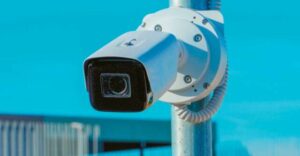
“In the era of social media, where we’ve handed over our personal data to just about anyone, is it really possible that we’re bothered by a camera?” This question may sound reasonable to many, but not to the members of the Hellenic Data Protection Authority (HDPA).
The people entrusted with guarding our sensitive personal data like watchdogs are once again in the spotlight, issuing opinions and…handing out fines to private individuals whose cameras captured images of their neighbors’ homes. The incident has reignited discussions: What is allowed when it comes to using cameras? Where can they point, and when might I get into trouble?
The issue came to light last week, when the Authority ruled that two private individuals, who had been sued by their neighbors, must pay €6,000 in compensation because three of their cameras recorded parts of the plaintiffs’ property, violating the general regulation on lawful use.
This reveals one of the two key aspects of what is and isn’t allowed when operating surveillance cameras. Guidance and answers come from the General Data Protection Regulation (GDPR) 2016/679 and Directive 1/2011 of the HDPA. What do they say?
Essentially, the opposite of what usually happens since the Greek market was flooded with ultra-modern cameras: devices that record in high-definition color, rotate, zoom, have speakers, connect to smartphones, and cost as little as €10. In short, the law does not allow recording public spaces and advises avoiding even capturing people in private spaces. It also prohibits processing any recorded footage.
This is why, in cases of traffic accidents or crimes, both victims and authorities often face refusals from shop owners or individuals who possess cameras that might have captured the events. As the Authority notes, “respect for privacy and protection of personal data is not an obstacle to safety, but a prerequisite for its legality.”
In the specific case, the HDPA ruled that although the cameras were installed for personal use in a residential property, the same building also housed a business. Therefore, the cameras could not be deemed exclusively for personal or domestic use but also served professional purposes.
So, while security cameras can now be installed virtually anywhere — from doorbells to car dashboards and motorcycle helmets — it’s easy to start feeling paranoid. In Greece, however, the use of such systems is subject to strict rules. There are laws, fines have been imposed, and courtrooms have often dealt with camera-related disputes. So, let’s look at what’s allowed and what’s not.
When the Neighbor Is Nosy
It’s a familiar image: a camera placed at the entrance of a house or apartment, pointed at the yard or balcony. So far, so good — as long as it doesn’t “drift” and record the street, sidewalk, or the entrance of the house across the street. Naturally, it must not record the windows of the neighboring home like a digital peephole.
The GDPR 2016/679 states that cameras used exclusively for personal/domestic use are exempt from its scope. However, this exemption holds only if no public space or person is recorded. This means that even if a camera captures just part of the sidewalk, it stops being a “private matter.”
The HDPA has fined people for such cases. In a notable ruling (HDPA 32/2017), a homeowner was penalized because their cameras recorded a public road, exceeding what was strictly necessary.
In apartment buildings, the situation is more complex. Installing surveillance systems in shared areas (entrances, hallways, parking garages, elevators) requires a general assembly decision with a qualified majority (at least two-thirds of the owners), identification of the data controller, recording in the activity log, and proper signage with information about who operates the system and why.
Even at your own apartment door, the camera must be placed so that it does not record anything else — not neighboring doorways, common hallways, or people passing by. Most complaints brought before courts and the HDPA involve neighbor disputes.
In summary, placing cameras in private homes is allowed only if they record exclusively private areas. If the lens “wanders” to the street, shared garage, or, worse, a neighbor’s window, then the owner becomes a data controller and is liable under the law.
And a strong candidate to pay a hefty fine imposed by the HDPA, which states:
“The use of cameras in homes to monitor private areas is allowed only when strictly necessary and not recording public or shared spaces.”
In reality, private residences have no reason to record public spaces — something the Authority has affirmed repeatedly. In decision HDPA 16/2020, a homeowner recorded the sidewalk outside his house “to monitor who was approaching his door.” The Authority fined him and ordered a system change, ruling that “a private individual may not record shared space without proving a real and serious security reason.”
Turn Off the Store’s Camera
Even more striking is decision HDPA 43/2022, where a citizen installed a 360° rotating camera on the facade of his home, covering an entire neighborhood square. The Authority, in a ruling meant as a warning against excessive technology use, found a violation of Article 5 of the GDPR and fined him €8,000.
In businesses, cameras often feel essential. Monitoring areas like cash registers, entrances, or storage rooms is considered necessary for security. However, security must not violate privacy. That’s why video surveillance in workplaces is permitted only under strict conditions.
Law 4624/2019, which supplements and specifies GDPR in Greece, clearly states that recording is allowed only for security purposes, not to monitor employees.
In decision HDPA 26/2019, a shop’s cash register camera was continuously recording employees without informing them. This breached the principles of necessity and transparency. The fine was €5,000, and the controller was ordered to destroy the footage.
Moreover — and this should go without saying — cameras are strictly forbidden in break rooms, changing areas, kitchens, or toilets. Even to prevent theft, monitoring personal moments of employees or customers is unjustifiable.
Such areas (kitchens, lockers, WC) are considered off-limits, as stated in the HDPA’s CCTV Guide:
“Recording in areas of personal use or leisure, even under the pretext of security, is incompatible with GDPR’s core principles.”
Clear signage is also required, displaying the data controller’s name, the purpose of the recording, and contact information.
But what about recording public spaces? Many small businesses place cameras not only at the entrance but also aimed to capture parts of the sidewalk or street. Even if the intention is to prevent crime, the legality of recording public spaces is tightly regulated.
The Authority is clear: “Video surveillance may not extend to public space, unless there are particularly well-substantiated conditions of heightened risk, and only if it does not systematically monitor people’s behavior.”
Is a dashboard camera allowed in Greece?
In recent years, as road conditions have worsened, more and more Greeks are turning to the use of so-called dash cams—cameras mounted on a car’s dashboard or rearview mirror to record activity and serve as evidence in case of accidents or disputes. While initially intended as a kind of “black box” for vehicles, these cameras have also captured some of the most viral videos featuring outrageous moments on Greek roads.
Some modern car models even come factory-equipped with built-in cameras that record the surroundings either while driving or when the car is parked. That means, for example, the envious neighbor who used to key a newly purchased car might now find himself in legal trouble. But is such recording actually allowed?
Here, things get a bit murky. Recording the road with a dash cam is not illegal in itself, provided that:
Footage is not stored continuously, but only in the event of a collision.
Images showing identifiable faces or license plates are not published without consent.
The camera is not used to deliberately monitor third parties.
So, vehicle cameras are not outright banned, but they are also not entirely unrestricted. The key factors are the purpose and the duration of the recording. If the camera is continuously recording and storing footage without an incident, that constitutes data processing without a lawful basis. However, if it only stores data in the event of a collision—and there’s no public disclosure—then it’s generally considered within legal boundaries.
What happens in the case of an accident?
In the event of a traffic accident, the use of footage recorded by a dash cam is permissible in court, provided that no other fundamental rights have been violated. As the Greek Data Protection Authority (DPA) notes, “recording for evidentiary purposes does not automatically lift the responsibilities of the data controller.”
In short, while dash cams can be useful for protection and evidence, they must be used carefully and within the framework of privacy laws. The GDPR still applies, and violations—such as publishing images of people without consent or using the camera for surveillance—can lead to fines or legal consequences.
Ask me anything
Explore related questions




