





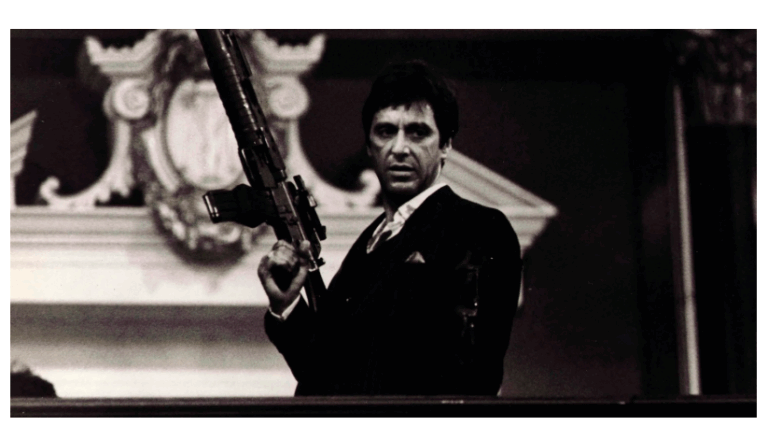
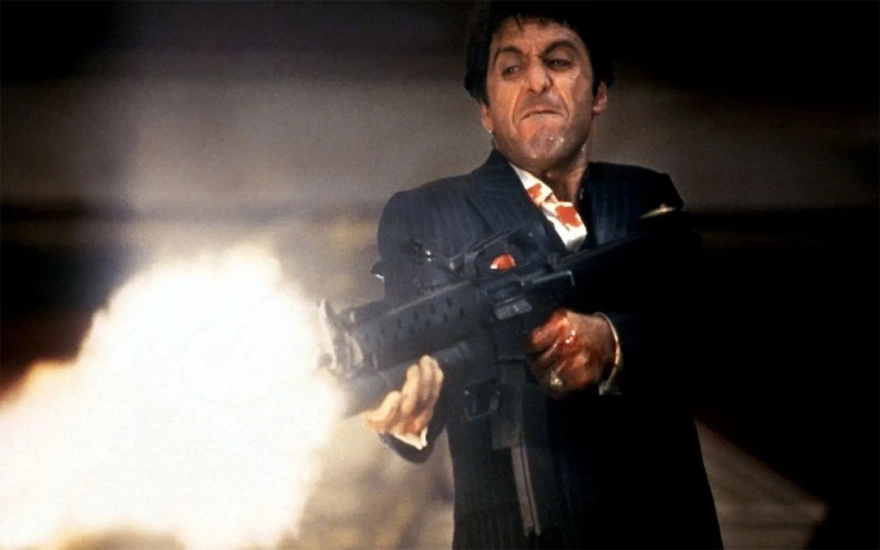
On a warm spring night in March 1983, Al Pacino was giving it his all in the final scene of Scarface. He delivered the iconic line, “Say hello to my little friend,” holding an M16 with a grenade launcher attachment and firing indiscriminately at everything that moved. After firing thirty rounds and several grenades, his left hand accidentally touched the scorching barrel of the gun, resulting in a serious burn.
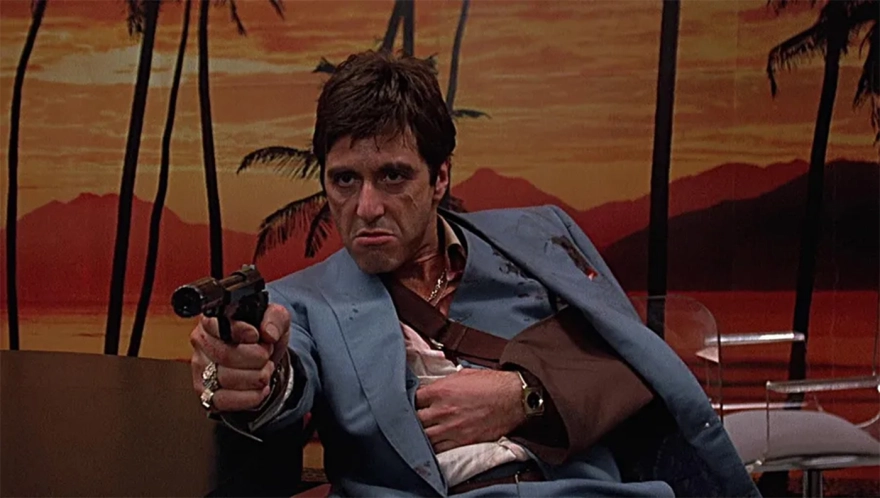
When he was rushed to the hospital, a doctor on call looked at the man in blood-soaked clothes with near disdain. As they prepped to clean the wound, she asked if he was Al Pacino. When he confirmed, she said, “At first I thought you were some bum…”
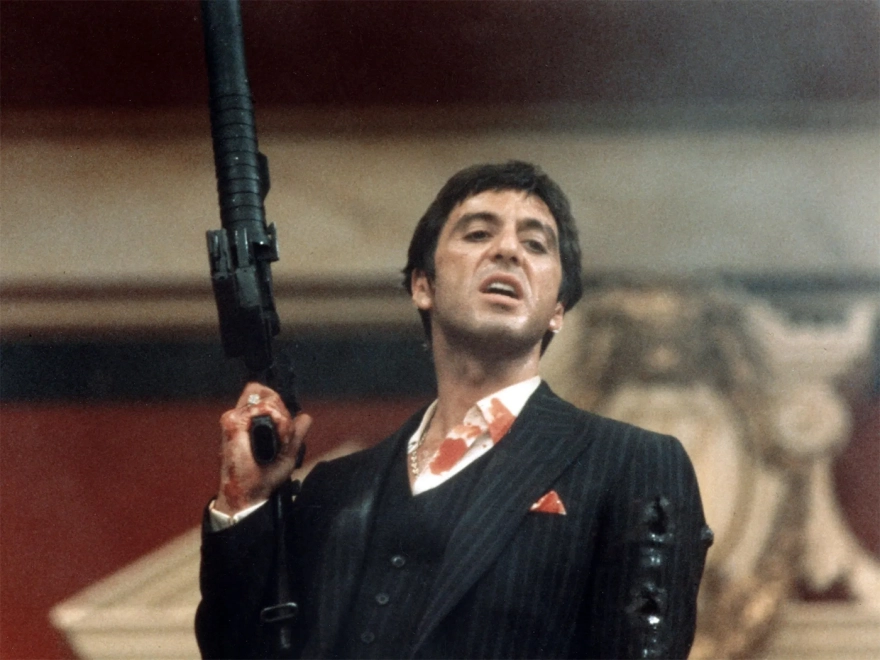
That hospital scene opens the chapter in Pacino’s autobiography Sonny Boy, which focuses on the now-legendary Scarface—a film that was extremely violent for its time. Pacino played Tony Montana, a Cuban immigrant whose blood-soaked rise to power involved murder, betrayal, deals with drug lords, and a fatal woman.
According to the book, published by Key Books, Pacino was inspired to remake Scarface after watching the 1932 original directed by Howard Hawks with some friends. The new version was set in contemporary America, during the 1980 Cuban immigration wave under President Jimmy Carter. That’s when 125,000 Cubans left the island with Fidel Castro’s blessing and arrived by boat in Florida, looking for a new beginning.
“Goodbye Sidney, Hello Brian!”
The idea to cast Cubans in the lead roles came from the original director, Sidney Lumet, which screenwriter Oliver Stone supported. However, Lumet soon realized his vision—a socio-political film—clashed with the bloody saga envisioned by producer Martin Bregman, Pacino’s close friend.
So Lumet left after reading the script, and Brian De Palma took over. Pacino, in the meantime, took intensive language and accent lessons from Steven Bauer, the only Cuban actor in the cast.
Problems started immediately. When the crew arrived in Miami, the local Cuban-American community, aware of the film’s content, strongly objected. As a result, filming was mostly moved to Los Angeles, Santa Barbara, and California, with only a few scenes shot in Miami. Shooting lasted from November 22, 1982, to May 6, 1983.
Tony Montana: A Guilty Fantasy
Tony Montana became the guilty fantasy of millions—rising from a dishwasher at a food stand to a cocaine kingpin making multimillion-dollar deals. Anyone who stood in his way was swiftly eliminated by the “cara cicatriz” (“scarface”), who lived by the motto, “The world is yours,” and climbed to the top at breakneck speed.
But Tony’s meteoric rise was destined to end with a spectacular fall—depicted in the film’s final scene. Pacino, allegedly having snorted continuous lines of coke (De Palma never confirmed if the drug was real; Pacino denied it), goes to war against a small army sent to kill him.
Spielberg, Cocaine, and the Critics
The cocaine seen on screen was powdered milk, although urban legend suggests real drugs were present on set, hidden from Oliver Stone—who was in recovery at the time. True, however, is that Steven Spielberg, visiting the set, directed the final scene with De Palma’s permission using a single camera. That’s the shot of Pacino on the floor, enraged, foaming at the mouth, trying to reload his M16.
After filming and editing, De Palma had to recut the film three times to get the rating they wanted. The word “fuck” was used 207 times, and 42 people were killed on screen. But in the end, De Palma submitted the original cut for theatrical release.
Critics slammed the film, but audiences loved it—especially gangsta rappers who treated it like scripture. In the years that followed, many of those critics changed their minds. And if we judge a film’s value by its cultural impact, Scarface is now considered one of the greatest and most influential films of all time.
Ask me anything
Explore related questions




