





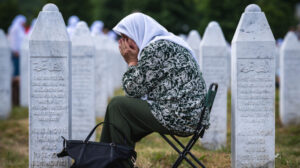
Thousands of people gathered today in Srebrenica to honor the victims of the genocide committed by Bosnian Serb forces 30 years ago.
The event was preceded by a three-day “peace march” spanning 100 kilometers, along the same route taken in July 1995 by thousands of Srebrenica residents trying to reach Tuzla, crossing through territory controlled by Bosnian Serb forces. Many did not survive the journey.
🇧🇦 Il y a 30 ans, les forces serbes massacraient 8 000 hommes et adolescents musulmans à Srebrenica.
— Camille Stineau (@CamilleStineau) July 10, 2025
Voilà où mène l'islamophobie et les discours déshumanisants qui se multiplient en France. Nous devons les arrêter, par TOUS les moyens, avant qu'il ne soit trop tard. pic.twitter.com/t584YaEUJn
On July 8, 1995, Serbian forces under the command of General Ratko Mladić launched an operation to seize Srebrenica. The town was a UN-protected enclave sheltering tens of thousands of civilians.
“Srebrenica is turning into the largest slaughterhouse, with dead and wounded being continuously brought to the hospital. The situation is indescribable. Every second, three deadly shells hit the city. Just recently, 17 dead and 57 wounded were brought to the hospital. Is there anyone in the world who can come and witness the tragedy unfolding in Srebrenica and its people? A crime is being committed here against the Bosnian (Muslim) population.”
This was the last dispatch by journalist Nino Čatić, broadcast on July 10, 1995, by Bosnia’s public television (TVBiH). His fate remains unknown to this day.
A day later, Bosnian Serb forces entered Srebrenica. The population sought refuge in the village of Potočari, where the Dutch UN peacekeepers had their base.
In front of cameras, General Mladić assured the civilians of their safety. But once the media lights were off, the horror began. Mladić’s forces allowed only women and children to leave Srebrenica. The men – and even some teenage boys who looked older – were taken to camps and subsequently executed.
Between July 11 and 17, 1995, more than 8,000 Bosnian Muslim men and boys were executed in Srebrenica. Of those, 1,042 were teenagers. To this day, around 7,000 victims have been found and identified in mass graves and buried at the memorial site in Potočari.
In 2007, the International Criminal Tribunal for the former Yugoslavia (ICTY) officially recognized the Srebrenica massacre as genocide. A total of 54 individuals were convicted for the genocide, including Ratko Mladić, receiving a combined sentence of 700 years in prison.
juli je…#srebrenica#genocid pic.twitter.com/WFPOiiGWbY
— Ramo Bunić (@ramobunic) July 8, 2025
Serbian Leaders Still Deny the Term “Genocide”
The political leadership of the Bosnian Serbs, as well as that of Serbia, still refuses to accept the term “genocide” for what happened in Srebrenica.
Serbian President Aleksandar Vučić, on the 30th anniversary of the genocide, referred to it as a “crime” and offered an apology to the Muslim population on behalf of the Serbian people.
juli je..
— Ramo Bunić (@ramobunic) July 9, 2025
grijeh je zaboraviti#srebrenica#genocide pic.twitter.com/A5Zq4Vu19X
UN Declares July 11 a Global Day of Remembrance
In 2024, the United Nations General Assembly passed a resolution declaring July 11 as the International Day of Remembrance of the Srebrenica Genocide.
Ask me anything
Explore related questions




