





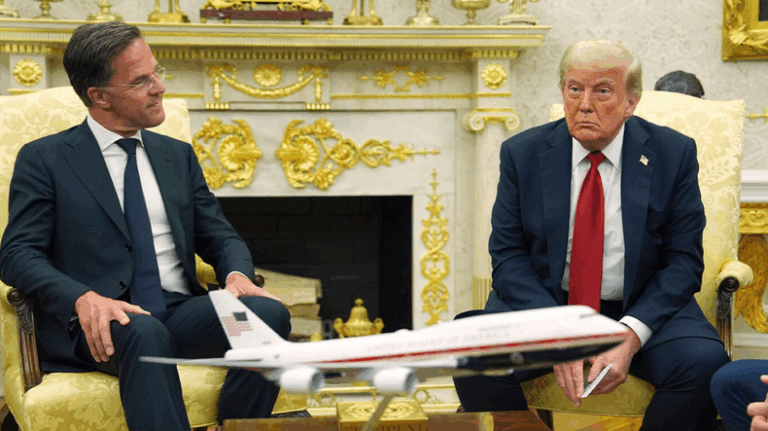
NATO Secretary General Mark Rutte is in Washington, where he is meeting U.S. President Donald Trump at the White House. Also present are U.S. Vice President J.D. Vance and Secretary of State Marco Rubio.
During the meeting, Trump emphasized that he is “very dissatisfied” with Russia over the war in Ukraine. “We will impose very strict tariffs if no agreement is reached in 50 days,” he stated. He referred to these as “secondary tariffs” and said they would be set at 100%. Trump stressed that he wants the war in Ukraine to end and added that he is “disappointed” in Russian President Vladimir Putin.
When asked about the possible tariffs against Russia, Trump said that secondary tariffs can be imposed without the approval of Congress or the Senate. When asked about calls for 500% tariffs on Russia, he replied that the exact percentage doesn’t matter beyond a certain point, and that 100% tariffs would serve the purpose.
Trump also said he felt he had reached an agreement with Russia to end the war in Ukraine “about four times. And here we are still talking.” “I thought we would have reached a deal a long time ago, but the situation keeps dragging on,” he added.
At the same time, the U.S. president stated that the U.S. is building the best equipment and missiles, clarifying that these weapons will be sent to NATO countries, which will cover the cost.
“Russia Must Focus on Trade, Not War”
Trump added that Moscow needs to get its economy back on a growth trajectory. He said Russia has “enormous potential” and should use its resources for trade, not war.
“I talk to him a lot,” Trump said about Putin, emphasizing that while their conversations are pleasant, they “mean nothing” when missiles are hitting cities.
U.S. Sending Weapons to Ukraine
According to Trump, the distribution of weapons systems to Ukraine will be coordinated through the NATO alliance. “We’ll make top-tier weapons and send them to NATO,” he stated, adding that the alliance will direct them where they are most needed.
The weapons the U.S. will send to NATO in support of Ukraine include Patriot air defense systems and missile batteries.
For his part, NATO Secretary General Mark Rutte, who Trump gave the floor to, welcomed the decision, calling it “truly significant.” He said the initiative will allow Ukraine to continue defending itself against Russia and reiterated that the funding will come from European allies. Trump commented that this is “absolutely reasonable,” while Rutte added that Europeans are “accelerating efforts,” building on the success of the recent NATO summit.
Rutte stressed that NATO’s decision will allow Ukraine to obtain “massive quantities of military equipment,” primarily for air defense, missile systems, and ammunition. He called the development excellent news for Kyiv, thanking President Trump for the initiative.
Additionally, Trump reiterated that if he had been in the White House in 2022, the Russian invasion of Ukraine would not have happened. In his speech, he listed a series of international crises that he claimed to have resolved in the past, emphasizing his frequent communication with Putin and that he saw the war coming.
“It’s all just talk until missiles fall on Kyiv,” he stated, noting that the situation “must end.” He also announced that billions of dollars in military equipment will be distributed to Ukraine to bolster its defense against Russia.
At the same time, he praised the courage of Ukrainian soldiers, noting that they “continue to fight with tremendous bravery,” but also acknowledged that Ukrainian forces are losing critical military equipment on the battlefield.
In the same vein, Rutte accused Russia of using bombings against Ukrainian cities not for military targets, but to spread panic among the civilian population.
Praise for NATO – “We Made a Lot of Friends”
Praising the NATO defense alliance, Trump referred to recent agreements aiming to increase defense and security spending from 2% to 5% of each country’s GDP by 2035.
He said that significant progress has been made since the recent NATO summit in the Netherlands and mentioned that the U.S. “made a lot of friends there,” describing some of the countries as “outstanding people” and “mostly stable and strong nations.”
Ask me anything
Explore related questions




