
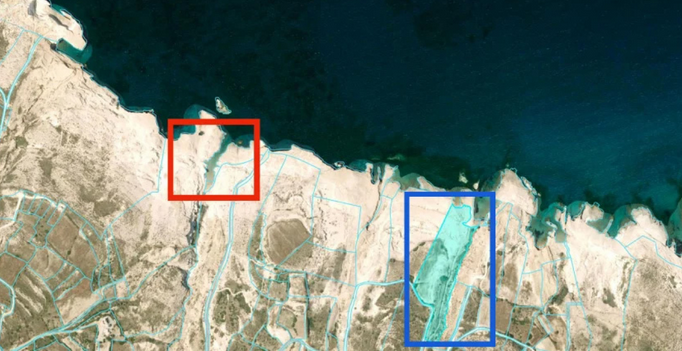
In an especially severe report, the National Transparency Authority fully invalidates the legality of the building permit for the construction of a luxury hotel in the Kaminia area of Milos, just a few kilometers from the famous Sarakiniko beach. The damning report reveals that the permit for the construction of a hotel complex on a 19-acre plot with a capacity of 54 beds – first revealed last February by THEMA – was issued based on multiple irregularities, the most critical being the lack of access to a recognized public road, as explicitly required by legislation for areas outside city plans, as well as the absence of a defined adjacent stream.
Moreover, at the time the building permit was issued, the boundaries of the nearby beach had not been officially validated, a condition that constitutes grounds for nullification, while final approval from the Ministry of Culture’s archaeological department was granted in December 2024, after the building permit had already been issued. Added to these omissions is the fragmented application of environmental legislation, all of which, according to the report, lead to the revocation of the building permit. Before that, the Transparency Authority – which received the case file from the Ministry of Environment and Energy (YPEN) – has already forwarded the case to the Appeals Prosecutor for an assessment of potential criminal charges.
The investigation brings to light a complex network of institutional gaps and arbitrary interpretations by the involved services, while simultaneously pointing out the reluctance of the then-leadership of the Ministry of Environment and Energy to issue clear guidelines, despite prior rulings by the Council of State (CoS). The conclusion is clear: this case is not an isolated incident but a symptom of a deeper, longstanding dysfunction in the implementation of urban planning regulations on the islands.
The matter gains even greater significance when one considers that, as of the beginning of this year, 48 new hotel projects were in the licensing process on Milos, a number that continues to grow, illustrating the pace and intensity of unchecked tourism development on the island. Within this already suffocating context, the report exposes the extent of arbitrariness behind what appears to be an innocent construction permit for a tourist facility.
The area where the hotel was planned is not part of an approved urban plan and has also been designated a Wildlife Refuge. Nevertheless, no special construction restrictions were ever enacted, rendering the protection of the landscape essentially meaningless.
No Guidelines Provided
Despite the changes in legislation regarding construction outside urban plans, CoS rulings explicitly stipulate that only plots with access to a legally recognized public road can be deemed buildable. The report even states that until December 2023 “there was no specific reference to this requirement in the applicable provisions concerning the buildability of a property,” while transitional provisions of the institutional framework (Law 3212/2003) allowed for ambiguity regarding when the road-access requirement should be enforced for out-of-plan development.
As noted, after the Council of State’s plenary decision on the Patmos case in 2023, local Urban Planning Offices (YDOM) and Regional Authorities sought clarifications from YPEN. “During the course of this audit, YPEN stated that Urban Planning Services are obliged to apply the established case law of the Council of State. However, there is no evidence that the ministry addressed this issue by issuing clear guidelines to the relevant services,” state the inspectors-auditors of the Authority in their 74-page report.
Frontage on a Rural Road
The property in Sarakiniko, Milos, only borders a rural road, which automatically renders it unsuitable for a tourist facility. Nevertheless, the Urban Planning Office (YDOM) not only issued the permit but also defended its legality even when it came under scrutiny, citing ambiguities in the legislation and the absence of official interpretation from the ministry, even asserting that the provisions of the existing law have not been deemed unconstitutional.
A noteworthy observation in the report is that, while the Council of State (CoS) has deemed frontage on a public road necessary for a property to be considered buildable, the Ministry of Environment and Energy (YPEN), despite forming working groups as early as 2018 to ensure compliance with this established case law, did not resolve the issue due to strong opposition from the Technical Chamber of Greece (TEE). The ministry believed the matter would be resolved with the completion of urban planning processes.
The result? Each YDOM interprets the law as it wishes, in an atmosphere of complete institutional ambiguity. As the Authority characteristically notes, the transitional wording of Law 3212/2003 has led to a “climate of arbitrary management,” as it was never clarified which legal framework applies to plots created before 2003.
Beaches Shrinking Dangerously
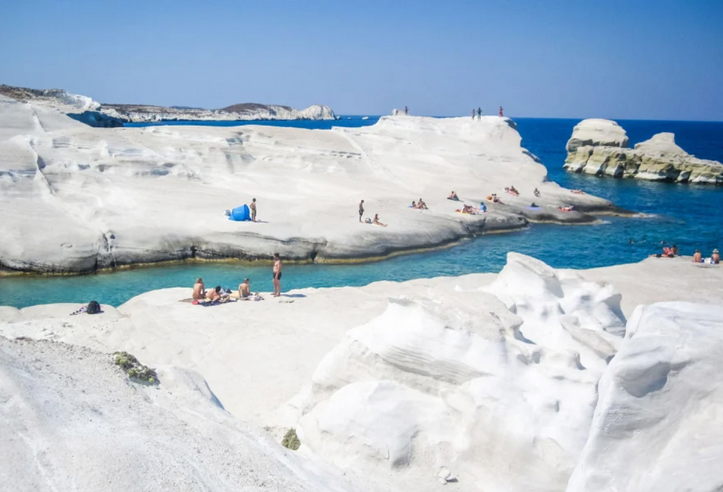
Significant omissions were also found in the delineation of the shoreline and the beach zone. The committee of the Decentralized Administration defined boundaries with an unjustifiably narrow width, without taking into account the unique geomorphological conditions of the area, to the detriment of the protection of the natural landscape. As a result, the buildable zone extends almost to the sea, despite the fact that this is an environmentally sensitive area of exceptional aesthetic value. The National Transparency Authority (EAD) calls for the redrawing of the beach boundaries to restore the balance between construction and environmental protection — a balance that has, in practice, been completely overturned.
Urban Planning That Legalizes Arbitrary Practices
The problem, however, is not limited to this specific permit. As the Authority has found, the Milos YDOM has in recent years issued hundreds of permits for houses and tourist facilities on plots that do not meet the basic requirement of having frontage on a public road. This practice applies to all the islands under its jurisdiction: Milos, Sifnos, Kimolos, and Serifos.
In a politically significant development, Elli Chorianopoulou, the head of the Milos YDOM, was recently appointed Deputy Regional Governor for Environment and Spatial Planning of the South Aegean. She has publicly stated in the regional council that plots created before 2003 are not required to have road frontage — a position that has been rejected both by case law and by the EAD’s report. Her appointment to such a critical institutional role, while she openly defends an unlawful interpretation of the law, raises serious questions about political accountability and administrative tolerance.
The EAD report underscores that this problem is neither isolated nor local but structural and systemic. The need for institutional, legislative, and disciplinary intervention is now more urgent than ever.
Ask me anything
Explore related questions