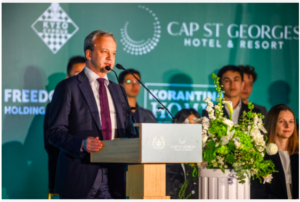
Migration flows in the country have balanced out over the past 20 days, Minister of Migration and Asylum, Thanos Plevris, told SKAI, while also discussing the ways in which the government is trying to solve the problem and plans for a closed structure in Crete.
“From the day we passed the amendment until today, (about 20 days) the total number is below 800 people. When we passed the amendment, we had more than 800 people a day,” Plevris said initially.
“247 people have been transferred to PROKEKA and about 550 more people, of which 300, are currently being transferred to a closed structure, which we have granted from the Ministry of Immigration and Asylum to the police. The same will be done with the rest as the status for anyone who enters after the amendment is passed is that they do not enter a shelter facility, they are arrested, remain incarcerated and the process is followed to return to the country they came from or their country of origin,” he continued.
As the minister pointed out, “The bottom line is that we have a largely balanced flow. We are not saying there is no flow at all. The part that some of these days have been bad weather has played a part in that. Accordingly, there is a significant pressure at the diplomatic level to be able to have even more cooperation from the government of eastern Libya in terms of information about the vessels that are leaving the coast. So far we have avoided large boats leaving, because the big problem and the very large flows were when boats with 300-350 people were leaving. At the moment we have no such phenomenon. And certainly our decision plays a big role because slowly there is a clear message that in Greece you cannot apply for asylum, you do not enter a hospitality facility, you enter a prison.
“The circuits operate in a multifaceted process and we can never be sure if an aggressive move is made. So we have to be prepared,” he noted.
He said, “We saw some strange activity before we passed the amendment. We had seen an aggressive process on the internet and social media calling for people from Libya to move to Greece and Crete, which we are following with great attention. That put us in an additional context that we need to be all over the place.”
On the return of migrants, Plevris said that “I believe we will complete the procedures so that there will be more returns because it is important that right now people have conditions of detention and not freedom. But there must also be more returns to make it clear to those on the Libyan coast, which is our main pressure right now, that it makes no sense for them to pay someone to move because they will go back.”.
On electronic surveillance, Plevris explained that “with the new bill that will be passed in late August or early September, once someone applies for asylum, the screening process is automatically done. That takes about a month. Then he will have to return voluntarily. Because sometimes we have the phenomenon that when you give him the time of voluntary departure, you lose it as well, the person whose asylum is refused will, depending on his profile, either be put in administrative detention directly or in electronic surveillance so that we can have full monitoring of him.
Right now, a big part of getting returns to happen is for countries to take them back. Most returns are done when the individual also consents. And we are trying with all these measures to force that illegal immigrant to cooperate, because when they cooperate, automatically we can have more returns that we have now.”
Asked about the structure in Crete, the immigration minister said the goal is to find space and have it ready next summer.
“There will be the structure in Crete. We have already applied for funding from the Commission. We need a time frame. If we consider that the flows arrive until October and usually after that because of the winter we have a big reduction, the main goal is to have a basic structure ready to prepare for next year. The sites that were indicated to us did not meet the terms and conditions for us to be able to structure immediately. We had looked at some camps. Based on the conditions, they could not immediately make a structure and we qualified the scenario to calmly make the structure where we need to and find the space and we will open a conversation with the local community.”
Plevris noted that spaces have already been found for an initial management of the flows. “With Chania and Rethymno we have reached an agreement, with Heraklion we are still in some thoughts“.
At the same time, the minister noted that “a central issue at the meeting of migration ministers was to detain migrants outside Europe, and this includes Libya,” and noted that the government of eastern Libya is in negotiations with the EU to finally hold a meeting.
“And the eastern side wants to take advantage of this meeting because, in addition to the quid pro quo that it can have on migration, it is also a piece of recognition,” he concluded.
Ask me anything
Explore related questions