





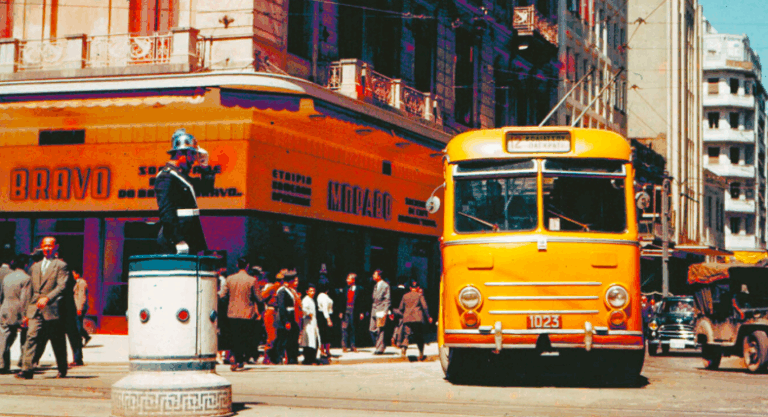
Alternate Minister of Transport Konstantinos Kyranakis has decided to gradually retire the trolleybuses, which are considered outdated in an era when wireless electric vehicles are on the rise. Maintaining the current fleet would require major investment, while new electric buses can perform the same functions without the overhead wiring. Supporters of the plan also argue that it will improve traffic flow and restore unobstructed views of the Athenian skyline, as trolleys are prone to frequent breakdowns. Some experts, however, argue that trolleybuses are more sustainable, offering higher energy efficiency, lower consumption, and no need for battery charging. Meanwhile, there are growing calls not only to preserve a few vehicles for museum purposes but also to maintain one or two lines for heritage value—though that proposal appears unlikely to move forward.
A Nearly Ancient Relic
By 2027, trolleybuses are expected to be a thing of the past following a two-phase retirement plan: first, the removal of overhead wires in central Athens starting this September, and second, the complete withdrawal of trolleybus operations.
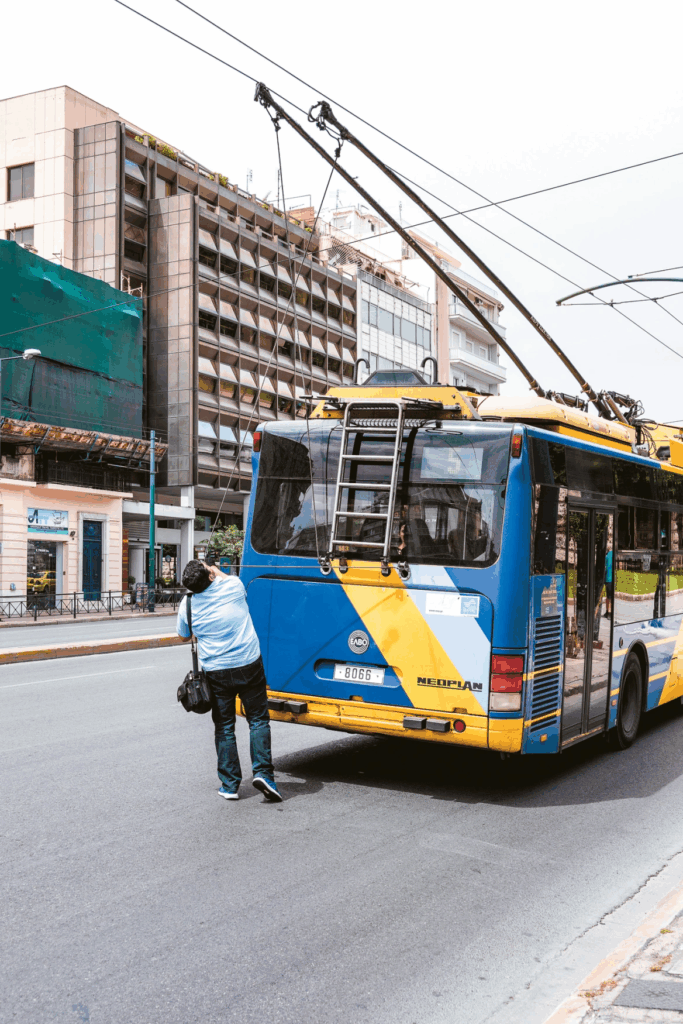
That familiar sound of the electric motor and the driver’s pedals, the telltale hiss from the pantograph as it touches the overhead cables, and the sight of the yellow—or more recently blue—vehicles gliding almost silently through the streets, will soon be just a memory. After 72 years of continuous service, a mode of transit beloved (and sometimes loathed) by generations of Athenians is reaching its final stop.
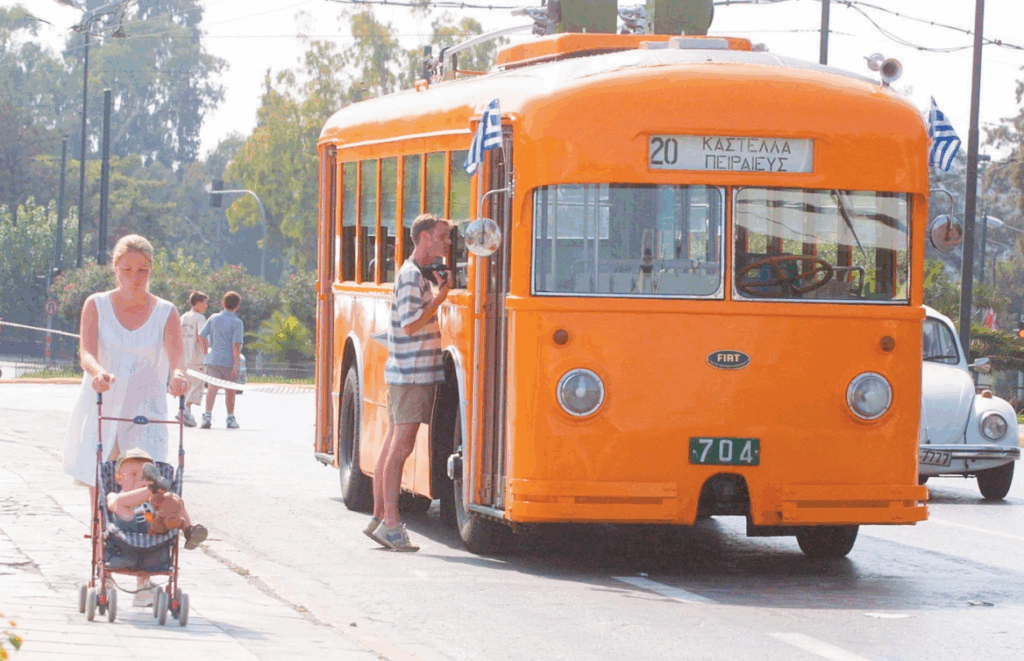
The first trolleybus to operate in Greece, on the Piraeus–Kastella route in 1948, was a FIAT model—which is still preserved today.
The Plan to Replace the Fleet
OASA (Athens Urban Transport Organization) has already outlined a plan to retire 130 aging trolleybuses and replace them with 100 new, fully electric buses, with a goal of reaching 250 vehicles by the end of the decade. This transition is deemed necessary for reasons of sustainability, cost efficiency, and greater operational flexibility. Many trolleybuses currently in use are over 20 years old, with maintenance costs that have become disproportionately high. The overhead infrastructure is now seen as outdated and aesthetically intrusive, while the new electric buses promise cleaner energy, lower operational costs, and a more adaptable solution for a modern city.
FIAT, Alfa Romeo, and Lancia on the Streets of Athens
Athens currently operates around 210 trolleybuses across 19 routes with approximately 247 stops, covering a total network of 390 kilometers. Most vehicles were acquired between 1999 and 2004, mainly from Neoplan and Van Hool, while Solaris is known more for conventional electric buses than trolleys. Older Athenians may remember the legendary Italian models from Fiat, Alfa Romeo, and Lancia that dominated the streets from the 1950s to the late 1980s, as well as the Soviet-made Energoma Chexport trolleys that ran from 1972 to 1992.

The technology behind trolleybuses is simple yet effective: a 600V DC electric current powers the motor via overhead wires connected through dual pantographs. Unlike modern battery-electric vehicles (BEVs or BEBs), trolleybuses draw power directly from the grid without onboard batteries. While this system limits their range to wired routes, it also means no downtime for charging—a strength and a limitation at once.
Here’s a natural-sounding English translation and adaptation of the text in a clear, informative tone. The result maintains historical context and detail, while making it smooth and engaging for a general audience.
The Early Years: From Trams to Trolleys
In 1925, three major transport operators—the Athens-Piraeus Suburban Tram Company (ETAPP), the Attica Railways (SA), and the Athens-Piraeus Railway (SAP)—were merged under the control of the British-owned Power and Traction Finance Company Ltd., known in Greece simply as “Power.” This merger resulted in two new entities: the Electric Transport Company (HEM), which took over the management of trams, bus lines, and the Kifisia railway; and the Hellenic Electric Railways (EIS), responsible for the urban electric railway and the seaside tram of Piraeus.
HEM was tasked with modernizing and expanding the tram network, renewing the fleet, and electrifying the Kifisia line. Meanwhile, EIS began constructing a new light rail line connecting Piraeus to Perama.
In 1939, twelve trolleys manufactured by the Italian Fiat/CGE consortium arrived at the Port of Piraeus, destined for HEM. Though operational, they remained unused at the depot in Neo Faliro because the overhead lines hadn’t been installed. The outbreak of World War II further halted progress. During the German occupation, the depot was used by Nazi forces, and the (admittedly primitive) trolleys—capable of carrying only 18 passengers—were forgotten. Post-war, there simply weren’t funds to build the necessary infrastructure in the devastated country.
A New Chapter Begins in 1948
After the German army withdrew, two of the twelve vehicles (numbers 708 and 710) were confiscated, leaving ten trolleys (numbered 701–712) to enter service. Originally painted green at the Fiat factory, HEM later repainted them yellow-orange to match the updated tram and bus fleet.
On July 27, 1948, Greece’s first trolley line officially began operation, running the Piraeus Station – Kastella – Neo Faliro route, known today as Line 20. This was not only the country’s first trolleybus line, but also the first to eliminate the fare collector in 1976. That didn’t mean rides were free, though—it was a step toward installing ticket validation machines, which finally appeared in 1989. In reality, these machines often ended up filled with junk: fake rings, buttons—anything but coins.
Athens Joins the Trolley Era
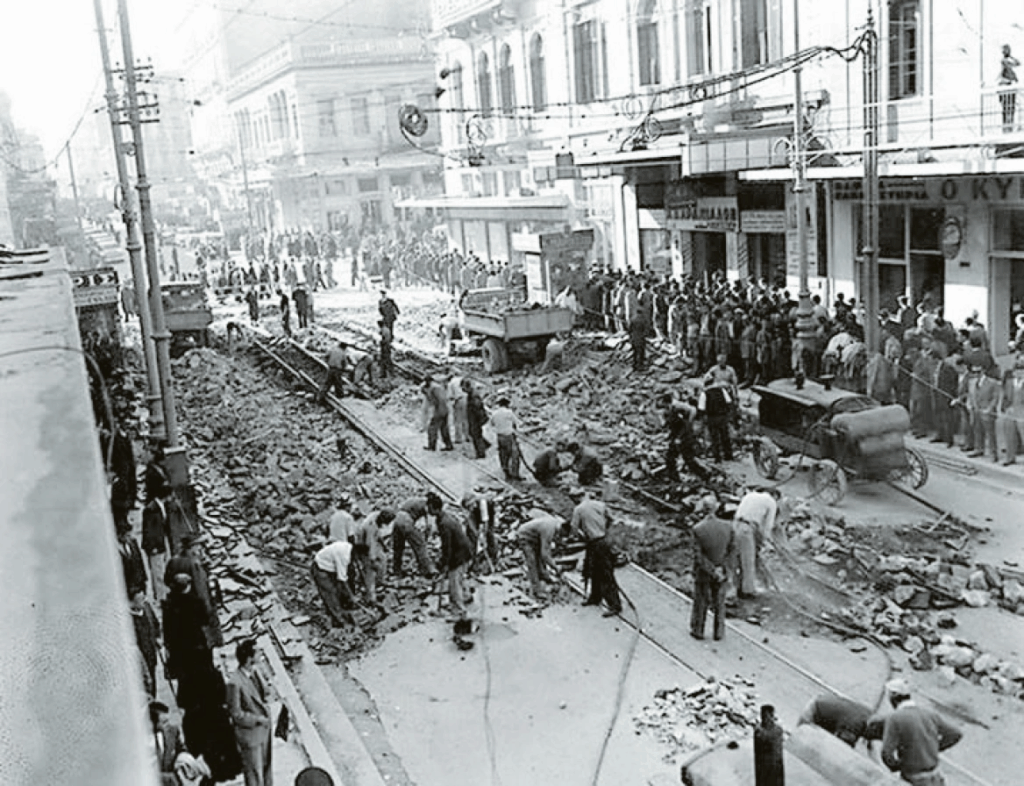
In Athens, the trolley era began later, following the removal of tram lines. As tram tracks were dismantled, a new overhead line network for trolleys was installed. Seen as a modern and more flexible solution used across Europe, trolleys first appeared on December 27, 1953, with the opening of the Patissia–Ampelokipoi route, replacing tram line 3-7. This new trolley route kept the number 3 and gradually introduced modern electric vehicles.
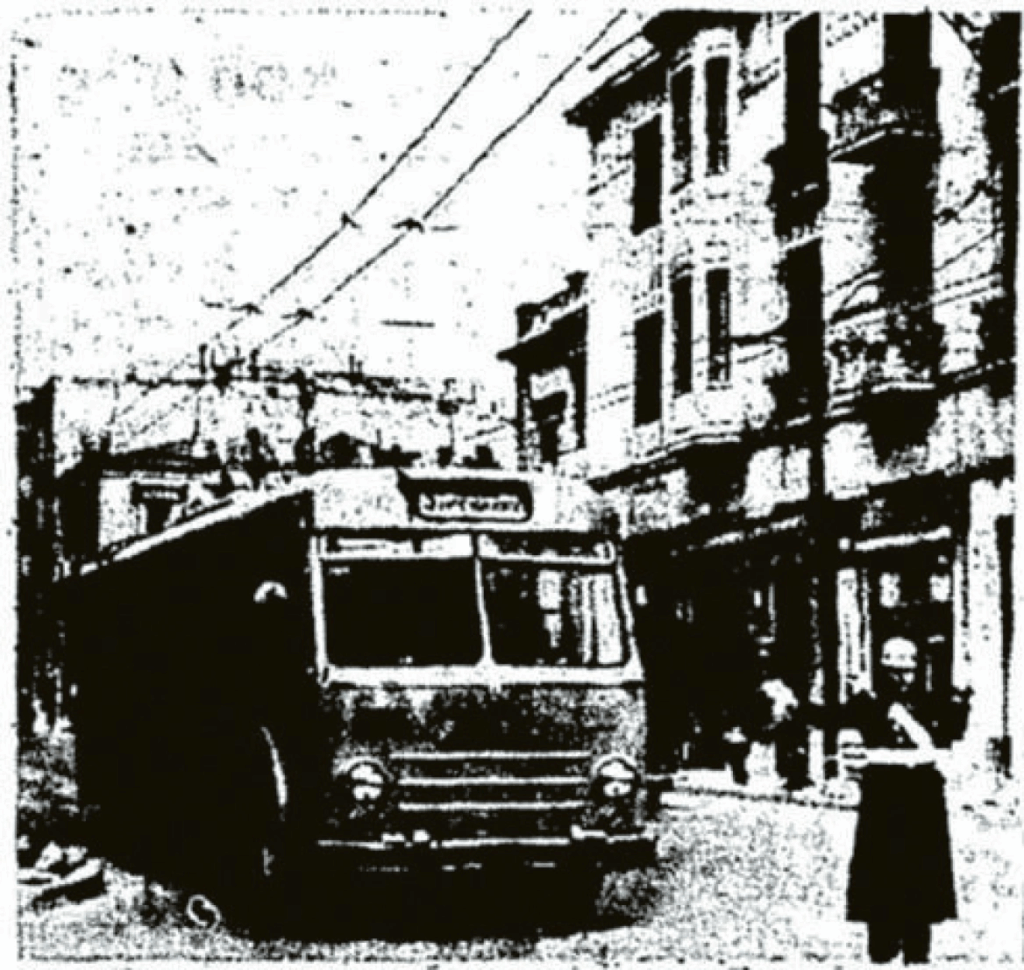
The first fleet included 40 large three-axle Alfa Romeo/CGE/Casaro trolleys, numbered 1001 to 1040, followed by another 40 similar units (1041–1080). Athenians were slow to embrace them—many kept calling them “trams,” and their drivers “tram conductors.” The signs banning smoking on board also took some getting used to.
Unusual and Iconic Trolleys
Some trolleys stood out—like the eight right-hand-drive models brought to Athens in 1982. These were originally built in 1959 but converted to left-hand-drive by 1987. In 1977, the city also received its first 15 two-axle Soviet ZIU-9 trolleys from Energoma Chexport, with the fleet growing to 158 by 1983.

The HLPAP Era and the Decline
In 1970, the operating license for HEM was revoked, and the newly founded Athens-Piraeus Electric Buses Company (HLPAP) took over the network. This marked a second phase of expansion, with significant growth over the following decades.
However, in recent years, the situation has worsened. A lack of spare parts, funding cuts, and economic crisis have left the system in disrepair. Delays, breakdowns, and abandoned vehicles are now common. The network, once 91% reliable, is struggling. Maintenance is insufficient, and passenger service has been seriously affected.
The “Falkonera” Trolley – A National Symbol
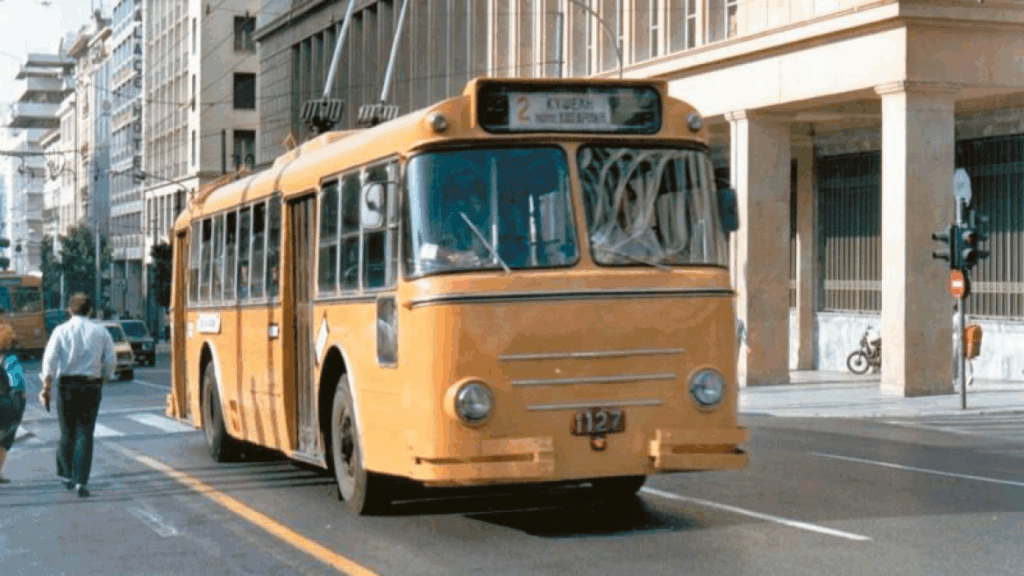
One especially notable trolley was No. 1127, known as the “Falkonera”—the only trolley ever built in Greece. Unveiled in 1967 at the Thessaloniki International Fair by VIAMAX, it featured mechanical parts from Lancia and CGE and was a prototype for a domestic series. It served the Kypseli–Kaisariani route.
The Falkonera played a role during the 1973 Polytechnic uprising, used as a barricade on Patission Street. Despite its legacy, production plans were scrapped, and the trolley was retired in 1993. It now sits rusting in the OSY depot in Ano Liosia, alongside other aging and newer trolleys.
Political Tensions and Environmental Shifts
Trolleys have also been a flashpoint in politics. In 1965, their service was briefly halted when Athens’ city council demanded national government funding—or threatened permanent closure. By contrast, in 1984, officials called for more trolley lines to fight air pollution. That year, efforts to convert old diesel buses into trolleys failed due to cost and technical challenges.
Although today trolleys are considered outdated, they were once seen as cutting-edge. The Mitr–Syntagma Line 15 even inspired poets and writers. Kostis Palamas referred to “the electric lines of the streets” as a symbol of progress, and both George Seferis and Zorz Sari used the trolleys as literary symbols of urban life.
Aging Fleet, New Technology
Are trolleys still reliable? The first-generation models—Fiat, Alfa Romeo, Lancia—were renowned for durability. One vehicle reportedly operated daily for 50 years. Between the 1970s and 1990s, Greece imported many Soviet trolleys. They were cheap and temperamental but got the job done. The 356 Russian-made trolleys were phased out by 2003. There were also a few imports from France and Western Europe.
Today’s fleet is mostly from Solaris, Neoplan, and Van Hool, purchased between 1999–2004. While well-built, these vehicles suffer from years of under-maintenance, and both the trolleys and the overhead network are in bad shape. Still, parts of the system—like the 1955 Kolonaki–Neapoli line—remain operational with minimal updates.
The Final Phase: Phasing Out the Trolley
Despite plans for extensive network repairs and fleet renewal, the current view favors retiring trolleys in favor of more flexible electric buses. Officials argue that overhead lines are inefficient, consuming power even when unused, requiring frequent maintenance, and restricting routes. In fact, no trolley routes are expected to remain after 2027.
Some citizens worry the replacement won’t be adequate—especially those in central areas. Others fear that long articulated trolleys (the 18-meter “accordion” models) will be withdrawn without being replaced, leading to overcrowding.
Electric Buses Without Cables
New technology, like In Motion Charging (IMC) vehicles with onboard batteries and extended range, is becoming the preferred choice. These are cheaper to maintain and have longer lifespans than older trolleybuses. The Ministry of Transport insists that the next generation of electric buses will have impressive range and lower operational costs.
Even so, trolley supporters argue for keeping the vehicles alive, at least in part. Some suggest preserving one or two as museum pieces, perhaps in collaboration with the Greek Bus Museum. For now, however, no official plan exists—meaning a piece of modern Greek history may soon fade into obscurity.
Ask me anything
Explore related questions




