





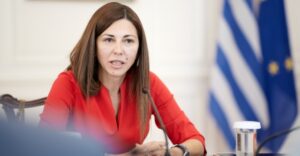
With special emphasis on the qualitative and functional upgrading of the education system, the Minister of Education, Religious Affairs and Sports, Sofia Zacharaki, presented in Parliament the main objectives of the draft bill of the Ministry of National Defence, stressing that education is for the government a national “currency” of strategic value.
The discussion was held on the occasion of the passage of a multi-thematic bill of the MFA Ministry of National Defence, which includes, among other things, regulations for the strengthening of special education, the institutional strengthening of universities, the awarding of a life-long pension to creators and artists, as well as issues within the competence of the General Secretariat of Religious Affairs.
“It is, I think, clear that on the issues of Education, the Greece of 2025 has not the slightest connection with the Greece we received in 2019: school with planning and institutional continuity, open, safe and creative character in the public university,” the Minister of Education stressed during her speech in Parliament.
“A school that does not make the support of students dependent on the availability of the moment. Public education that relies on stable mechanisms, transparent procedures and people present where they are needed.
From 9,882 Parallel Support teachers we found in the 2019-2020 school year, we reached 16,284 in 2023-2024 – an increase of 65% in five (5) years,” the Minister of Education stressed.
“Some colleagues seem to be nostalgic for a time and a system that left children with disabilities on the sidelines, teachers in constant insecurity and parents without a voice.
We, on the contrary,” Sophia Zacharaki argued, “are implementing an inclusive school, adequately staffed, with modern support structures and, dare I say it, with staff boldness to correct even historical failures.
More special education teachers, more Inclusion Departments, more Parallel Support, twice as many school nurses, thousands of full-time psychologists and social workers: this is not a “class attack on public schools”, it is an investment in the country’s most valuable human capital, its children.
Yes, it was a big bill with several issues, but if you had dug into the school issues, colleagues, you would have something good to say about the fact that:
– We are expanding the provision of Parallel Support in Full Day School.
– We are creating, for the first time, Integration Departments in the National School of Education.
We are creating for the first time, Integration Departments in the National School of Education.
– We create 1,200 new full-time positions for psychologists and social workers in schools.
– We are creating 700 new full-time positions for special education in KEDASY.
– We strengthen the coverage of schools with nurses – already 2,000 school nurses are serving in schools.
– We actively support Greek-language education abroad.
Special Education
Let’s finally stop the narrative about the abandonment of special education,” the Minister stressed, “because the truth is not told with slogans – it is reflected in numbers, in actions, in results.
In the last four years alone, we have made 5,734 permanent appointments of special education teachers and 2,800 appointments of Special Education Teaching and Support Staff. For the first time since 2010, public education is being systematically and consistently strengthened – not with contracts, not temporarily, but with permanent staff.
And if some say this is not enough, the answer is one: a new wave of permanent appointments is coming, because we are choosing to make the rule what others have left as the exception.
Regarding the reduction in the number of students per class in cases where students with disabilities and/or special education needs are enrolled, I must remind you what your track record is. In 2013, a reduction of three students could be implemented by a simple recommendation of the Teachers’ Association.
In contrast, in 2017, the Syriza government imposed stricter requirements of at least three students with disabilities or five with special needs and a complex bureaucratic process, which in addition required the agreement not only of the Teachers’ Association, but also of the General and Special Education Advisors and the Director of Education. If the school had an Inclusion Department, the reduction would not have been allowed at all.
“We,” the Minister of Education stresses, “are approaching the issue with a different philosophy: our goal is a functional, coherent, and equitable system of support that utilizes all available tools, serving the true purpose of meaningful inclusion and support for students.
The first support mechanism is the inclusion of a Parallel Support teacher. Where and only where there is no other institution, the “minus three” measure is applied. This means better use of resources, but also a fairer distribution of human resources.
At a time when everything in education was done according to your standards and priorities, Parallel Support teachers were placed with huge delays in November or later.
Today, the process has been institutionally streamlined and provides for two phases of recruitment: the first, of 10,000 teachers, completed in August and the second by October 20, as required by law.
The double phase is not a delay; it is necessary to meet the needs arising from opinions, which for objective reasons cannot be issued earlier.”
Interventions in public universities
“With targeted interventions,” Sofia Zacharaki pointed out, “we seek to protect the open, safe and creative character of the public university, so that dialogue, research and knowledge can flourish unhindered, without being undermined by acts of violence:
– We put a clear end to organised lawlessness
– We protect the prestige of student status, without instrumentalizing it.
– We establish a fair and uniform disciplinary system.
– We give universities the tools necessary to protect students, faculty, and staff
– We are ending the regime of impunity for property damage.”
The issue of the duration of studies and in particular the deletion of the so-called “perpetual students” was mentioned in her speech by the Minister of Education, noting that “we are in favour of the completion of studies within a reasonable period, but also with recognition of the real difficulties faced by many students – either due to social conditions or unforeseen circumstances.
Against those who reproduce stereotypes, distort reality and invest in defeat and stagnation, we respond with facts: an increase in regular funding, a historically high level of support for student care, new projects in food, housing, equipment and research, an upgraded institutional framework that responds to problems without doing injustice to the people of the university”, Sophia Zacharaki stressed in her speech.
So today we are ensuring the obvious”, the Minister of Education clarified, “the public university is exclusively a place of dialogue and not of lawlessness.”
a place of knowledge and not violence. That is why we are embarking on a bold and comprehensive reform. Not to punish, but to protect. Not to restrain, but to open paths of freedom.”
Ask me anything
Explore related questions




